This Revolting Traffic: How Sugar Shaped Fort Point

In January, a month out from Super Bowl LVIII, Ad Age reported ‘a modern-day record number of candy and sweets brands advertising’ during the game, a noteworthy development given the $7 million price tag for each 30-second spot. Beyond a general rise in marketing spend across the category, and an opportunity to target younger viewers via the game’s zany Nickelodeon simulcast, consumer research experts and brand leaders pointed to more fraught psychological and cultural factors driving the commercials. ‘There’s the feeling of, “The world was nicer when I was younger” and people want to indulge in that,’ theorized a senior director for market intelligence firm Mintel. ‘We are heading into an interesting year—there are wars, conflicts, return to work policies, and an election year,’ her colleague continued. ‘That’s a lot of stressors. But the Super Bowl would be a prime time to remind consumers those treats are here.’ The VP of Oreo U.S. promised that ‘fans can expect the cookie brand to continue to find unexpected ways to alleviate the seriousness of adulthood.’

Whether or not Oreos can really take the edge off geopolitical carnage and domestic strife, the idea isn’t as fanciful as it sounds. Sweetness can stir powerful feelings of nostalgia and comfort, a fact novelists and marketers alike know well. Proust’s crumbly madeleine dipped in tea unleashes a stream of memories that flows for thousands of pages. In Don Draper’s pitch to Hershey executives—the fantasy version before he reveals his upbringing as an orphan in a brothel—the iconic chocolate bar is ‘the currency of affection. It’s the childhood symbol of love.’ Mintel research found that 76% of UK consumers are ‘attracted to sweets that remind them of their childhood,’ and the same percentage of US consumers ‘use sugar and gum confectionery as a mood improver.’ According to the CEO of the National Confectioners Association, ‘Seasonal treating is deeply rooted in tradition and elicits memories of happy times, sharing with loved ones and an unmatched feeling of nostalgia.’

Retro treat vendors in particular deal explicitly in the remembrance of things past—OldTimeCandy.com has trademarked the tagline ‘Candy you ate as a kid!’—and few brands have been as wrapped up in their throwback appeal as those of the once-eminent New England Confectionery Company. The longest operating candy manufacturer in the United States until its messy demise in 2018, Necco produced its flagship multicolored sugar wafers, conversation hearts, and other sweets for over 150 years in a series of factories in and around Boston, but after World War II it struggled to sustain a lasting hit on the level of the marquee bars of Hershey and Mars. Unusual for a candy product, Necco’s signature creation eventually became known for not tasting particularly good at all: a Wall Street Journal headline around the time of the company’s meltdown read, ‘For Candy Fans, the Only Thing Worse Than Necco Wafers Is No Necco Wafers.’ The wafers’ charm is in their longevity as chalky tokens of vintage Americana, that they have been around since before the Civil War and haven’t much changed, except for a brief period when Necco executives sought to please the ‘modern, health-conscious consumer’ by swapping out artificial ingredients for ‘more expensive natural flavors and colors derived from red beet juice, purple cabbage, cocoa powder, paprika, and turmeric.’ Wafer sales tanked 35 percent, and the original formula returned less than two years later. The company had misunderstood the whole point of its namesake offering.
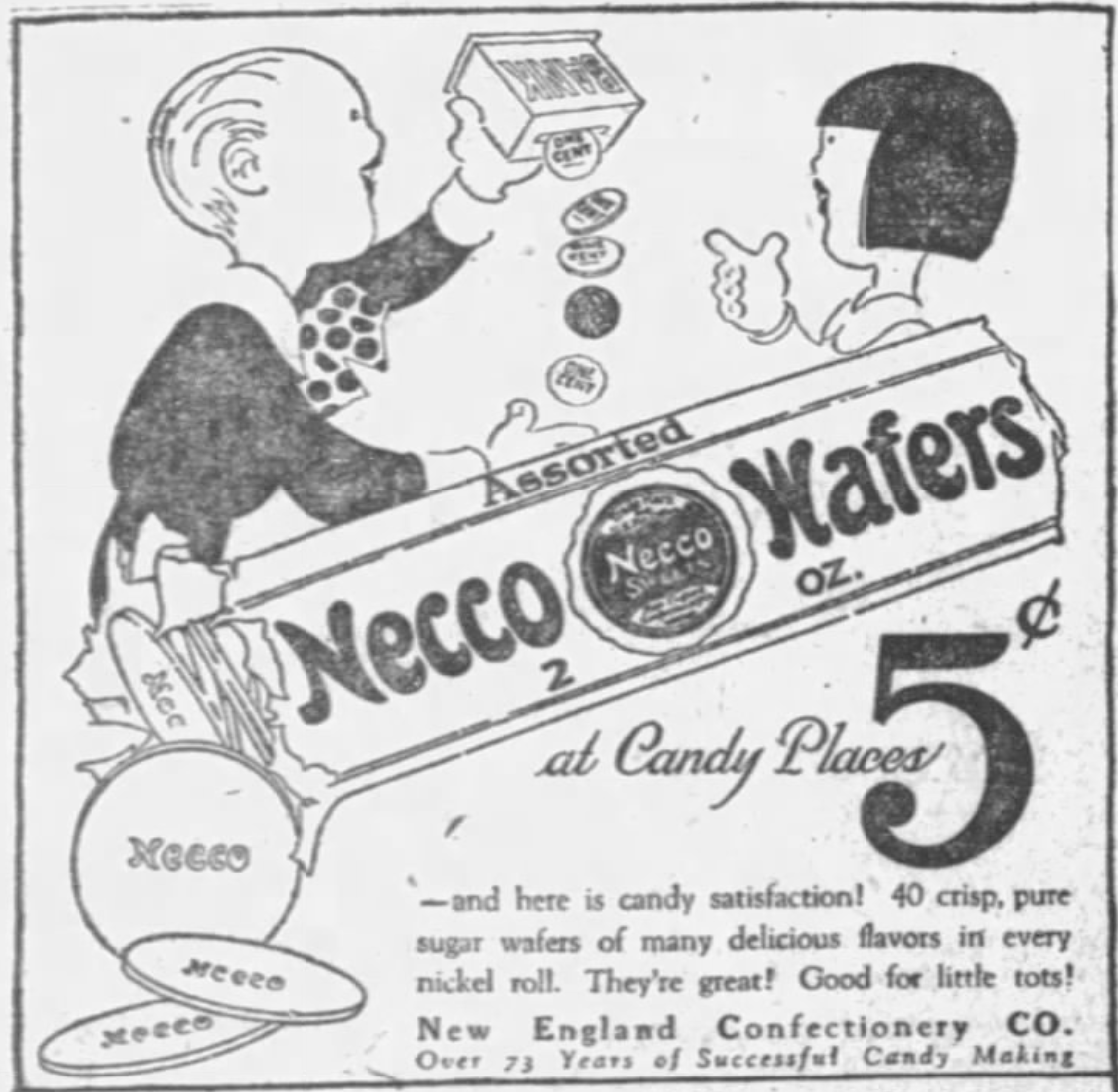
1920s Necco Wafer advertisement: they’re ‘Good for little tots!’ (Boston Globe, June 16, 1921)

The recipe debacle might have been overcome, but by then Necco was already on its way to a chaotic dismantling at the hands of profiteering private equity firms. In 2007 American Capital Strategies (ACAS) acquired the company in a leveraged buyout and split it into two separate entities, one holding Necco’s real estate and the other running the confectionery business. After ACAS was itself acquired by Ares Management in 2017, the merged firms proceeded to sell Necco’s most valuable asset, its recently built 50-acre factory in Revere, for nearly $55 million, and the candy maker filed for bankruptcy a year later. A lawsuit filed by Necco’s bankruptcy trustee charged ACAS and Ares with ‘misconduct and manipulation’ of the company, spiking a deal that would have given Necco a chance to continue operating so that the firms could extract maximum gain for themselves:

In sum, the sale of the Revere Property enriched Ares/ACAS by approximately $54,700,000 but left NECCO Candy in a dire position in which it was incurring rent expenses it could not afford, receiving zero additional funds to operate an already struggling business and being required to vacate its facility, without any financial ability to fund the cost of relocation. As a result of the sale of NECCO Realty, the only option available to NECCO Candy was a liquidation.

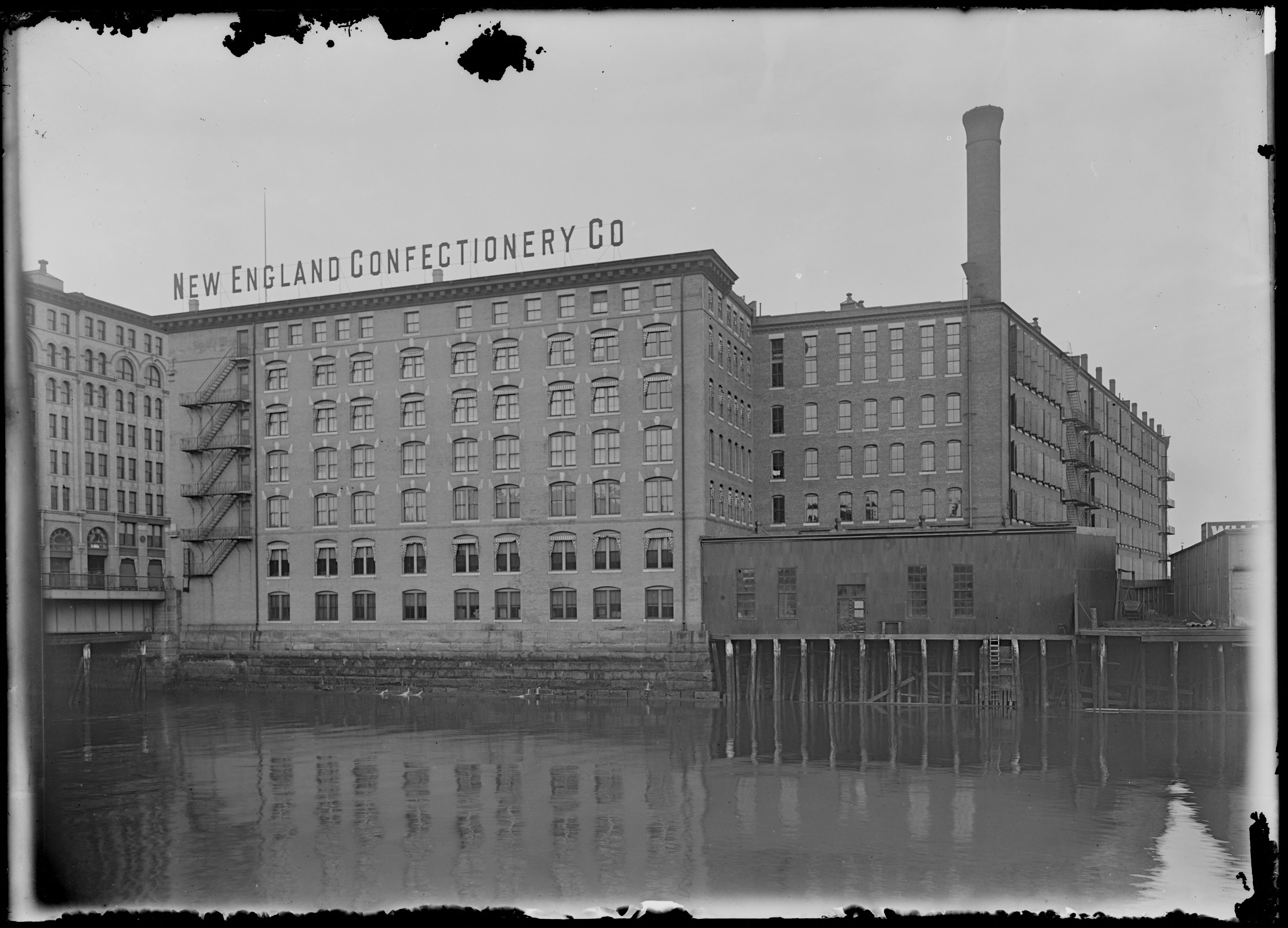
The saga served as a bitter reminder that no business, no matter how sweet and whimsical its product, is immune to the unsavory machinations of high finance. Necco’s main brands were auctioned off to other confectioners to carry on production, but the bankruptcy proceedings marked the end of a venerable institution that dated back to 1847 with apothecary Oliver Chase’s invention of the first candy-making machine. The New England Confectionery Company was incorporated in 1901 via the consolidation of Chase & Co. and two other leading Boston candy firms, and the following year moved into a large manufacturing complex along the Fort Point Channel built for the new combine by the Boston Wharf Company. Aside from its place in the annals of sugar lore, Necco’s architectural legacy may end up its most enduring: the Cambridge factory it moved to in 1927 is listed in the U.S. National Register of Historic Places, and the Revere site was ultimately sold again for $355 million because of its newfound use as an Amazon fulfillment center. In a sign of the times, since 2018 Amazon has also occupied the first Necco factory in Fort Point as corporate office space.
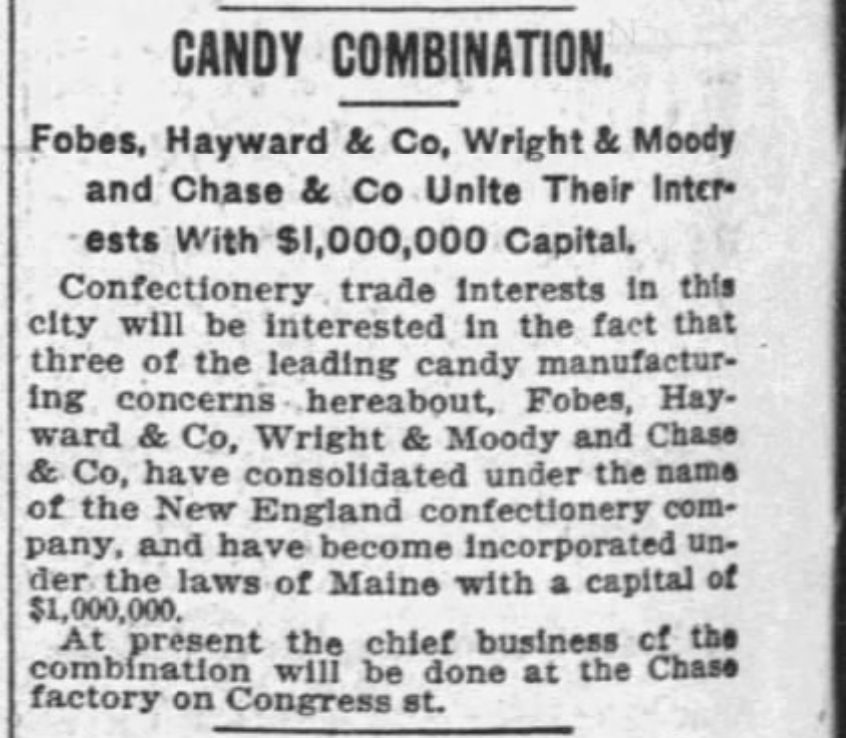

Boston Globe, June 30, 1901
The new Necco factory offered ‘Light, airy workrooms, steady work and good wages.’ (Boston Globe, August 30, 1903)

Boston Wharf Company. New England Confectionary Co. from bridge slip, Ft. Pt. Channel corner of Summer St. bridge. [ca. 1898–1907] https://ark.digitalcommonwealth.org/ark:/50959/br86bd29p

With its imposing chimney, prominent frontage on the channel, and a curving, yellow-brick facade along Melcher Street, the original Necco complex may be the most distinctive set of buildings in a neighborhood cherished for its grand old lofts. Histories of Fort Point begin with the filling of the area’s shallow tidal flats by the Boston Wharf Company in the mid-nineteenth century, and note the land’s initial use for sugar and molasses storage sheds, but they have perhaps undersold just how important the sugar business was to the creation and evolution of the district. They don’t pause to tease out the darker implications of what was for centuries a brutally lucrative trade built on the labor of enslaved millions. While Fort Point would indeed serve a broad range of commercial uses, sugar provided the impetus and a chief source of capital for the Boston Wharf Company’s landmaking and later pivot to real estate development, and as industrial activity in the area generally declined, large-scale sugar refining lasted well into the twentieth century. One powerful Massachusetts merchant family played a central role in all of it.

The Atkinses of Truro, later Belmont, trace their lineage almost all the way back to the beginning—family historian Helen Atkins Claflin records their earliest American ancestor’s arrival in Plymouth in 1639—but they didn’t accumulate much wealth or renown for five or so generations. All that’s written about one Samuel Atkins, who lived through the Revolutionary War, is that he ‘made his living from fishing and farming.’ That began to change with Samuel’s son Joshua, who found success as a sailor and merchant shipowner plying the ‘West Indies trade,’ something of a euphemism for the traffic in tropical commodities produced by the slave colonies of the great European powers. New England merchants had prospered enormously from the famous ‘triangle trade’ for over a century before Atkins got involved; lacking a hinterland full of precious metals or farmland able to support a plantation economy, colonial Boston had to look seaward to sustain its tenuous position far from the motherland. ‘But the challenge of survival,’ Mark Peterson writes in The City-State of Boston, ‘pushed the infant colony into a fatal bargain: an economic alliance with the sugar islands of the West Indies. This effectively made Boston a slave society, but one where most of the enslaved labor toiled elsewhere, sustaining the illusion of Boston in New England as an inclusive republic devoted to the common good.’

Joshua Atkins made a trading voyage to Cuba in 1806, ‘bringing back as cargo hides, sugar, and molasses,’ the earliest record of the family’s presence there, but the extent and nature of their involvement around this time is murky. Joshua’s son Elisha Atkins would formalize an ongoing, high-volume business in Cuban sugar beginning in the late 1830s, but according to historian Stephen Chambers, the family’s ‘true start in Cuba, like that of many elite New Englanders, began with the illegal slave trade, in a commercial house at the Cuban port of Matanzas, under the leadership of Zachariah Atkins, where he worked since at least 1808.’ There are few extant archival records of Zachariah Atkins, and no genealogy detailing his relation to the other Atkinses, but his name appears in British Foreign State Papers regarding the 1822 seizure of the ship Joseph, which ‘Was employed at the time of Capture in carrying on the Slave Trade for the account of one Zachariah Atkins, resident at Matanzas, in the Island of Cuba.’ Neither Elisha Atkins’s biographer nor Helen Atkins Claflin make any reference to a Zachariah, but it seems plausible that the family may have been unaware of or disinclined to note an ancestor’s direct participation in the most heinous and reviled of businesses. In any event, the later, more famous Atkinses’ relation to Cuban slavery is rather less ambiguous.
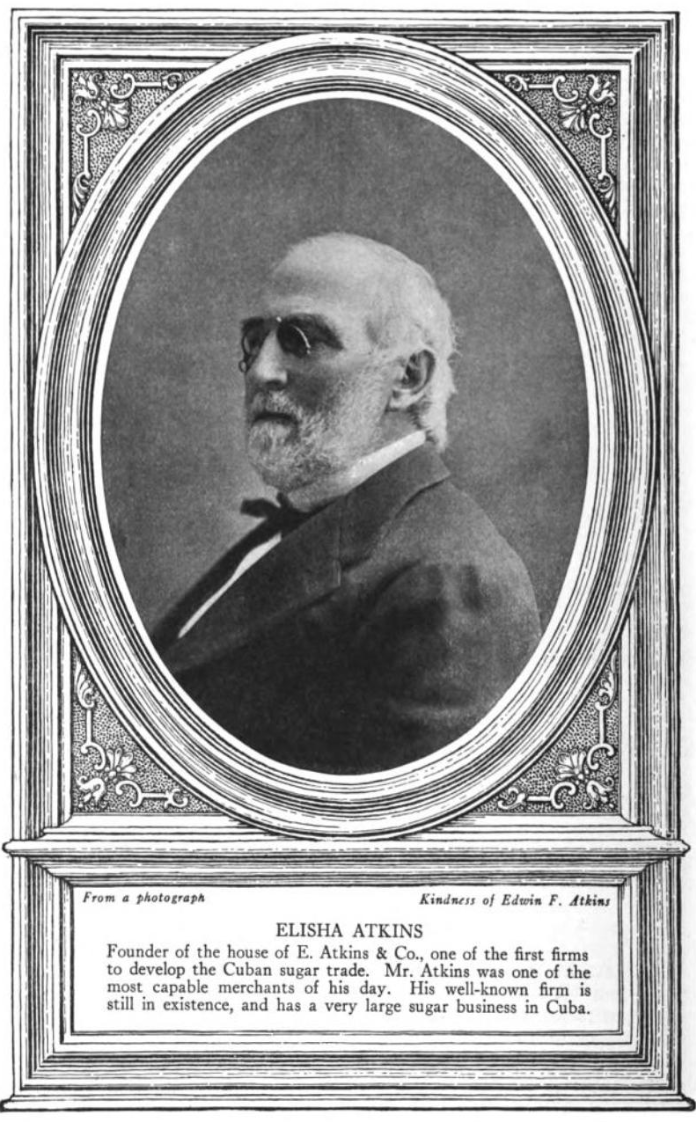
Some Merchants and Sea Captains of Old Boston, State Street Trust Co., 1918

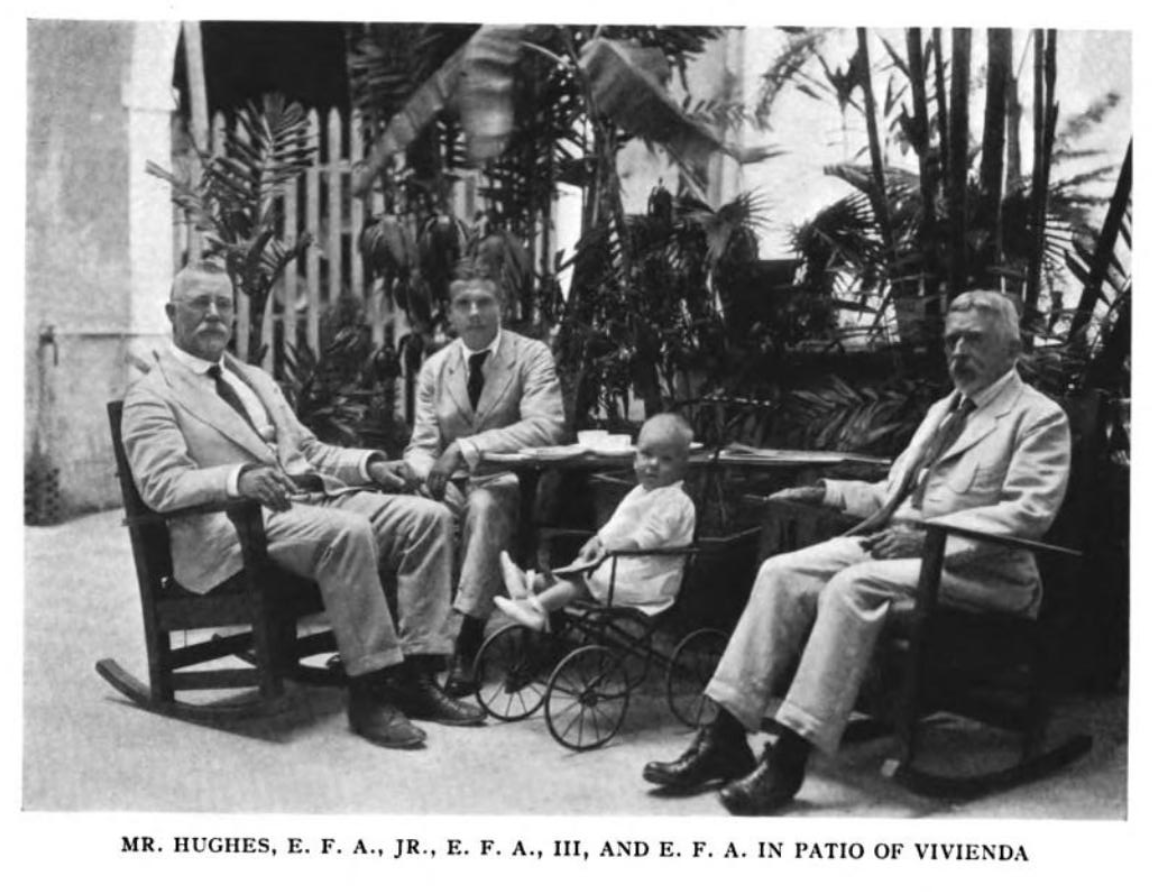
In 1838 Elisha Atkins established a partnership with the son of William Freeman, a prominent Boston merchant who set the pair up with three of his trading vessels and loans of $2,500 each. Freeman Sr. had close ties to Cuba—his brother and son had both lived there, engaged in the sugar trade—and helped found the Boston Wharf Company in 1836, serving as one of its original directors and later president for 16 years. Elisha Atkins married Freeman’s daughter in 1844, around the time he had begun making regular voyages to Cuba; in an 1843 letter to his then-fiancée, Atkins wrote of his reception at a plantation near Trinidad, a significant center of sugar production:

We were treated with much attention by the major-domo, who opened the house for us, got us a fine supper, and furnished us with cots. Here we slept, the sole occupants of the house, surrounded by about three hundred and fifty negroes, and perhaps but three or four white men on the place; but so perfect is the subordination that you feel perfectly secure. But if ever they learn their strength, woe to the white population! The estate of which I speak is situated in a beautiful valley which extends many leagues into the interior, the whole of which is occupied by plantations all highly cultivated, three of which we had passed over, with three to four hundred negroes on each, and around us, within sound of the report of a cannon, lay some two thousand slaves, among whom were perhaps not thirty white men. There was, to be sure, a small guard of soldiers in this neighborhood. Yet there are to be found persons who are anxious to sow among the negroes the seeds of discontent, and by showing them their situation excite them to rebellion. . . 

The sense of paranoia is palpable: Atkins fixates on how outnumbered he and the other ‘white men’ are, and seems to waver in his certainty of how ‘perfect’ the ‘subordination’ really is or might remain. Like many New Englanders who profited from slavery, whether in the American South or the Caribbean, Atkins could apparently tolerate the practice itself, but not the transport and sale of human beings that made it possible. In the same letter, on witnessing the landing of a slaving vessel, Atkins remarks, ‘This revolting traffic, the slave-trade, is still far from extinguished.’ Although Britain had abolished the ‘revolting traffic’ throughout its empire in 1807, ‘it struggled to contain the Atlantic slave trade in Cuba and Brazil,’ Ulbe Bosma writes in The World of Sugar, and ‘Cuba emerged as the world’s largest sugar exporter through massive importation of enslaved Africans.’ Bosma cites figures that ‘suggest that at least 332,800 enslaved arrived between 1835 and 1864,’ the period when Atkins cemented his company’s status as one of the leading dealers of Cuban sugar.

Elisha Atkins and Mary Freeman Atkins at the Soledad sugar plantation near Cienfuegos, Cuba (Sixty Years in Cuba: Reminiscences of Edwin F. Atkins, Edwin Atkins, 1926)

Back home, Atkins became a shareholder and director of the Boston Wharf Company in 1849, when the venture was still in the early stages of what would over the next several decades become a massive landmaking operation. According to his biographer, from then on Atkins ‘gave constant attention to the development of the company,’ steering it as it overcame persistent opposition from rival property owners and the Commonwealth of Massachusetts itself. Atkins ‘was never prominent in these controversies, but he was the power behind them, leading forward every movement of the company,’ because its main business was building warehouses to handle the increasingly large quantities of sugar and molasses his ships were delivering to the port of Boston. It was a shrewd and effective step toward vertical integration: the sugar merchant ‘became the largest customer of the corporation,’ and ‘his interest in the plans for these stores, which gave promise of such profit to the company and such convenience to himself, was continued for a series of years, and he became personally familiar with every foot of ground about them.’

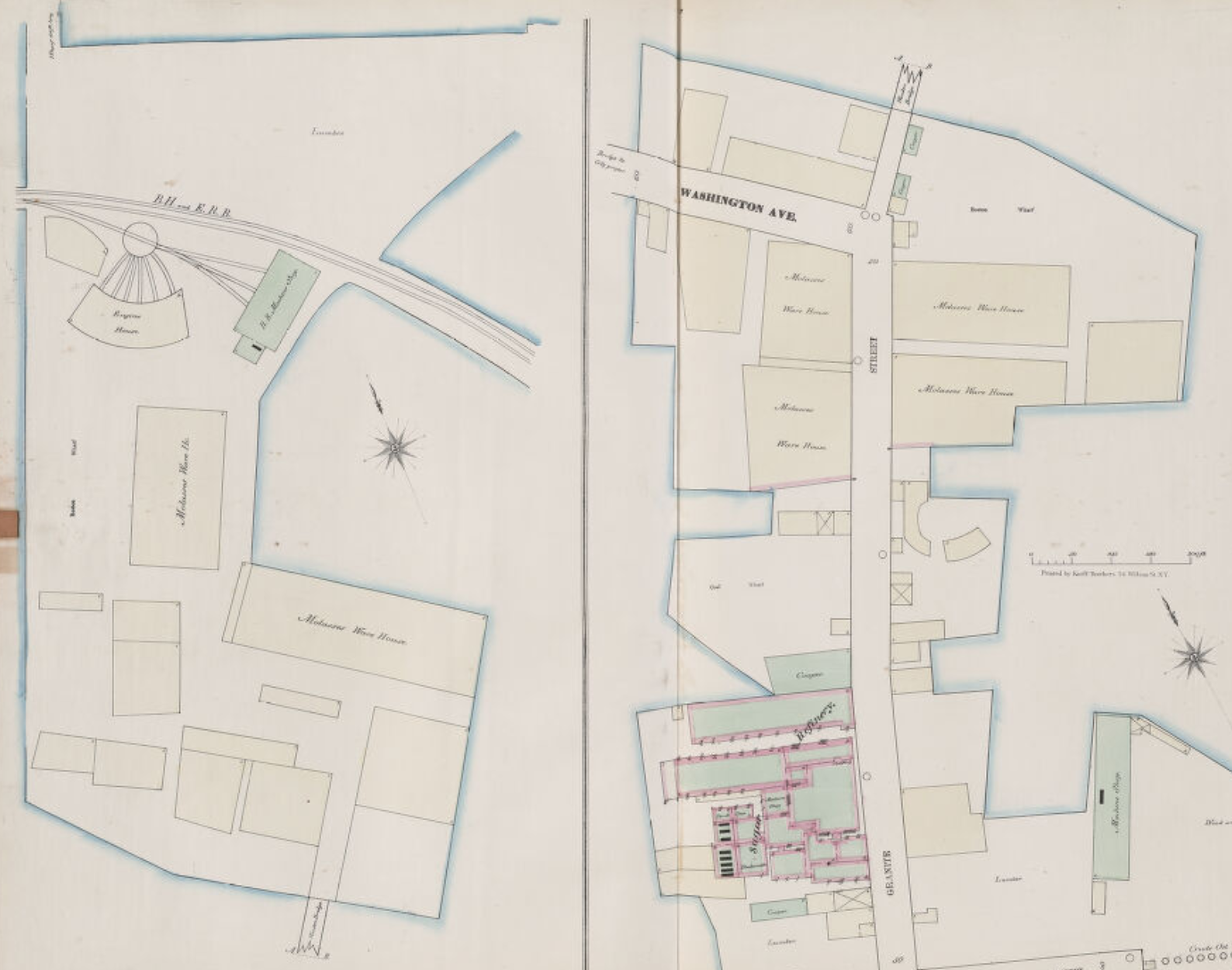
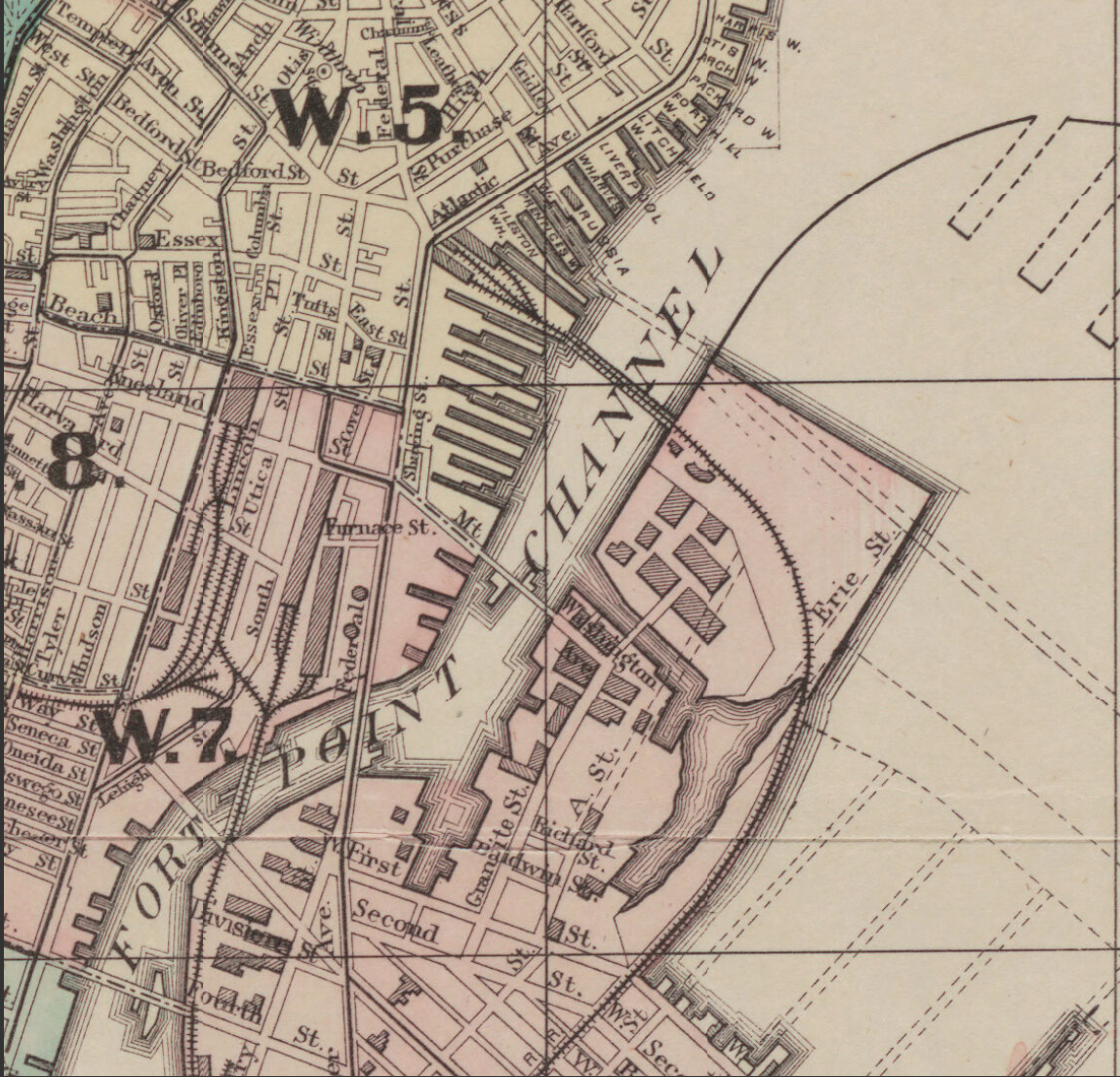
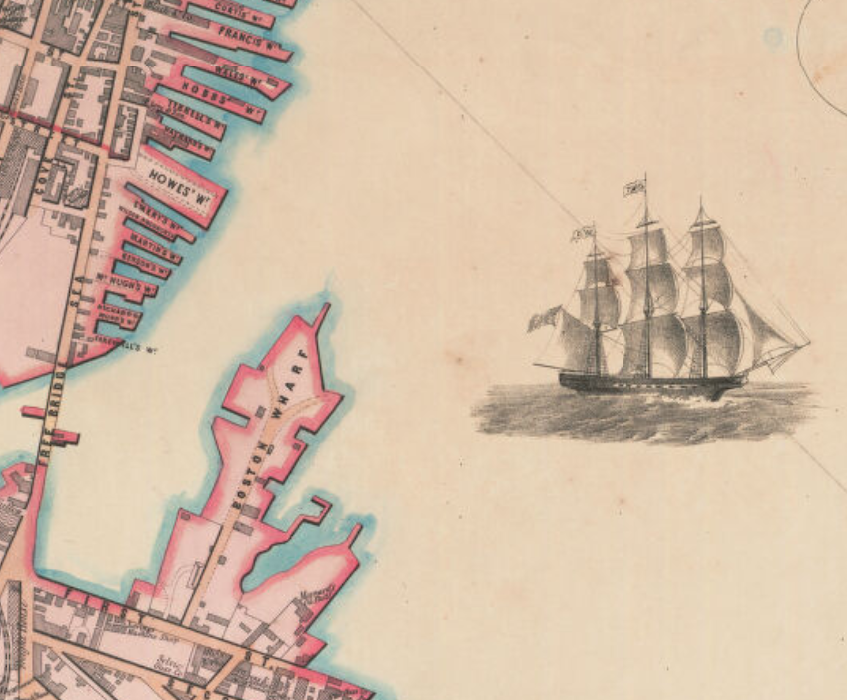
The Wharf Company made halting progress in filling the South Boston Flats until winning key approvals from the Legislature in the early 1850s; in an 1852 appeal to lift restrictions on their development rights, officials portrayed the firm as an underdog fighting a ‘class of opponents who represent the wealthy wharf owners of Boston. . . who are desirous of keeping up those very high prices of wharfage which are so injurious to the commerce of the State, and who fear the effect of competition with our wharf.’ Surveys from the period show the wharf jutting out from First Street along the upper edge of South Boston, largely unchanged between 1846 and 1852, but by 1868 it had extended far into the Fort Point Channel, about to present-day Congress Street. Most of the land was occupied by several vast molasses warehouses and a sugar refinery.
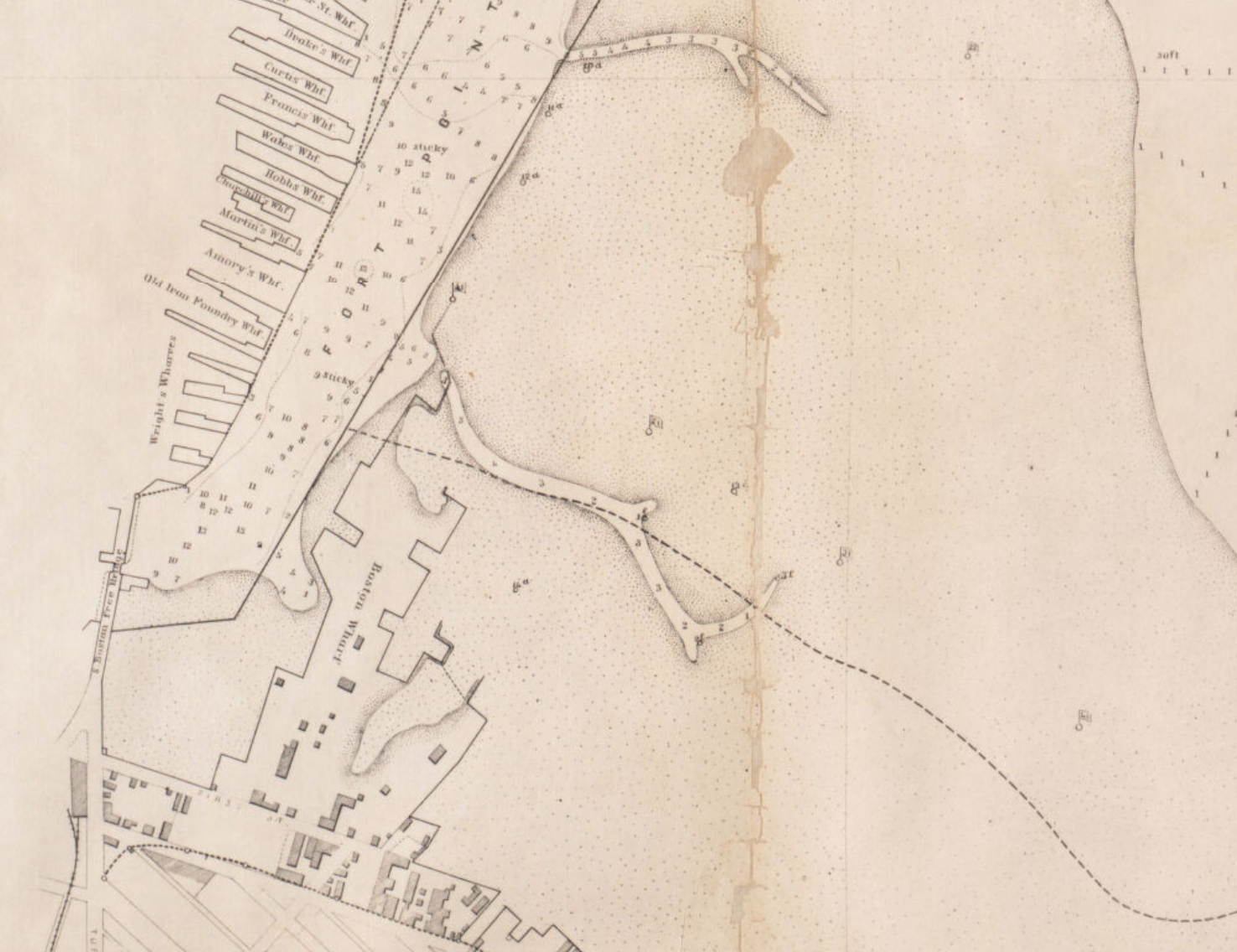
Detail from Plan of the Inner Harbor of Boston. Washington: United States Coast Survey, 1847. Norman B. Leventhal Map & Education Center, https://collections.leventhalmap.org/search/commonwealth:3f4632315
Detail from Map of the city of Boston and immediate neighborhood : from original surveys. McIntyre, H., Friend & Aub, & Wagner & M’Guigan, 1852. Harvard Map Collection, https://curiosity.lib.harvard.edu/scanned-maps/catalog/44-990093967530203941

BWCo. property in 1868; the left panel is the furthest extent of the land, showing the railroad that crossed the channel to downtown Boston. (Insurance map of Boston : volume 2, D.A. Sanborn, 1868. Norman B. Leventhal Map & Education Center, https://collections.leventhalmap.org/search/commonwealth:tt44pw386)
Detail from Map of the city of Boston and its environs, G.M. Hopkins & Co., 1874. Harvard Map Collection, https://curiosity.lib.harvard.edu/scanned-maps/catalog/44-990053246190203941

Over these decades Elisha Atkins was building a substantial fortune, his family’s rise in status indicated by their increasingly upscale choices in real estate: they moved to the then-fashionable Pemberton Square in 1856, bought a summer estate in Belmont in 1864, and in 1872 relocated again to a house on Commonwealth Avenue in the Back Bay, a neighborhood newly created on filled land much like that of the Wharf Company in South Boston. Edwin F. Atkins was born in 1850, and instead of going to college was trained to take over the family business, making his first visit to Cuba with his father at age 16. The young Atkins began working in the firm’s Boston office in 1868—in his memoir he recalls one of his duties was ‘to go through the cargoes of molasses to note the color and to taste hundreds of hogsheads to ascertain the quality’—and the following year was sent to Cuba to learn Spanish and pick up the local knowledge needed to run the trade in earnest. Elisha had shifted his attention to his duties as a director of the Union Pacific Railroad, a position that would result in his testifying before Congress as a bit player in the infamous Credit Mobilier scandal. Though Atkins himself wasn’t implicated in any crimes, the revelation of the fraudulent manipulation of railroad construction contracts became the signal case of corruption at the highest levels of finance and government during the Gilded Age.

Meanwhile, Edwin Atkins had begun his career in Cuba at a time of bloody upheaval. ‘Dear Father and Mother,’ he began a letter home in 1869, ‘I have arrived safely at this city without being captured by any rebels. . .’ The Ten Years’ War erupted on the island in 1868 when the sugar planter Carlos Manuel de Céspedes freed his slaves and launched an uprising ‘to throw off the Spanish yoke, and to establish a free and independent nation’; though ultimately unsuccessful in this aim, the rebellion and brutal decade of fighting, which resulted in as many as 200,000 deaths, would reshape Cuban society and its slave-based plantation economy in particular. On the eastern side of the island, César J. Ayala writes in American Sugar Kingdom, the war ’caused the destruction of many plantations and the liberation and migration of many slaves,’ such that it ‘had de facto done away with slavery, whereas in the western parts of Cuba slavery continued until final abolition in 1886.’ In his memoir Edwin Atkins recounted that, ‘The devastation of war, extravagant management, and the loss of slave labor led to the impoverishment and transfer of ownership of many of the Cuban sugar estates.’

The years following the war marked the transformation of the Atkins merchant business into a vertically integrated sugar-producing concern. A profitable side of their operations had involved advancing credit to planters, many of whom were left destitute by the end of the fighting; according to historian Christopher Harris, the ‘family’s risk grew as more and more planters defaulted on their loans,’ and ‘as land prices collapsed after 1878, Atkins & Company was, in effect, forced into becoming a sugar grower.’ Similarly, around the same time the family acquired the Bay State Sugar Refinery, on Eastern Avenue in the North End, as the large buyer of Atkins product had become insolvent and unable to pay its debts to the firm. In the most momentous transaction, after years of foreclosure proceedings Edwin Atkins officially assumed ownership of the Soledad sugar plantation at Cienfuegos, on Cuba’s southern coast, in 1884. The question of whether and to what extent this acquisition made the Atkinses slaveholders has in recent years attracted renewed attention from institutions that have benefited from the family’s largesse.
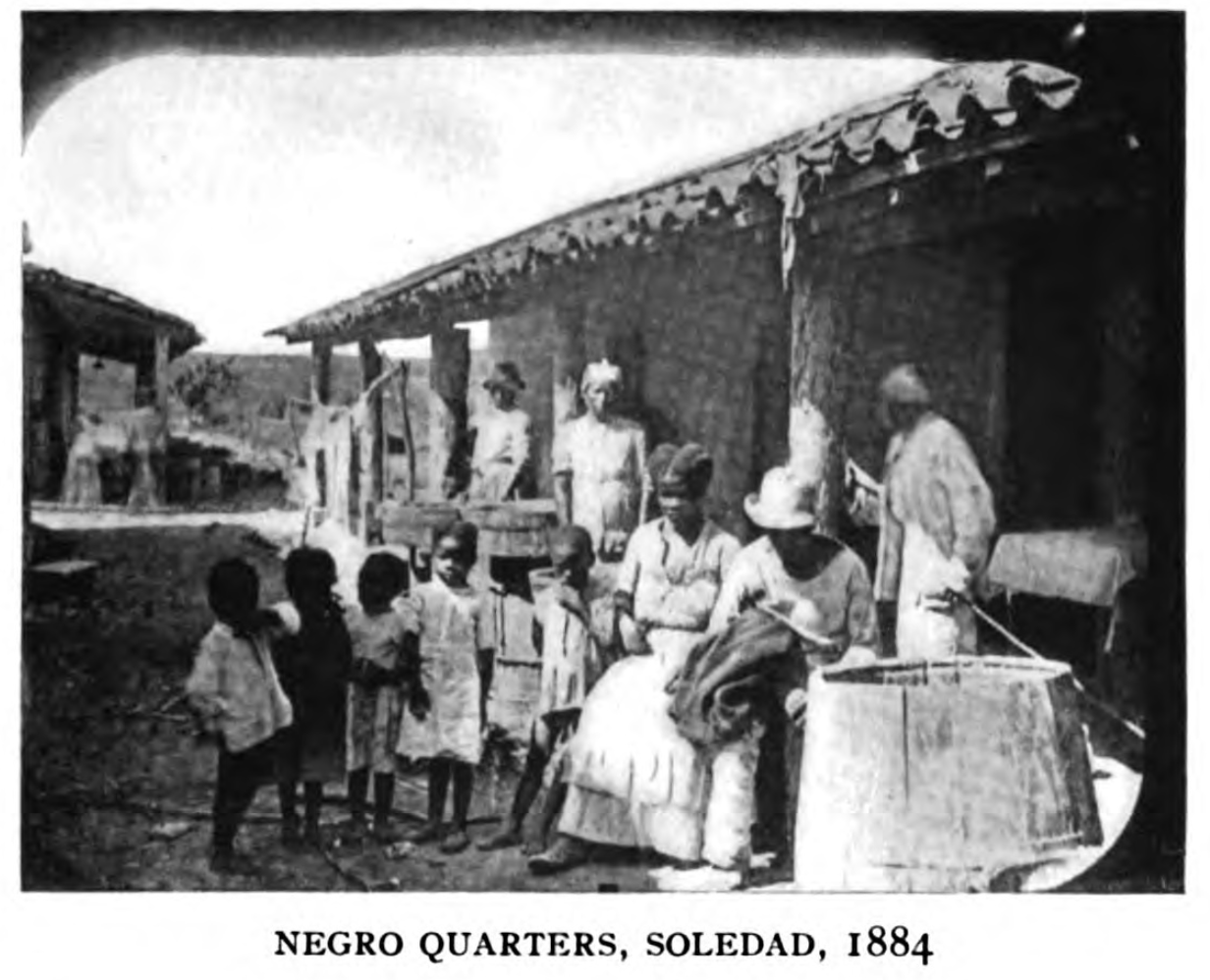
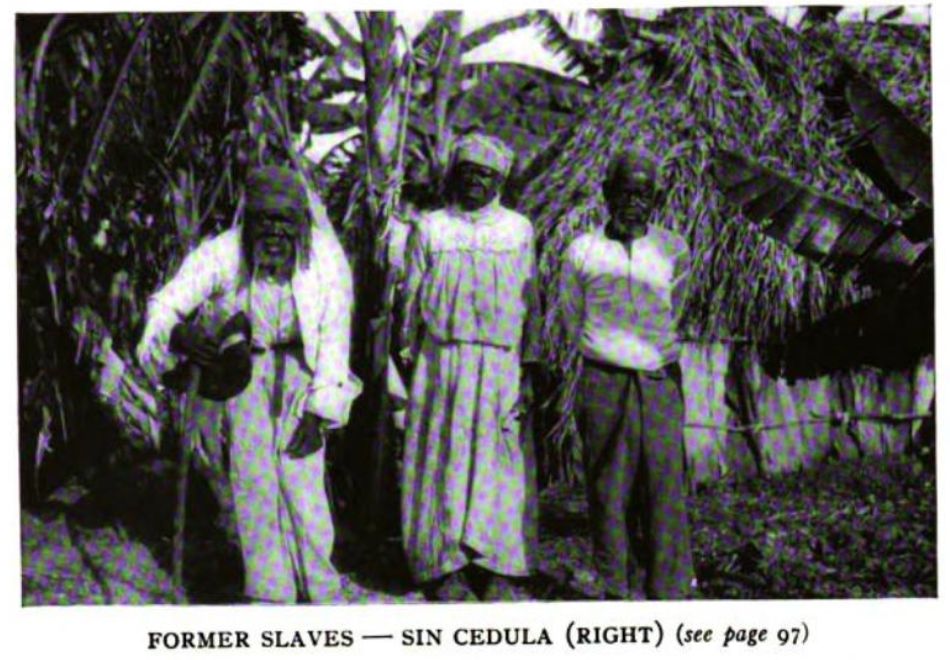
Sixty Years in Cuba: Reminiscences of Edwin F. Atkins, Edwin Atkins, 1926

In 1880, as a result of the Ten Years’ War and a subsequent, smaller conflict known as the Guerra Chiquita, Spain enacted a law formally abolishing slavery in Cuba, though not immediately. The act ‘bound former slaves as patrocinados, or apprentices, to their masters for eight more years,’ notes legal historian Rebecca Scott, and ‘the cloak of patronato (patronage) covered a system that appeared to offer freedom but enabled masters to extract several more years of largely unpaid labor from their slaves.’ Citing Scott’s research, in 2022 the Report of the Presidential Committee on Harvard & the Legacy of Slavery included Edwin Atkins as a prominent example of the university’s ‘extensive financial ties to slavery’: ‘This [patronato] system was, in effect, slavery by another name. In fact, before Atkins purchased Soledad, the plantation’s owners sent a bill of sale to his business partners that listed 177 patrocinados as slaves, despite their new legal status. When E. Atkins & Company officially acquired the plantation, it came with at least 95 formerly enslaved patrocinados.’ In 1899 Atkins began financing the work of Harvard botanists to improve the yield of his cane crop, and an estate on the Soledad plantation became the Harvard Botanical Station for Tropical Research and Sugar Cane Investigation, later operated by the university as the Atkins Institution of the Arnold Arboretum for decades until its seizure by the Cuban government in 1961.

The Atkins memoirs and biographies don’t acknowledge or speak to their status as slaveholders one way or the other, but there are telling passages. In an account included in Helen Atkins Claflin’s family chronicle, Edwin’s wife Katharine records a visit from Sam Eliot, the son of Harvard President Charles Eliot, writing, ‘One of our old slaves came in one day while Mr. Eliot was there, and looking at him admiringly, said to me, “Niña, is that God himself?” He certainly was a very good looking young man and I suppose that may have been the old negro’s idea of the Lord.’ In his reminiscence of the era, recalling the ceremony that accompanied he and his wife’s arrival to Soledad each winter in the 1880s, Edwin wrote, ‘As the procession filed in front of us, many of the older African negroes would kneel and kiss our hands and feet, asking our blessing. These negroes addressed us as father and mother, and always called me master. They really considered themselves as our children.’ Decades after the Civil War had put an end to slavery in their own country, the Atkinses could live as old-fashioned plantation masters in their adopted home of Cuba.

In Boston, Edwin Atkins had joined his father as a director of the Wharf Company by 1884, and that year became involved in a boardroom battle over its management and future direction. In June the Boston Globe reported that a group of stockholders were complaining about the firm’s flagging financial position—one ‘claimed that thousands of dollars’ worth of business had been lost to the company, and the stock which should bring $57 per share had lately been sold for $25’—and had begun ‘inquiring into the company’s system of business, with the view of either putting a part of its land on the market for sale, or of leasing it at a rental for building purposes.’ Several factors apparently contributed to the decline of the Wharf Co.’s storage business: the disruptions to and restructuring of the Cuban sugar market, the ongoing consolidation of the domestic refining industry, and according to company director J.B. Russell in an 1887 letter to the Globe, ‘the unequal, improper and dishonest execution of the same custom laws and regulations in the different ports.’ That is, Boston merchants believed the examiner of the New York customs office in particular to be appraising sugar at a lower value of purity, and therefore a lower rate of duty for importers; the accusation was ultimately proven and the examiner fired. In his letter Russell claimed that receipts from sugar and molasses storage at the Boston Wharf Company’s warehouses totaled $74,000 in 1885 but ‘this year. . . will probably not exceed $20,000, and another year in all likelihood, will see the property devoted to other uses, its legitimate use practically destroyed by dishonesty.’
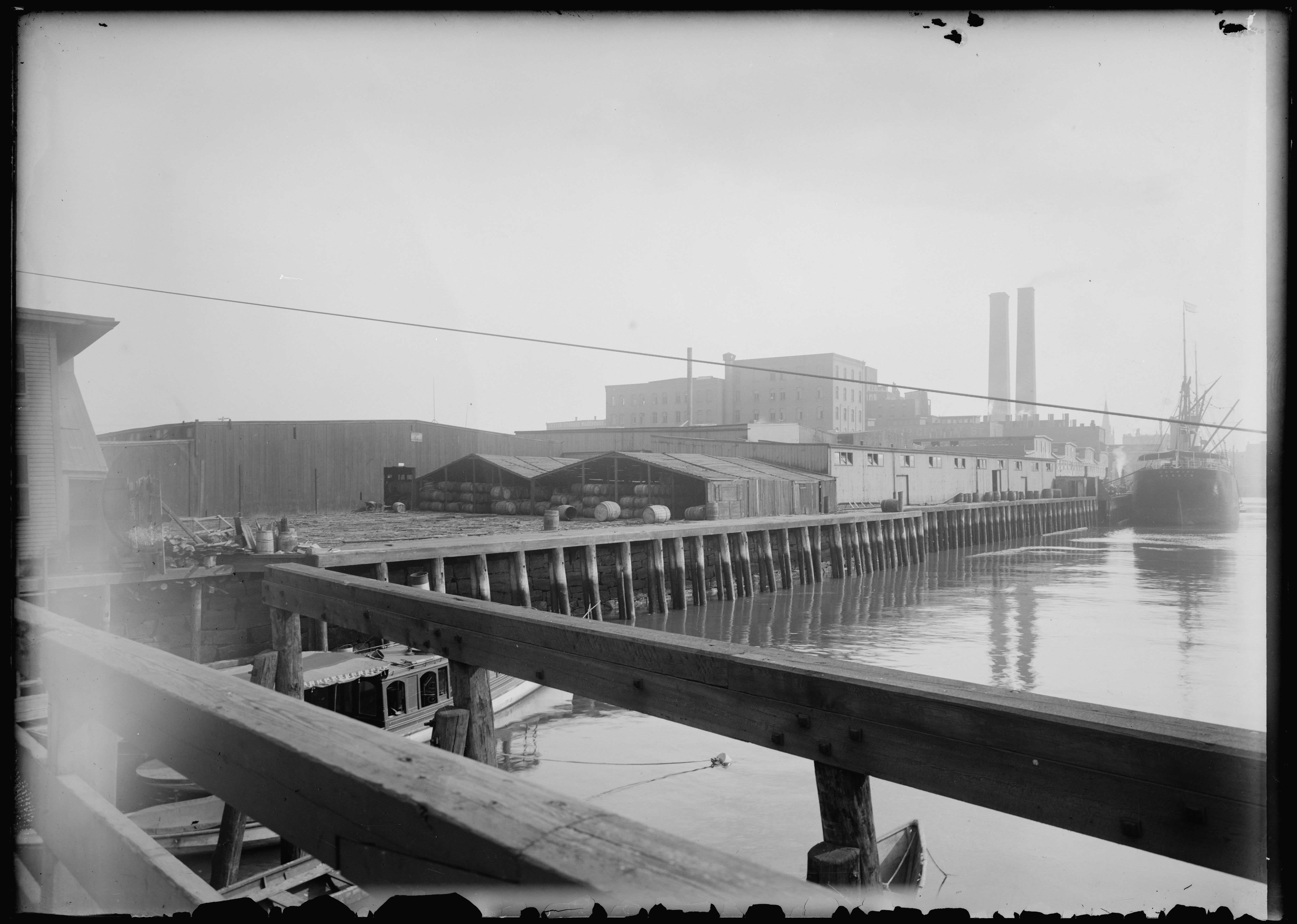
Boston Wharf Company. Old Molasses Wharf/sugar refinery Mt. Washington Ave. [ca. 1898–1907]. https://ark.digitalcommonwealth.org/ark:/50959/br86bc45v

The company’s decline spurred the group of aggrieved shareholders to accuse the board of serious conflicts of interest: ‘The trouble seems to have originated in part in the election as directors of two or three stockholders who were at the same time among the largest customers of the company,’ the Globe reported, and ‘it had been insinuated by certain stockholders that these directors were getting wharfage at special rates.’ The allegation was aimed squarely at the Atkinses, and Edwin fired back to likely devastating effect:

He said that at a previous meeting surprise had been expressed that the Messrs. Atkins did not resign as directors, inasmuch as they were the largest customers of the Boston Wharf Company. At that time, he said, the need no longer existed, as his firm had withdrawn their business and engaged storage room for some 7000 hogsheads of sugar among other wharves. As to the statement that his house obtained lower rates of the Boston Wharf Company than could be obtained at other wharves, he said that he placed before the committee receipted bills of nearly all the wharves doing a sugar business, all of which showed lower rates than those charged by his company. . . In conversation after the meeting Edwin F. Atkins said his firm handled 60,000 hogsheads of sugar annually, and had heretofore given all their business to the Boston Wharf Company. And in addition to this they had indirectly brought fully one-half of the company’s business to its wharves and bonded stores.’

Not only would he decline to resign as a director, Atkins had actually pulled his sugar out of the Wharf Company’s sheds anyway, and up to that point his family’s business had been the primary reason why the landmaking venture existed in the first place. Who exactly did these shareholders think they were dealing with?

Edwin Atkins stayed on, and would serve as president of the Boston Wharf Company from 1896 until 1925, the period when it transitioned fully into an industrial real estate developer and created the Fort Point neighborhood as it largely still stands today. Though no longer the company’s central source of revenue, the business of sweetness remained a significant physical presence in the area—through the Chase & Co. confectionery, built on Congress Street in 1887; the Necco factory, completed in 1902 and enlarged with two additional buildings in 1907; and the expanding footprint and evolution of the Standard Sugar Refinery, which had operated at a location halfway up the channel, on the company’s earliest made land, since at least 1868. In 1887, Atkins agreed to merge the Bay State Sugar Refinery into Henry O. Havemeyer’s newly incorporated and soon-notorious Sugar Trust, which controlled the Standard Sugar Refinery; the news of the shutdown of the Bay State the following year was notable enough to make the front page of the New York Times, the headline just under the masthead reading, ‘Closed by the Trust.’ 

Atkins’s involvement in the Sugar Trust would, like his father, result in his testifying before Congress in 1911, where he acknowledged that the Bay State refinery was closed and its machinery removed to the Standard to concentrate Boston’s refining capacity, and that he had received stock in the Trust as part of the deal. (Atkins claimed the Bay State was a money-losing operation, and that, rather than a nefarious bid to stifle competition, the ‘purpose of the combination was to. . . turn the business of the weaker houses over to the best, and reduce the cost of refining. . . so that we could sell to the consumers of the country at a lower figure than we would otherwise be able to sell for.’) The Trust, which after the Sherman Antitrust Act of 1890 was reorganized as the American Sugar Refining Company, became a leading corporate villain of the era, embodying the most flagrant excesses of encroaching monopoly: ultimately controlling 98 percent of sugar refining in the United States, it ‘often operated on the edges of the law,’ Ulbe Bosma writes, ‘and it perpetrated major legal offences, ranging from illegal transport arrangements with the New York Central Railway Company to multiple cases of defrauding customs.’ The Trust made a crucial contribution to the era of corporate consolidation with its 1895 victory in the United States v. E. C. Knight Company case, in which the Supreme Court drastically curbed the ability of the federal government to enforce the provisions of the Sherman Antitrust Act.
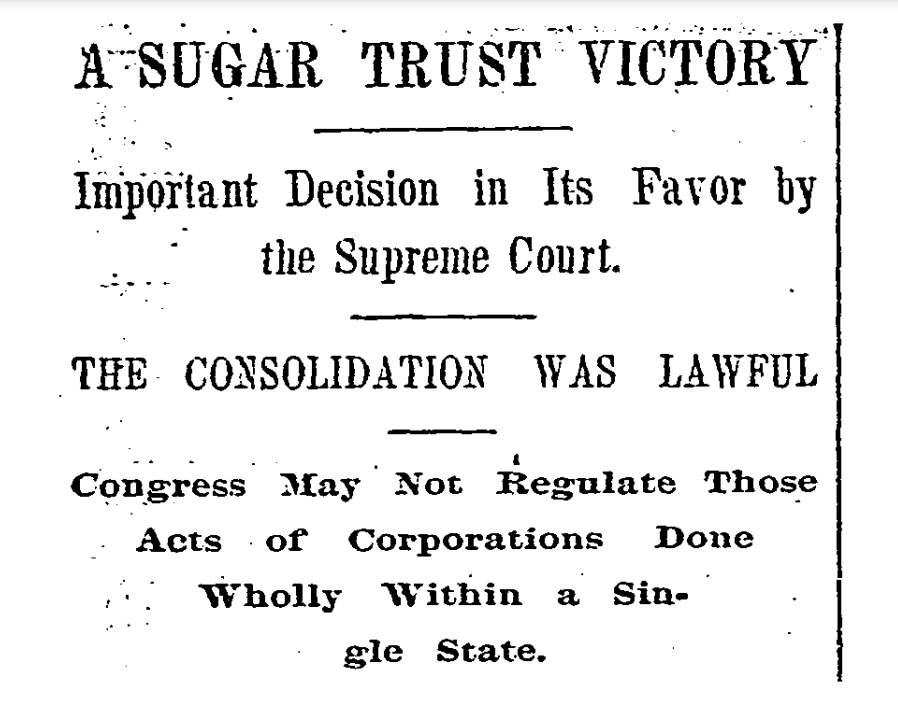
The New York Times, January 22, 1895

Following the death of Henry O. Havemeyer in 1907, Atkins took on a central role in overseeing the American Sugar Refining Co., serving variously as vice president, acting president, and chairman of the board of directors, such that for a period of time he was officially running the dominant refining concern, plantations in Cuba that controlled one-eighth of the island’s total sugar production, and the Boston Wharf Company, on whose land one of his refineries and the nation’s largest candy maker both operated. (There’s no record of Atkins himself having a direct interest in Necco, but it’s fair to infer that the company was a major customer of American Sugar Refining, given their proximity in Fort Point and the latter’s stranglehold on the industry; a 1952 Report of the Federal Trade Commission on Interlocking Directorates found the firms shared an ‘indirect interlock’ via respective company directors who served together on the board of the Boston Elevated Railway.) Altogether, Atkins presided over a fully integrated, continent-spanning empire of sugar.

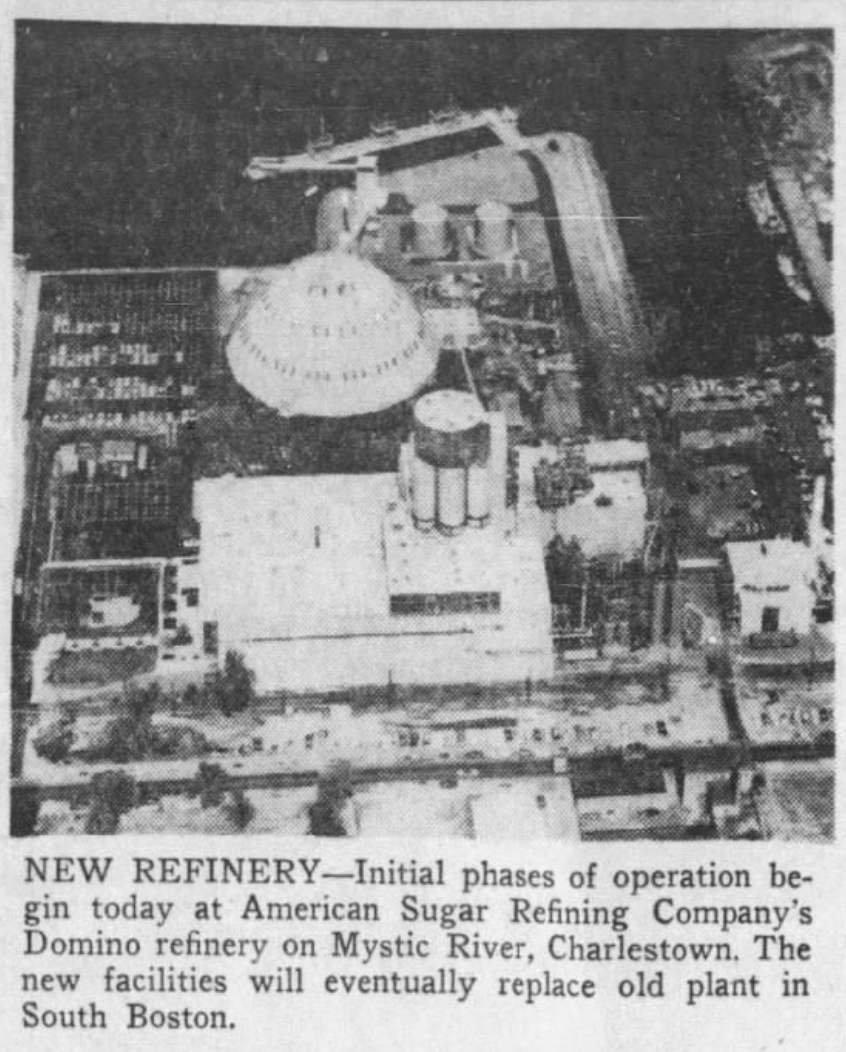
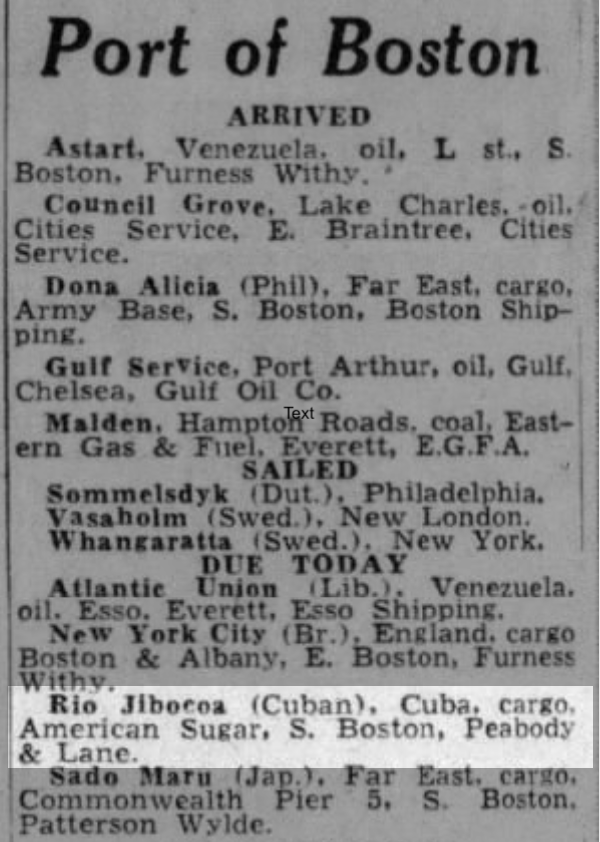
American Sugar Refining introduced the famous Domino line of packaged consumer products in 1900, and later built large, neon-lit signage advertising the brand over its refineries in Boston, Brooklyn, and Baltimore, where the sign has become an iconic visual element of the city’s Inner Harbor. The Domino Sugars sign in South Boston has long since come down, but we can see how it would have looked looming over the Fort Point Channel in the most striking photograph surviving from the area’s waning industrial era. Captured by engineer and entrepreneur Nick DeWolf, the image shows the Cuban cargo ship Rio Jibacoa docked next to the American Sugar refinery, the Domino Sugars logo glowing bright, with the Boston Wharf Company Industrial Real Estate sign and the chimney of the Necco factory appearing faintly in the far background, everything mirrored in the glassy stillness of the channel’s surface. A notice in the Globe recorded the vessel’s arrival on May, 4, 1960, a full year and a half since the final triumph of Fidel Castro’s revolution over the regime of Fulgencio Batista. The American Sugar Refinery relocated to Charlestown at the end of 1960, its channel-side site taken over by the Gillette razor company, and imports from Cuba were officially banned by President John F. Kennedy in February of 1962. The prior year, the new Cuban government confiscated the Atkins’s Soledad sugar plantation.
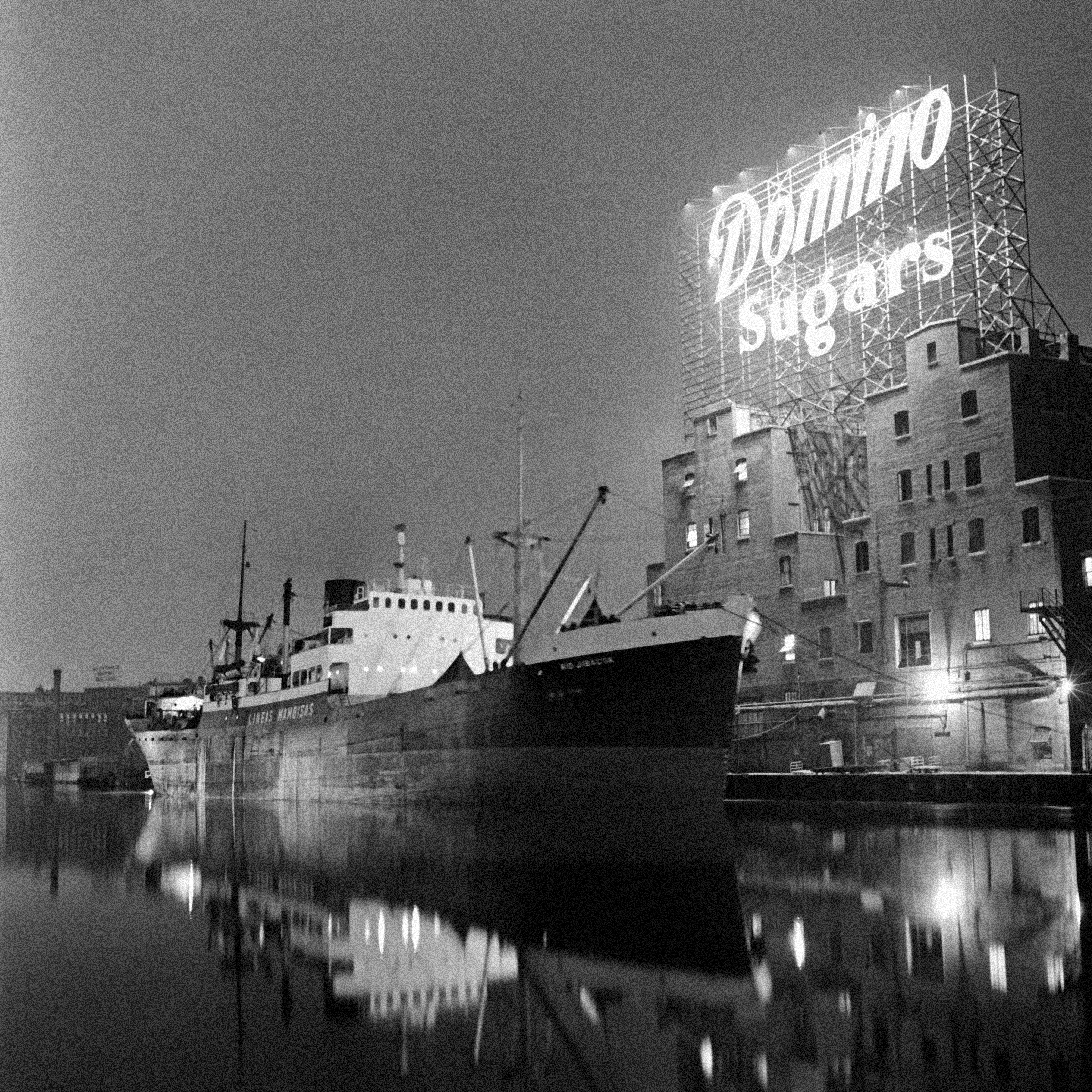
Photograph by Nick DeWolf
Boston Globe, May 4, 1960
Boston Globe, September 20, 1960

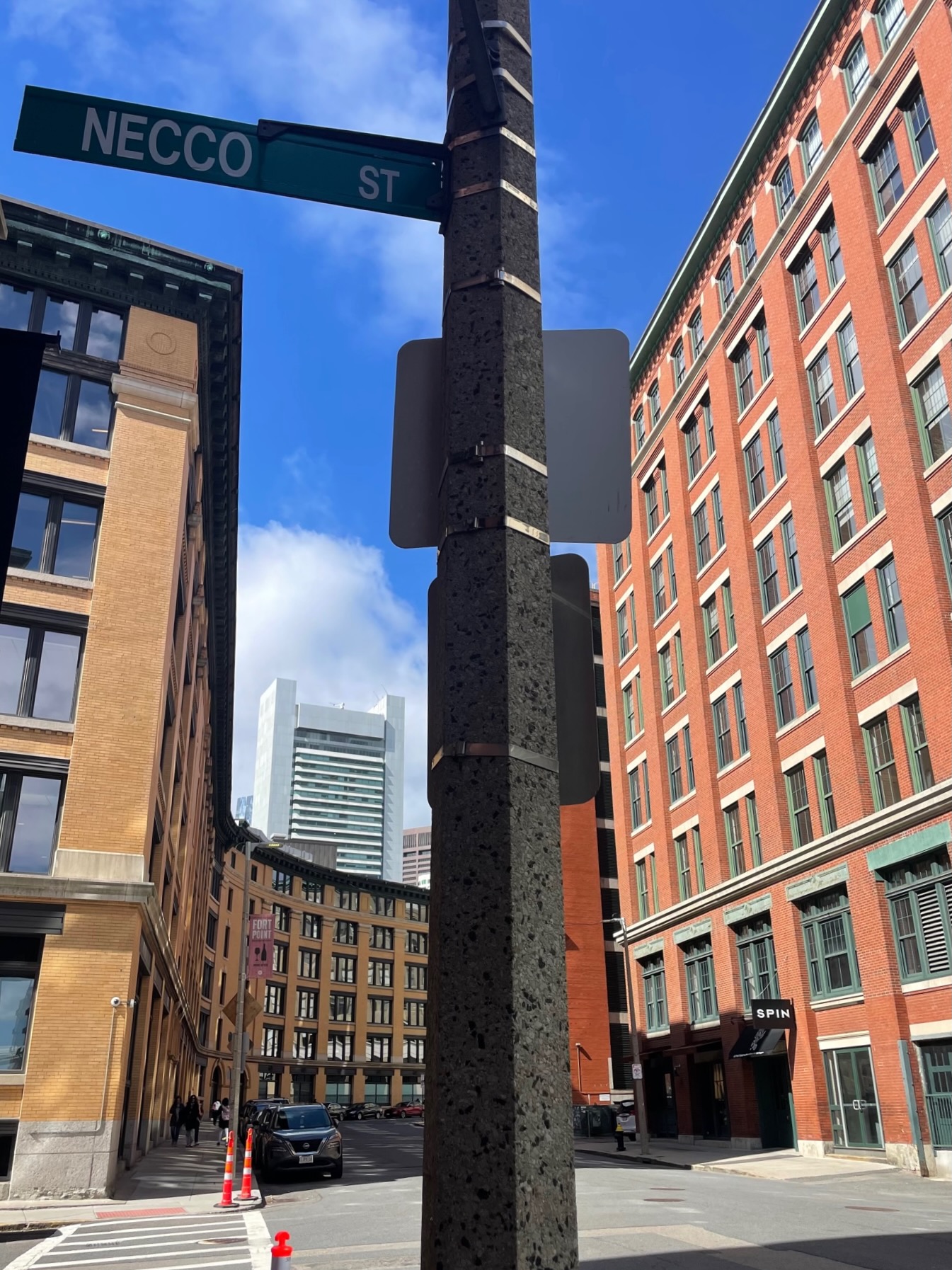
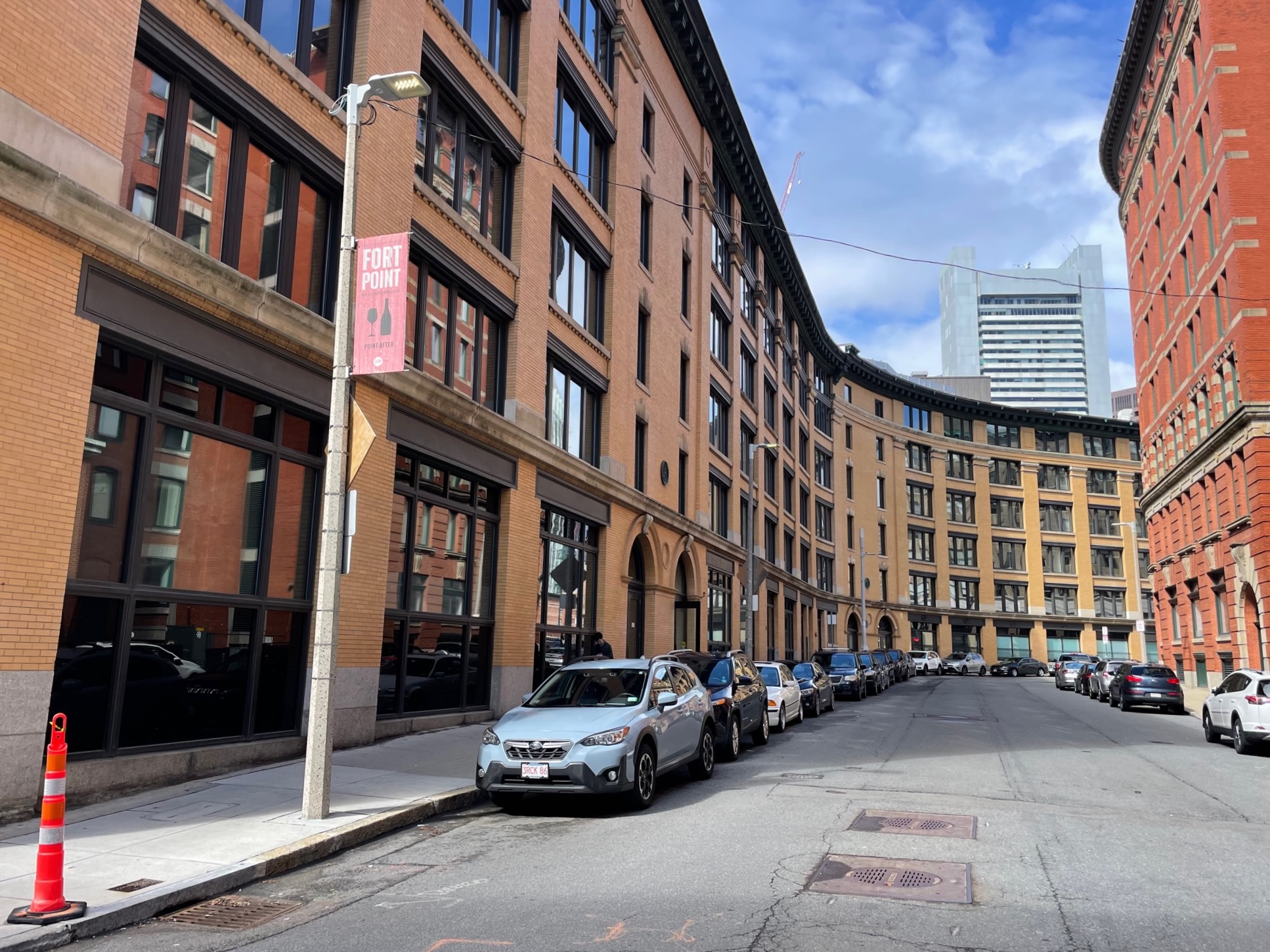
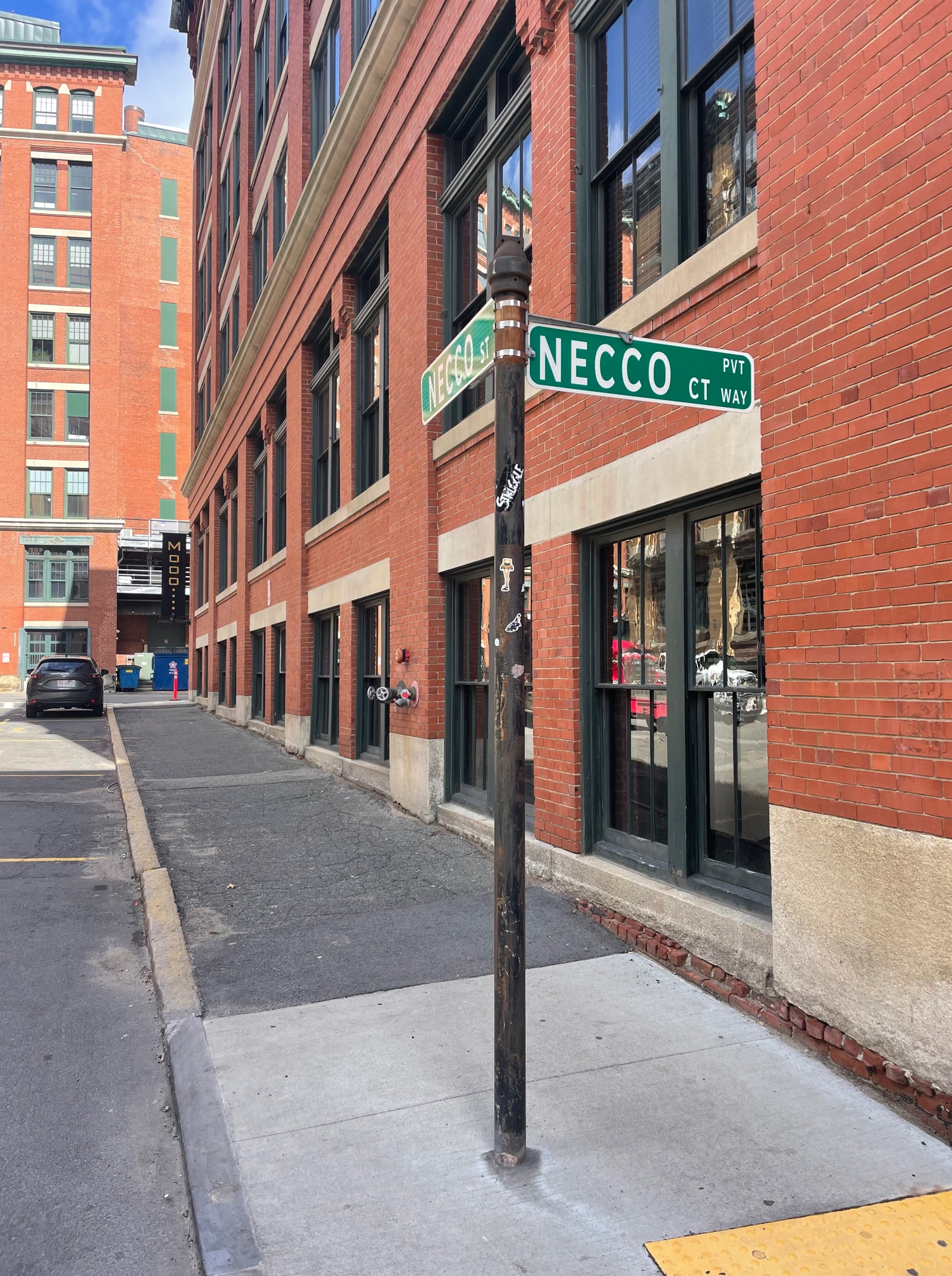
Walking along the Fort Point Channel today, it’s hard to imagine that huge oceangoing ships once traversed its waters, unloading cargos of raw sugar grown and milled in Cuba, to be further processed at a refinery that had operated at the same location for nearly a century. There are few lingering reminders of the long and complex history of sugar in the neighborhood. While there is a plaque mounted on a Summer Street building commemorating the ‘Center of the Boston Wool Trade,’ the legacy of the Atkins family and its stewardship of the Boston Wharf Company—a legacy bound up with the horrors of the Atlantic slave trade, the decades-long exploitation of workers enduring the punishing conditions of the cane fields, and the emergence of imperialistic industrial monopolies—is little noted, and not well remembered. The most visible remnants of the sugar business relate to the final link of the commodity chain, when the refined material was transformed into delightful treats for mass consumption: the Necco factory buildings, Necco Street, and Necco Court record the palatable side of a story that in its full telling can be harder to swallow.

In a 2000 Boston magazine article detailing a recent trip to Cuba by Atkins descendants—’a combination of family reunion and political fact-finding mission’—former Congressman Chet Atkins and his cousin Dr. Elisha Atkins reflected on the troubling origins of their patrimony. ‘Growing up in the ’60s, for people like Chet and me,’ Elisha said, ‘meant that coming from a family owning a sugar plantation in Cuba was nothing we really wanted to talk about or acknowledge.’ Regarding the legacy of his great-grandfather Edwin F. Atkins, Chet said, ‘The Boston Unitarian didn’t free his slaves until the last possible moment, because they were an asset on his books, and he wanted to be able to depreciate the asset. I think the whole thing is coming to grips with a crazy set of contradictions that he was a paragon of American imperialism, that he in fact developed and refined some of it, bought governments and elections, bent US policy and presidents to achieve his end, which was greater profitability for operations.’ But, he continued, ‘He was also an extraordinary philanthropist. . . I talked to children of the slaves, and they had enormously fond memories—I was really amazed to find—of Edwin Atkins, and particularly Katherine Atkins, good feelings.’ Family ties can color perceptions, and encourage us to think the best of relatives and ancestors. So too it is with nostalgia, perhaps of the kind evoked by a favorite candy from childhood: we tend to fixate on the sweeter memories, however bitter the reality may have been.
This Revolting Traffic: How Sugar Shaped Fort Point

And the Building Continues: Inundation District and the Making of the Seaport

In December 2016, at a press conference announcing the release of the landmark Climate Ready Boston report, then-Mayor Marty Walsh declared a new approach to building in the city. Citing the recent rebranding of the Boston Redevelopment Authority to the Boston Planning & Development Agency, Walsh insisted the update was less a simple name change than a ‘whole cultural change.’ ‘It’s about truly planning an entire area and planning for the future,’ he said. ‘When you look at the waterfront today, if we could go back in time 30 years and start looking at the different buildings that were built… if we really thought it through, we could have done some real spectacular things during the development phase. We missed that opportunity, so now we have to figure out how do we do it and then with the new development coming in, have the new development prepare for the future.’

Two days later, the Boston Herald ran an article interviewing developer John B. Hynes, III, the main player in the planning of the 23-acre waterfront megaproject dubbed Seaport Square. ‘I have my doubts,’ Hynes said of the city’s climate projections. ‘The global warming phenomenon that everybody’s worried about is nothing more than historic cycling.’ The Mayor’s report identified the South Boston Waterfront as the area at the highest risk of damages due to sea level rise and chronic flooding, but one of its most prominent builders wasn’t as concerned. ‘If these guys are all right, I guess the next generation will be developing out in the Berkshires. Eastern Massachusetts will be under water, which is crazy,’ Hynes said. ‘I’m not going to get into the science of it because there’s too much science.’

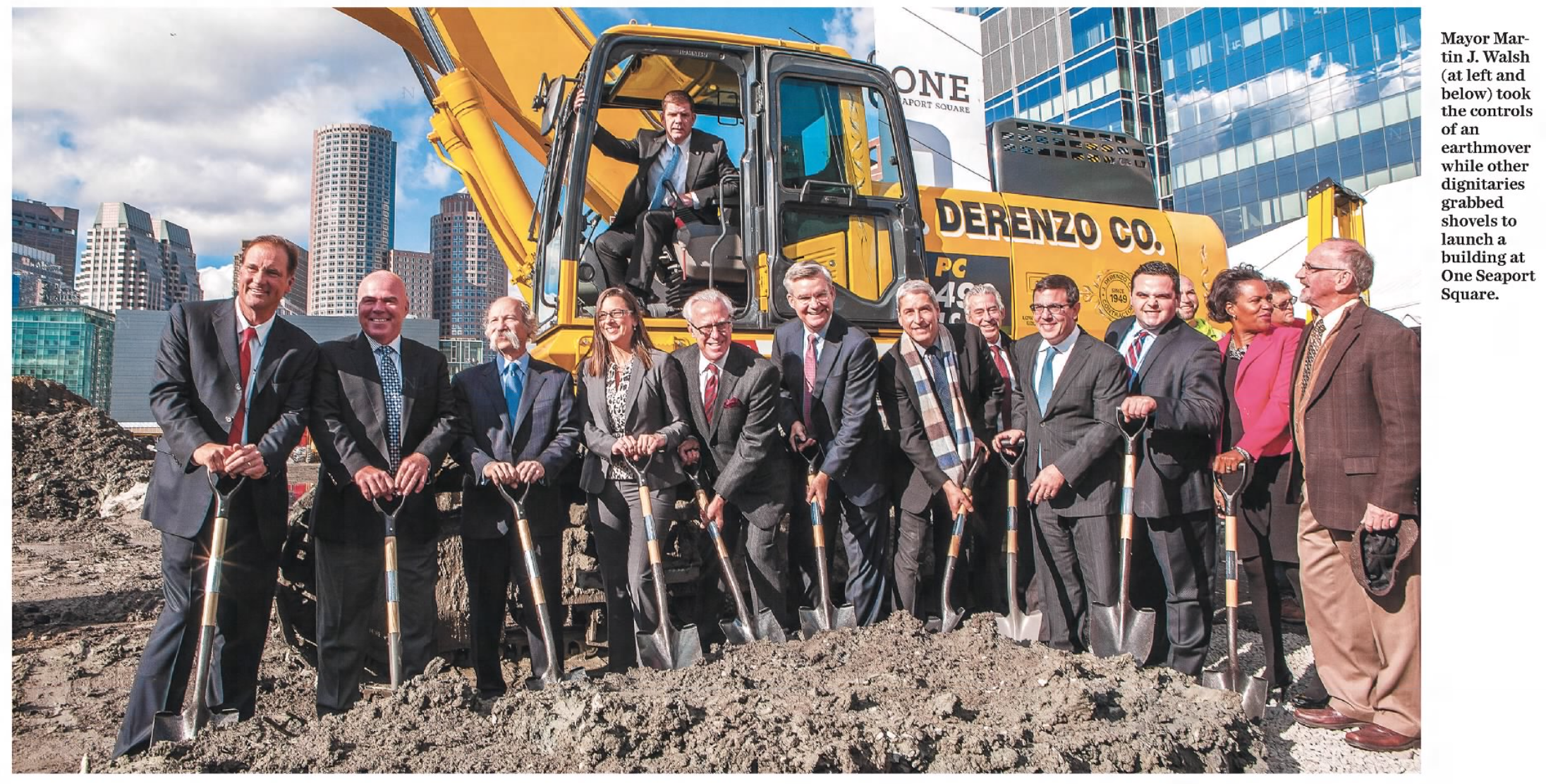
By then, Hynes’s firm Boston Global Investors and majority partner Morgan Stanley had already completed an impressive ‘exit’ from the Seaport Square project, netting north of $360 million in profit in less than ten years. Following the initial $204 million acquisition of the land from Rupert Murdoch’s News Corp in 2006, Hynes estimated a further $80 million went into the permitting process and infrastructure work, and once the required approvals were secured, the Seaport Square blocks were sold in a series of deals totaling $665 million. A triumphant Hynes put on an elaborate show for the 2014 groundbreaking of the centerpiece One Seaport Square complex, which featured live models posing in stage-set creations of a luxury condo living room and rooftop, a movie theater, and an Equinox gym. Following remarks in which he lauded the Seaport District as representing ‘the future of our economy,’ former construction worker and union head Mayor Walsh hopped in the cab of an excavator for the big shovels-in-dirt photo op.
The groundbreaking at One Seaport Square: Mayor Walsh in the excavator, and John Hynes at far left. (Boston Globe, December 31, 2014)

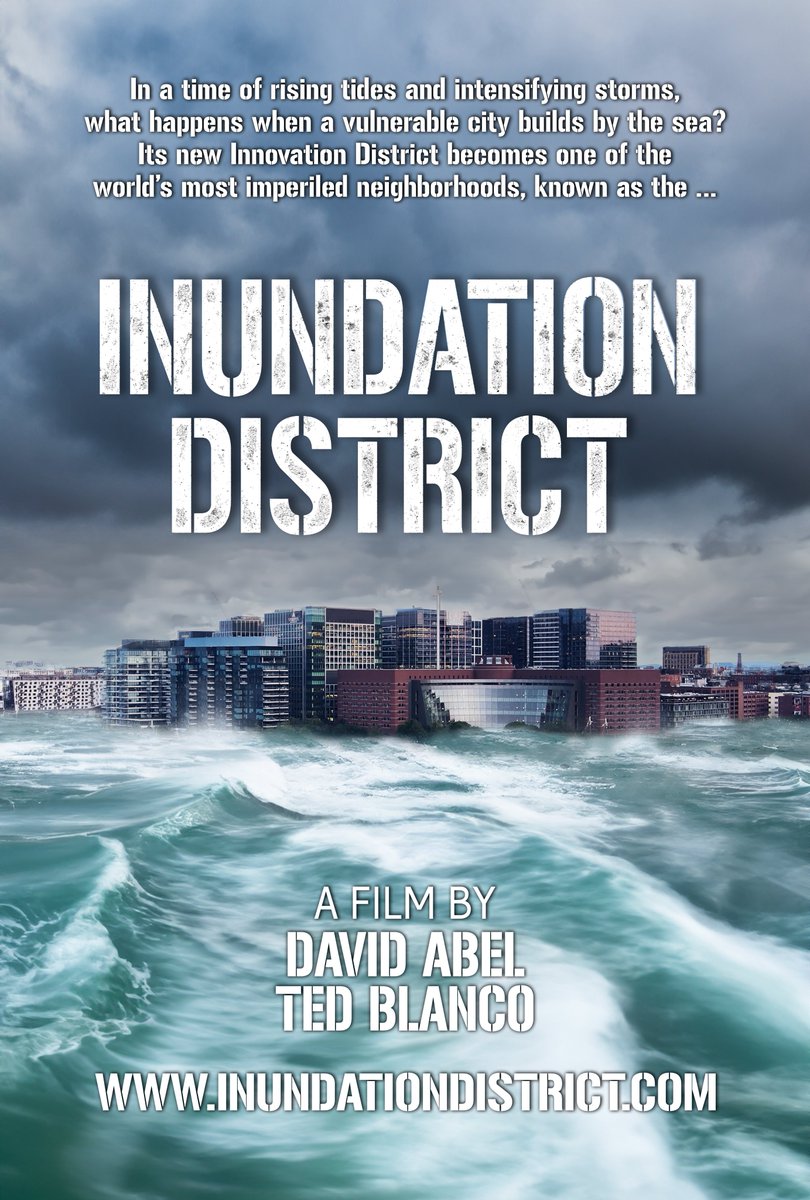
The premise of David Abel and Ted Blanco’s new documentary Inundation District is that such spectacles amounted to shortsighted hubris at best, and willful negligence at worst. How, the film asks, could the city of Boston embark on a multibillion dollar buildout of a brand new neighborhood on filled tidal flats when the threat of sea level rise and worsening coastal storms was already widely understood? And what is to be done about it now?

These questions have become stock media and conversation fodder in Boston, but Inundation District offers the most compelling and accessible rendering of the subject yet. It deserves wider distribution, and an audience well beyond just the Bay State. Timely, informative, and engrossing, the film weaves history lessons and technical expositions with more cinematic moments played up for pathos or outrage, and Abel covers a lot of ground over a 79-minute runtime. If anything, possibly too much: in its attempt to explore all the angles, and make the most of a large, well-selected cast of characters, Inundation District can feel stretched a bit thin. But that is partly the nature of what is a vast and complex set of issues to consider, and the documentary still succeeds as both a hyper-local investigation and a cautionary tale on a more universal level.

Will it persuade the doubters and deniers? Probably not, and if that’s not quite the film’s remit, there might be some truth to the inevitable charge of preaching to the choir: so far it has only been shown at select events and venues, some in partnership with local environmentalist groups, in places like Cambridge and Nantucket, where likely most in attendance arrive well-primed to lament the insane overbuilding of the Seaport. In one ‘meta moment‘ at a recent screening at Boston University, some of the same Extinction Rebellion activists seen in Inundation District interrupted the Q&A to grill and make demands of Massachusetts Climate Chief Melissa Hoffer—though the organization later clarified its ‘appreciation and admiration to the creators’ of the film.

Many others are not so alarmed, or at least view other issues as more pressing. A 2022 poll from MassINC sponsored by cable billionaire Amos Hostetter’s Barr Foundation—which also provided support for Inundation District and the 2016 Climate Ready Boston report—found that while 77% of respondents said climate change posed a ‘very serious’ or ‘somewhat serious’ problem for Massachusetts, only 47% ranked it as a ‘high priority’ for the state government to address, compared to 68% who said the same regarding ‘jobs and the economy.’ This is roughly in line with recent nationwide figures: in a 2023 Pew Research Center survey, 37% of Americans said the federal government should prioritize ‘dealing with global climate change,’ well below support for ‘strengthening the nation’s economy’ at 75%.

There may be doubts about the reliability of public opinion polling, but such results point to an intuitively understood dilemma at the heart of debates surrounding efforts to mitigate climate change. That is, the idea that even if we accept the looming danger of the situation, we can’t afford to do anything too sudden or drastic about it. As one interviewee in the Pew survey said regarding the transition to using renewable energy sources, ‘I’m fine with the change. What I’m not fine with are the demands and the urgency to change, which then has a major impact on the economy.’

The parallel with the rise of Boston’s gleaming, seaside ‘Innovation District’ is clear enough. There was, and is, simply far too much money at stake not to build. The most coveted land at Fan Pier and Seaport Square had been tied up in litigation and planning battles for decades, so that when it at last came time for construction to begin, the mood was jubilant. ‘Remember all the fights we had on this one?’ Mayor Thomas Menino said ahead of the groundbreaking ceremony for Joseph Fallon’s Fan Pier development in 2007. ‘The day finally has come to see Fan Pier rise out of the ground to become a very important part of the city’s economy.’ The sense of long-awaited momentum on the waterfront provided a rare source of hope when the global financial crisis and recession hit soon after; a 2010 Globe report on the BRA’s pending approval of Hynes’s Seaport Square anticipated that the project’s initiation ‘could signal a reawakening for private development, which has been largely dormant in the city since credit markets froze.’

Boston Globe, September 26, 2007

Over the next decade the Seaport would lead and come to symbolize the broader post-recession building boom in Boston. The BPDA’s 2018 Economy Report identified 124 developments under construction across the city at a total value of $11 billion, with $1.9 billion of that rising in the South Boston Waterfront, the highest of any neighborhood. According to Boston Global Investors, Seaport Square’s projects have to date ‘created approximately 10,000 construction jobs [and] 20,000 permanent jobs,’ with the rise in property values ‘resulting in increased real estate tax payments to the City of Boston of approximately $45 million annually.’ As Mayor Walsh said at Hynes’s grand groundbreaking for One Seaport Square, ‘We are seeing our city’s economy work right here in front of us.’ Boston might pride itself on world-renowned tech and life sciences sectors, but builders still largely call the shots: Suffolk Construction’s John Fish has ranked near or at the top of every Boston magazine Power List since 2012, and Walsh’s 2013 election victory was widely attributed to his rock-solid backing from the building trades unions.

Inundation District doesn’t deal with all the tricky implications at play in the world of Boston power politics and the real estate game—to pull those threads would probably result in a separate film entirely—but it does prominently feature one developer as a stand-in for the rest. This is, of course, WS Development, the company that has more than any other defined the look and feel of the central Seaport area, initially partnering with John Hynes and Morgan Stanley in 2007 and later acquiring the remaining unsold 12.5 acres of their land for $359 million in 2015. In a scene played for irony, the filmmakers crash WS’s festive 2021 ribbon-cutting for ‘The Rocks at Harbor Way’ and speak to executives Amy Prange and Yanni Tsipis, and to his credit Tsipis agrees to a longer interview, according to Abel the only developer willing to do so. Tsipis emphasizes the firm’s long-term interest in the area, and gamely walks through various flooding resilience measures they’ve implemented—building at a raised grade, putting mechanical systems on a higher floor, designing a parking garage to double as a vast stormwater repository—but is ultimately set up to take the fall in the film’s climactic moment.

The scene has Abel, otherwise unheard and unseen, at his most confrontational, and serves its purpose to heighten the drama, but at the risk of washing out some nuance. WS deserves plenty of scrutiny for its choices in the Seaport, from specific instances of abandoning or altering promised public spaces to an overall paucity of vision, in thrall to brand names and moneyed tenants, but Tsipis is indeed one of the more ‘enlightened developers,’ as Abel told Boston Public Radio, and there doesn’t appear to be reason to doubt the firm’s claim that they ‘plan to own the area for a very long time.’ The Seaport’s most egregious practitioner of climate denial and windfall land-flipping doesn’t feature in the film, nor do any other major waterfront operators, like the Fallon Company, Fidelity Investments, or the federal government. Which is all to say the situation is complicated, bigger than one developer or landowner, and demanding a fully integrated preparation and mitigation strategy that has yet to be realized. As Deanna Moran of the influential Conservation Law Foundation advocacy group has said, ‘This ad hoc, parcel-by-parcel, project-by-project resilience approach is not a long-term solution.’

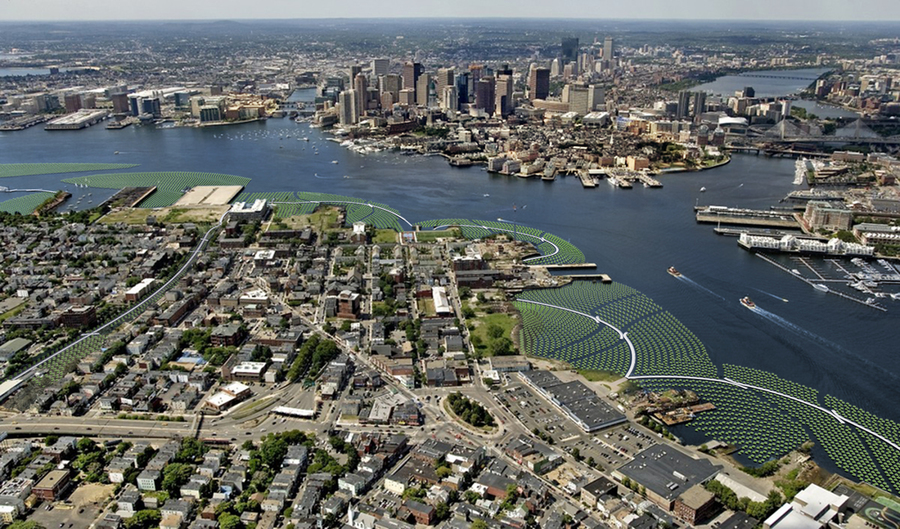
The Emerald Tutu, a climate infrastructure answer to Frederick Law Olmsted’s Emerald Necklace. (https://news.mit.edu/2020/emerald-tutu-design-wins-nsf-grant-protect-boston-coastline-0903)

Where do we go from here? The film looks at a few proposals to stave off the worst, all either conceptual, expensive, or somewhat outlandish: a massive seawall along the outer mouth of the harbor, a deployable storm surge barrier that could turn the Fort Point Channel into a huge drainage basin, an Emerald Tutu of ‘floating biomass modules’ to diminish high wave energy. On the development side, the Coastal Flood Resilience Overlay District guidelines were added to Boston’s zoning code in 2021, and this past December the Massachusetts Department of Environmental Protection issued new draft wetlands regulations that have already drawn criticism from the business community. ‘Yes, we all deserve to be protected against climate change flooding,’ a recent Banker & Tradesman editorial grants. ‘But every state and local agency that touches the built environment must keep maximizing housing production top of mind at all times. After all, what use are legal and regulatory protections to someone who can only afford to sleep in their car under a bridge?’

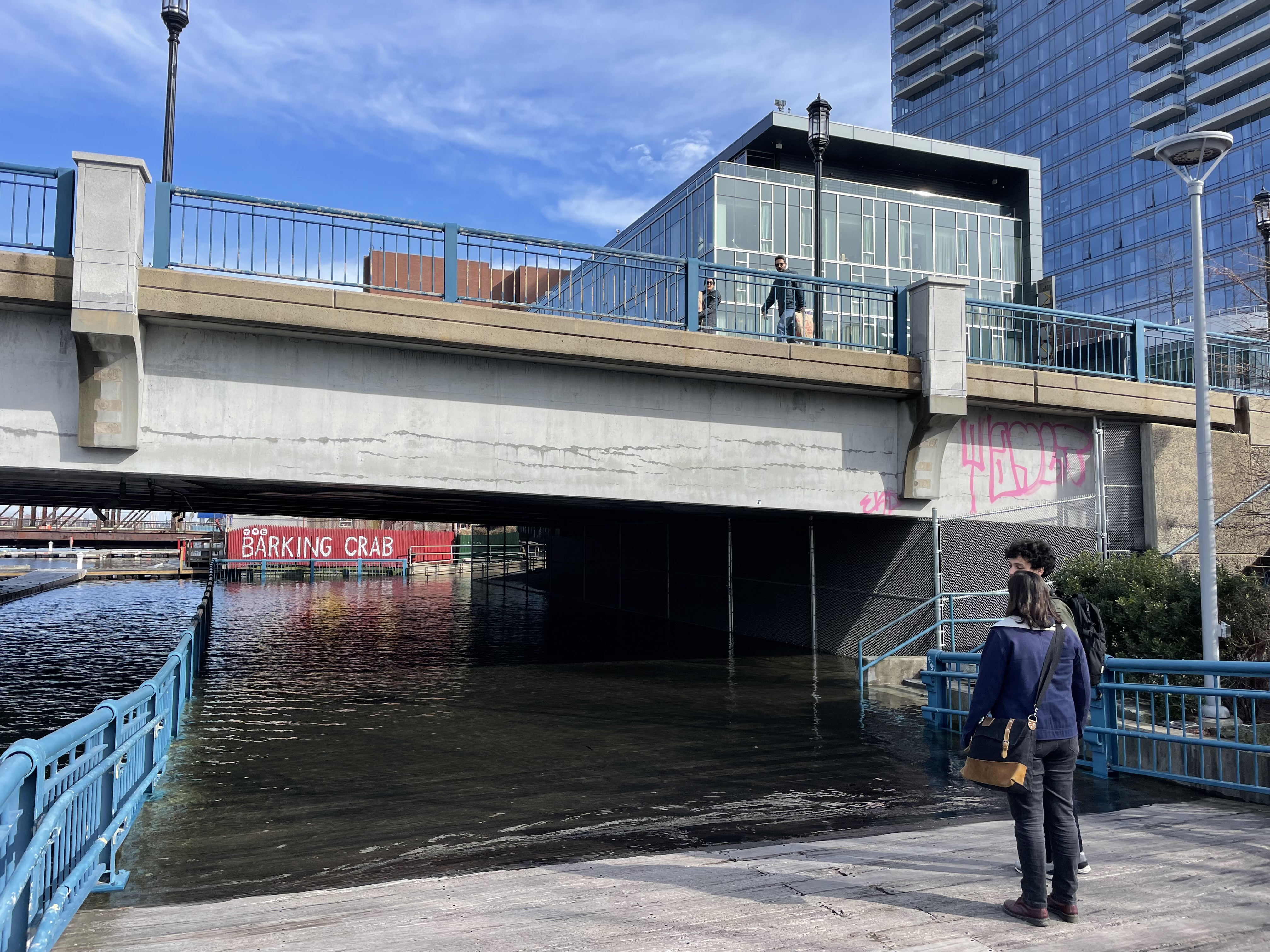
As it happens, Inundation District does spotlight a man, Nathan Wyatt, who sleeps under a bridge in the Seaport, the Harborwalk underpass near the waterside Barking Crab restaurant. His message is the opposite: all this building is for naught, certainly not intended to help people like him in the first place, and anyone who can’t see what’s coming is hopelessly deluded. Taken by surprise on a high tide flooding day, he wakes up to find blankets and belongings soaked through, and eventually leaves the area to seek drier shelter elsewhere.

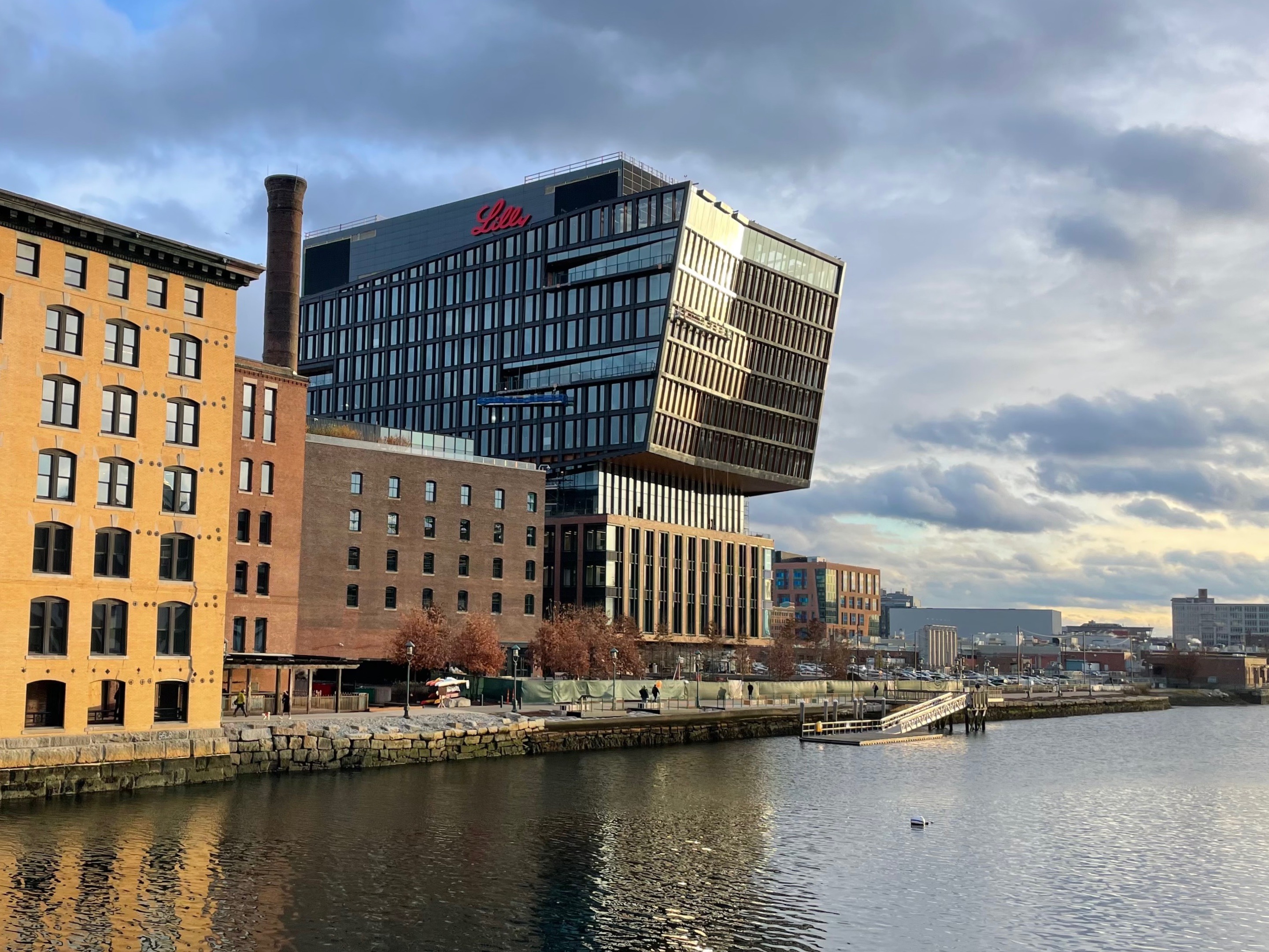
So we can’t afford to do too much, and we can’t afford not to. However the broader climate battles play out in Boston and across the country, one thing is certain: development in the Seaport is not stopping anytime soon. ‘This place is going to be subject to devastation,’ former Mass Audubon and Coastal Zone Management official Jack Clarke says indignantly in the film, ‘and the building continues.’ Directly on the harbor’s edge, the St. Regis condo building opened in late 2022, Fidelity has commissioned a large-scale renovation of its Commonwealth Pier office and retail complex, and the last piece of Fallon’s Fan Pier is set to rise on Parcel H diagonal to the Institute of Contemporary Art. Along the flood-prone Fort Point Channel, Eli Lilly will soon move into its new $700 million Institute for Genetic Medicine, Related Beal has planned the $1.2 billion mixed-use Channelside project, and Gillette is now making moves to undertake a major redevelopment of its longtime 31-acre manufacturing campus.

They say that we have to keep building here, that ‘there’s too much science,’ and that attempting anything truly ambitious in the way of adaptation or resilience just won’t pencil out. More than a failure of imagination, this mindset speaks to a dire lack of ‘civic solidarity,’ as the novelist Greg Jackson has put it. ‘Regardless of how one estimates the financial burden of massive refugee flows, failing cropland, lost coastline, disease, and crippling storms,’ he writes, ‘the cost of taking mitigating steps today pales in comparison. The current price of insurance, in other words, is cheap. The problem is that no person, company, or nation can take out a policy on its own. We have to go in on it together or it won’t work.’

The Seaport is not the only neighborhood in Boston at risk, and Boston is just one of many cities situated perilously low and close to the ocean. In Inundation District multiple people invoke the idea that water seeks its own level, that despite what we might or might not do, we will always be at the mercy of unyielding and dispassionate laws of nature. Spilling over walls or flowing through cracks, the flood will come rushing in, and we will have prepared ourselves and our homes or not. Sooner or later, water finds a way. Will we?

And the Building Continues: Inundation District and the Making of the Seaport

Making the Grade? The Summer Street Steps, So Far


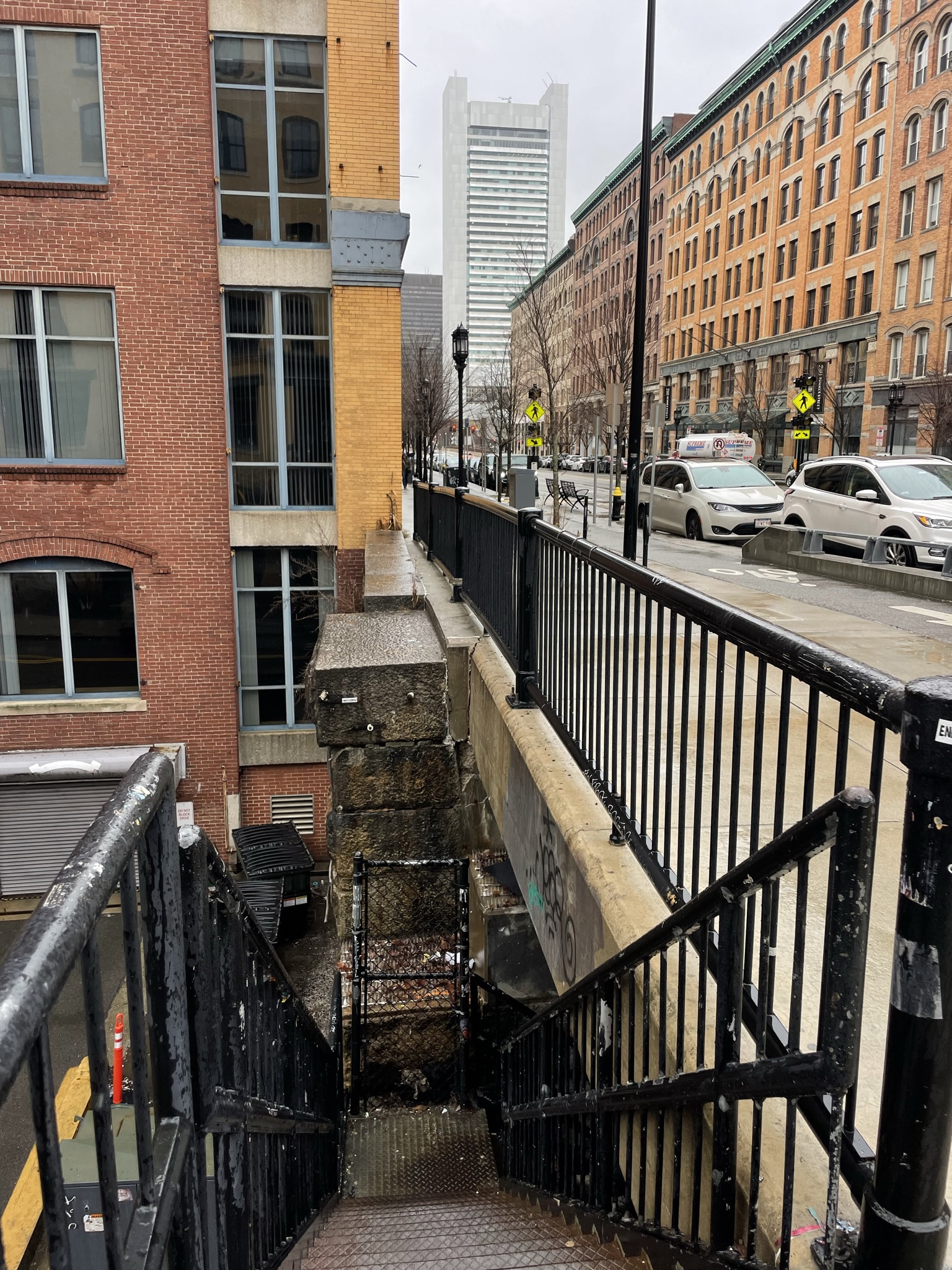
Around the end of November, the Summer Street Steps in Boston’s Seaport District quietly opened for passage. Described as an ‘iconic public gathering place’ by its developer—before much, if any, public gathering has occurred—the new outdoor stairway connects Congress Street and Summer Street, unlocking a corridor between two key arteries notably separated by a 24-foot change in grade. An artifact of the Seaport’s maritime and industrial beginnings, this rift in the grid has posed a challenge to creating a cohesive streetscape in what is today a rapidly evolving area of the city.

Where Congress Street now hums with foot traffic and ground-level activity—there are several restaurants and bars, a hotel, a convenience/liquor store, a Dunkin Donuts, and three family-oriented museums—the elevated stretch of Summer Street west of the Boston Convention & Exhibition Center is by comparison barren, its only retail tenants a salon and a clinic offering botox injections and other cosmetic services. There are few options for descent, involving long walks down D Street or World Trade Center Avenue, or negotiating the somewhat treacherous sets of stairs at the A Street overpass.

What is now an impediment was once a boon for the Boston Wharf Company and the waterfront area it created, owned, and built its signature brick warehousing and manufacturing lofts upon. ‘The pace of loft construction got a particular boost around 1900,’ the Fort Point Channel Landmark District Study Report notes, ‘when the Summer Street Bridge opened and extended Summer Street from downtown to BWCo land.’ The 1899 opening of South Station, which consolidated four separate rail terminals into one grand ‘union station,’ allowed for the removal of a railroad drawbridge that had spanned the channel near Summer Street since 1855, and helped relieve the problem of troublesome ‘grade crossings’ where trains met streets at the same level: 

Even though Congress Street Bridge had been in place for over two decades, Congress Street never became an important route in South Boston. The tracks of the railroad, after 1873 owned by the New York & New England Railroad (NY & NE RR), crossed it at grade; likewise, more tracks crossed A Street at grade, separating Congress Street from BWCo’s bonded yards. Summer Street, intended to give access to the new state piers, avoided this problem by being built above grade; it ran at an elevated level through the BWCo site and continued on a viaduct over the railroad’s tracks and yards east of the BWCo land. Congress Street was then terminated at the train yards. Summer Street provided easy access between BWCo’s site and downtown, and the grade separation made it an important thoroughfare in South Boston.

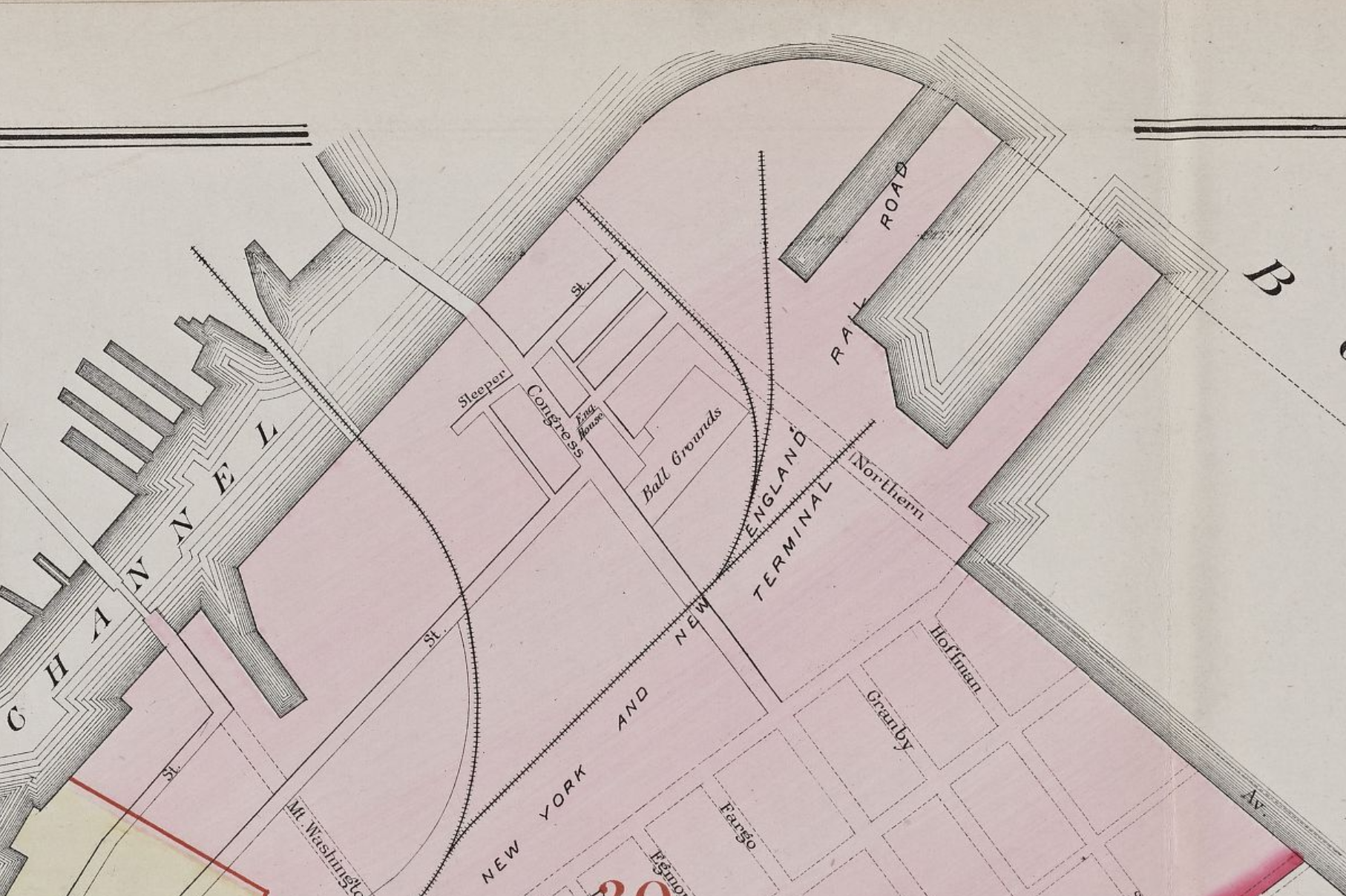
Fort Point in 1891, before the extension of Summer Street across the channel: railroads cross at grade at Congress Street and A Street. (“Atlas of the city of Boston, volume eight, South Boston, Mass.” Map. Philadelphia: G.W. Bromley and Co., 1891. Norman B. Leventhal Map & Education Center, https://collections.leventhalmap.org/search/commonwealth:tt44pv711)
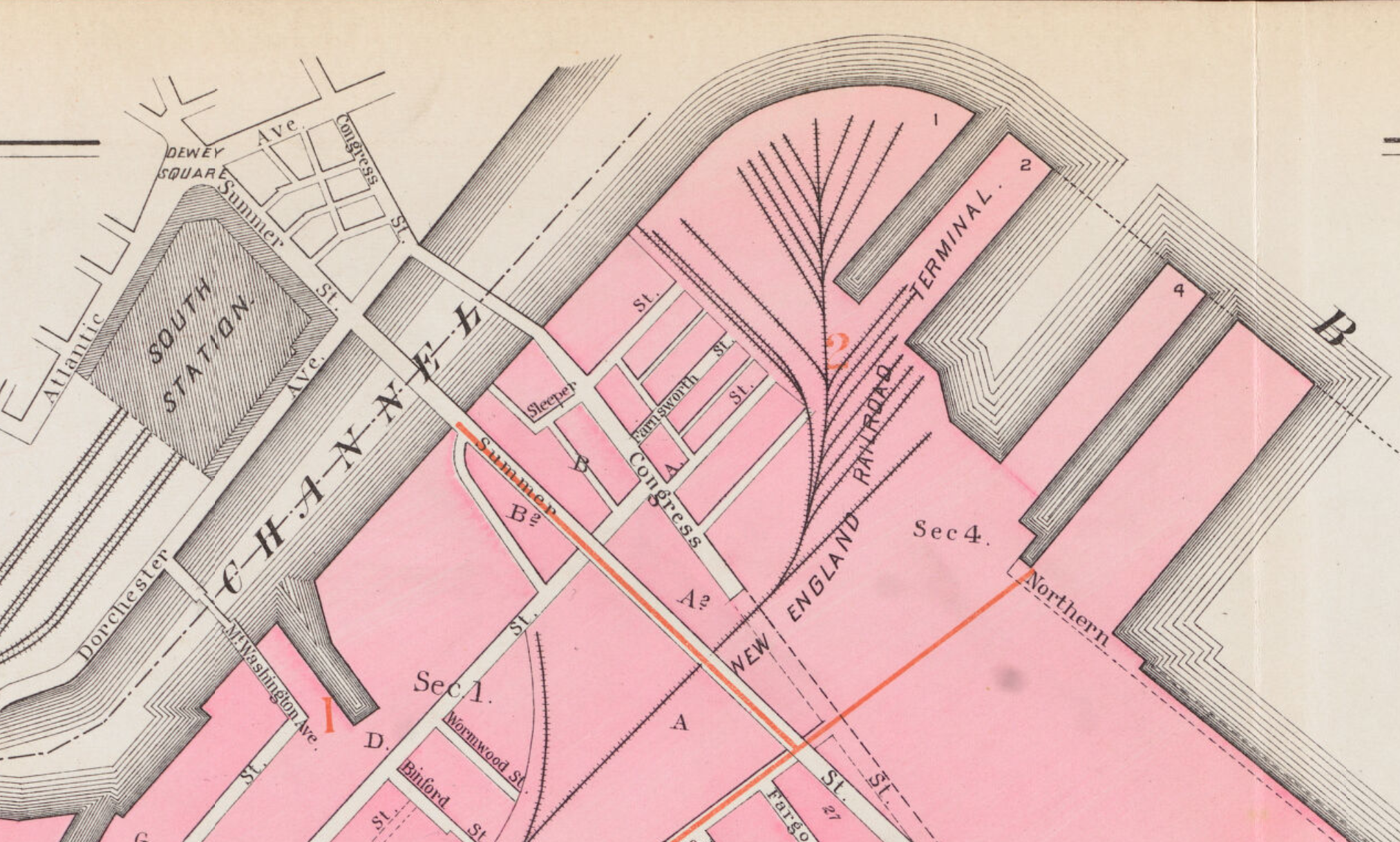
Fort Point in 1899: South Station complete, Congress Street terminated, Summer Street extended through BWCo land at its raised grade. (“Atlas of the city of Boston : South Boston.” Map. Philadelphia: G.W. Bromley & Co., 1899. Norman B. Leventhal Map & Education Center, https://collections.leventhalmap.org/search/commonwealth:tt44pv932)

The Boston waterfront in 1925: Summer Street runs along the left edge. (Fairchild Aerial Surveys, inc. (1925). Boston. South Boston, Commonwealth Pier https://ark.digitalcommonwealth.org/ark:/50959/xp68km56j)

Though much has changed since the days when freight lines threaded through the Seaport, Summer Street remains elevated, and an ‘important thoroughfare’ connecting South Boston to Downtown, such that it has recently become the subject of a contentious debate regarding a city plan to implement ‘a range of transportation improvements throughout the corridor.’ These include a dedicated lane for buses and trucks, and eventually bike infrastructure to extend the near quarter mile of protected lanes completed in Fort Point in 2019. The project website deems Summer Street ‘a critical missing link in existing pedestrian and bike infrastructure in the City,’ and one of the principal objectives is to make it better for walking: ‘An improved pedestrian experience will be had with the addition of transit/bike infrastructure. With improved traffic management along the corridor, pedestrians will be able to have a safer experience.’

So the Summer Street Steps are just one piece of a bigger, high-stakes puzzle. But they are an important piece, and have been touted as such since their developer presented the initial plan and renderings in 2017. How is it going so far? In one sense, it’s too early to say. The construction of the entire site isn’t complete, and the winter months aren’t the best to gauge an outdoor structure’s level of ‘activation’ as a ‘public gathering place.’ There hasn’t been much wider attention, nor a press release, though the Massachusetts NAIOP (‘the Commercial Real Estate Development Association’) did invite guests to explore the Steps as a part of their annual meeting and holiday party. An official ribbon cutting might still be years away.

In another sense, though, the Summer Street Steps are already complete by fulfilling their most basic and important function as a set of stairs: to allow for movement from up to down, or down to up. This is an accomplishment. It should be celebrated. But there is much work yet to be done, and it’s too soon to declare the project a resounding success. The first and so far only review for the Steps on Google, the listing categorized as a ‘park,’ reads:

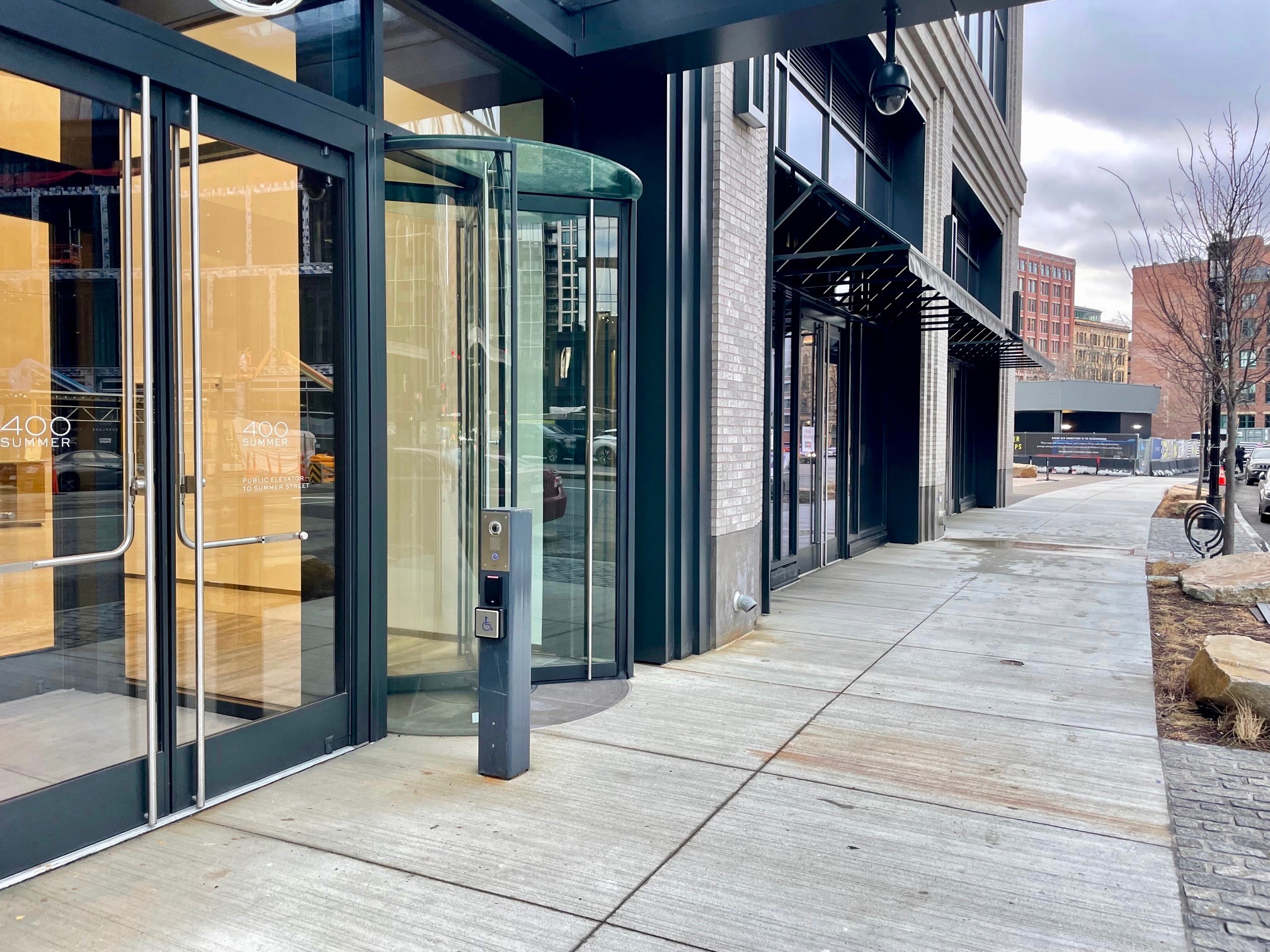
Summer Street Steps are a game changer for commuting from Southie to Seaport! It’s now a straight shot down D Street, down the Summer Street Steps and you’re right in Seaport! The Steps even have a rail to walk your bike down the steps. And, if you have a stroller or need elevator access, you can do so right in the 400 Summer Street building.

Which is all more or less true, but if it reads like marketing copy, that’s because it is—a quick search shows the effusive reviewer is an employee of WS Development, the master developer overseeing the project. 

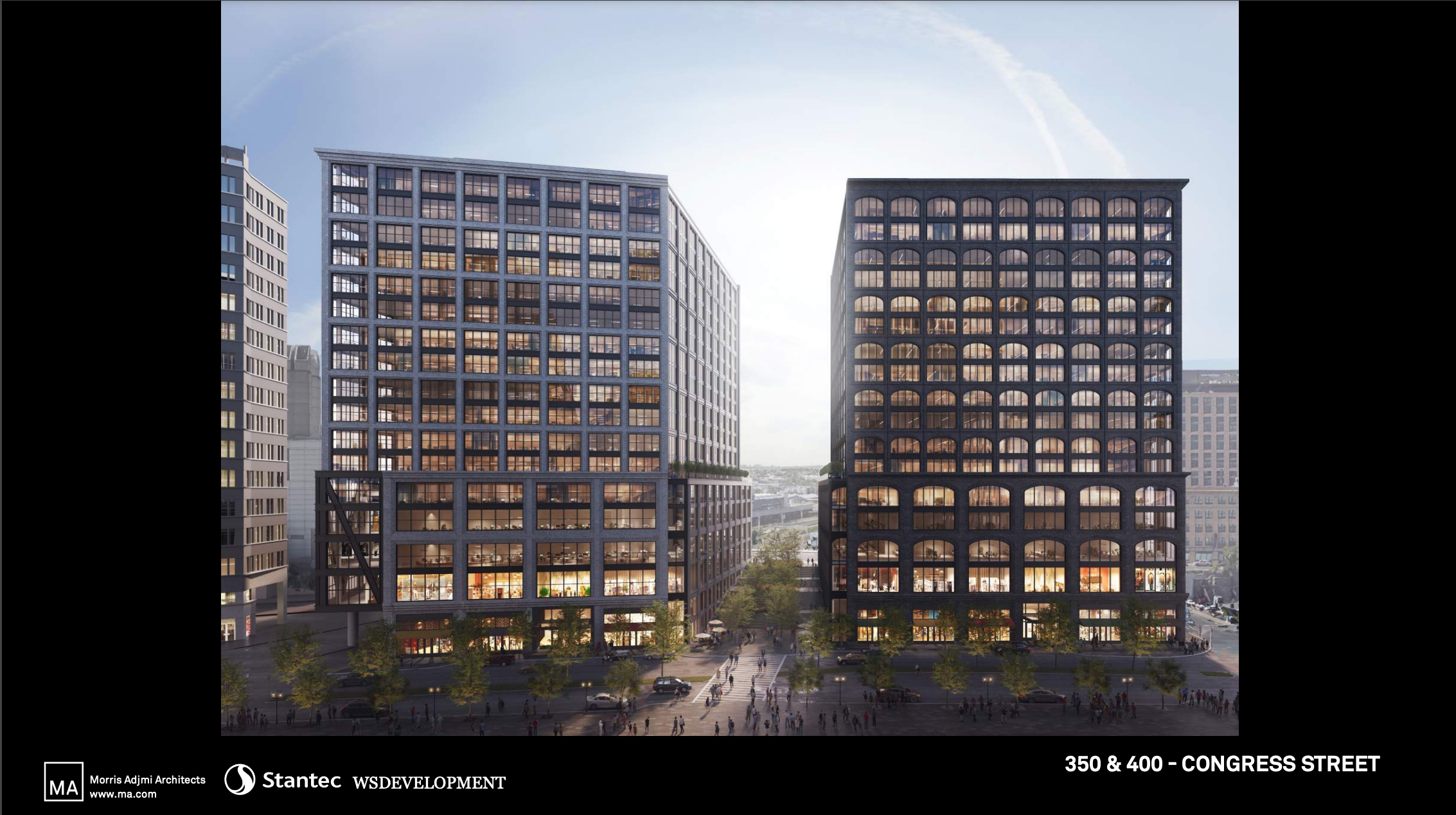
Rendering of WS Development’s 350 & 400 Summer Street project, on Seaport Square Parcels N and P; the Summer Street Steps ultimately will ‘cut’ between the two buildings. (Presentation to BPDA, November 2019 https://www.bostonplans.org/projects/development-projects/seaport-square-block-n)

WS’s involvement in the Seaport dates back to early 2007, when it signed on as the retail partner for John B. Hynes, III and Morgan Stanley’s proposed Seaport Square development, a massive, multibillion dollar buildout of 23 acres of land at the time occupied mainly by parking lots. The provenance of the Seaport Square tract is itself a colorful, twisting saga of bankruptcies, litigation, big names, and big deals, something of a microcosm of America’s long transition to its post-industrial present, and well worth an abridged review.

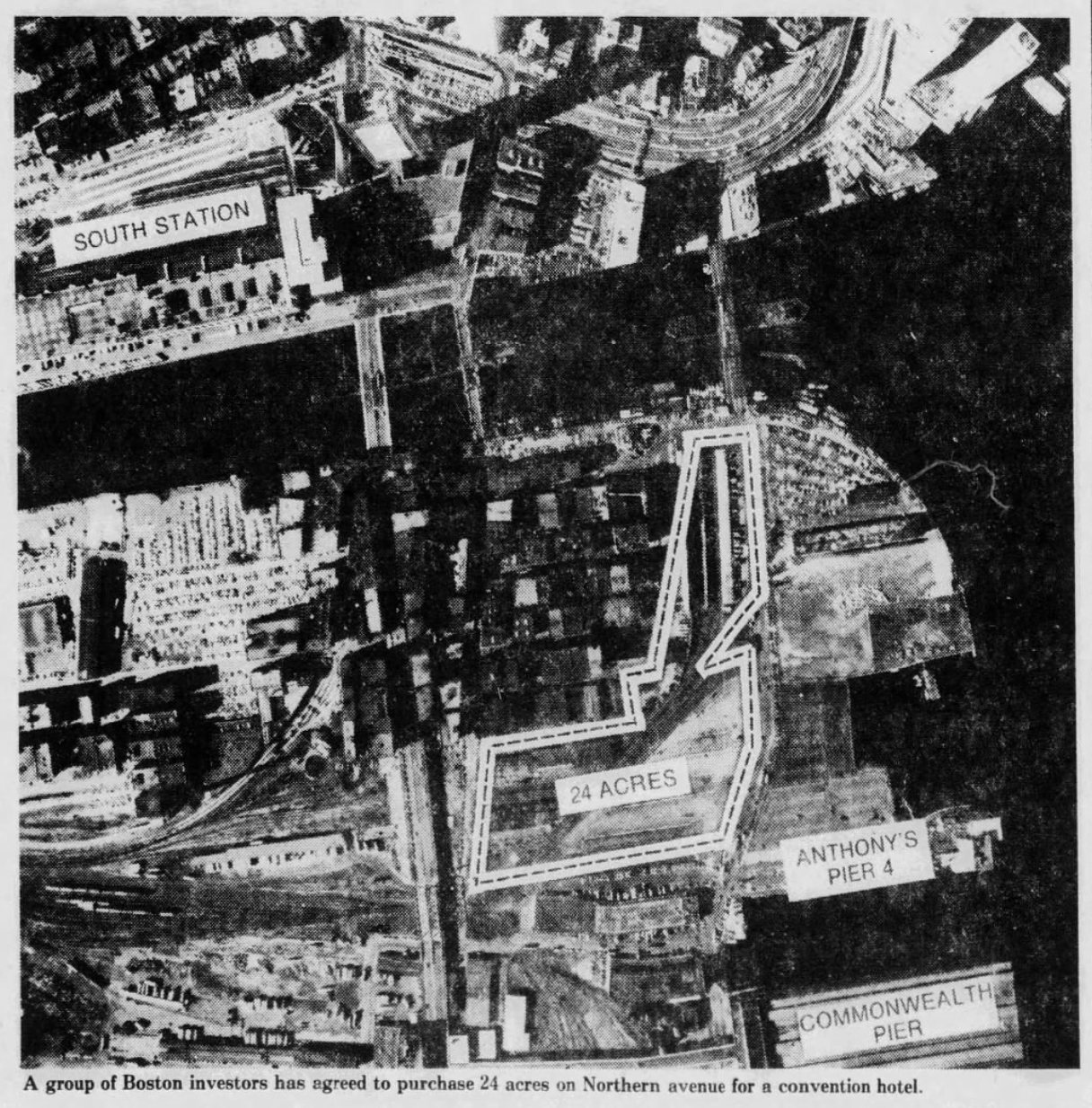
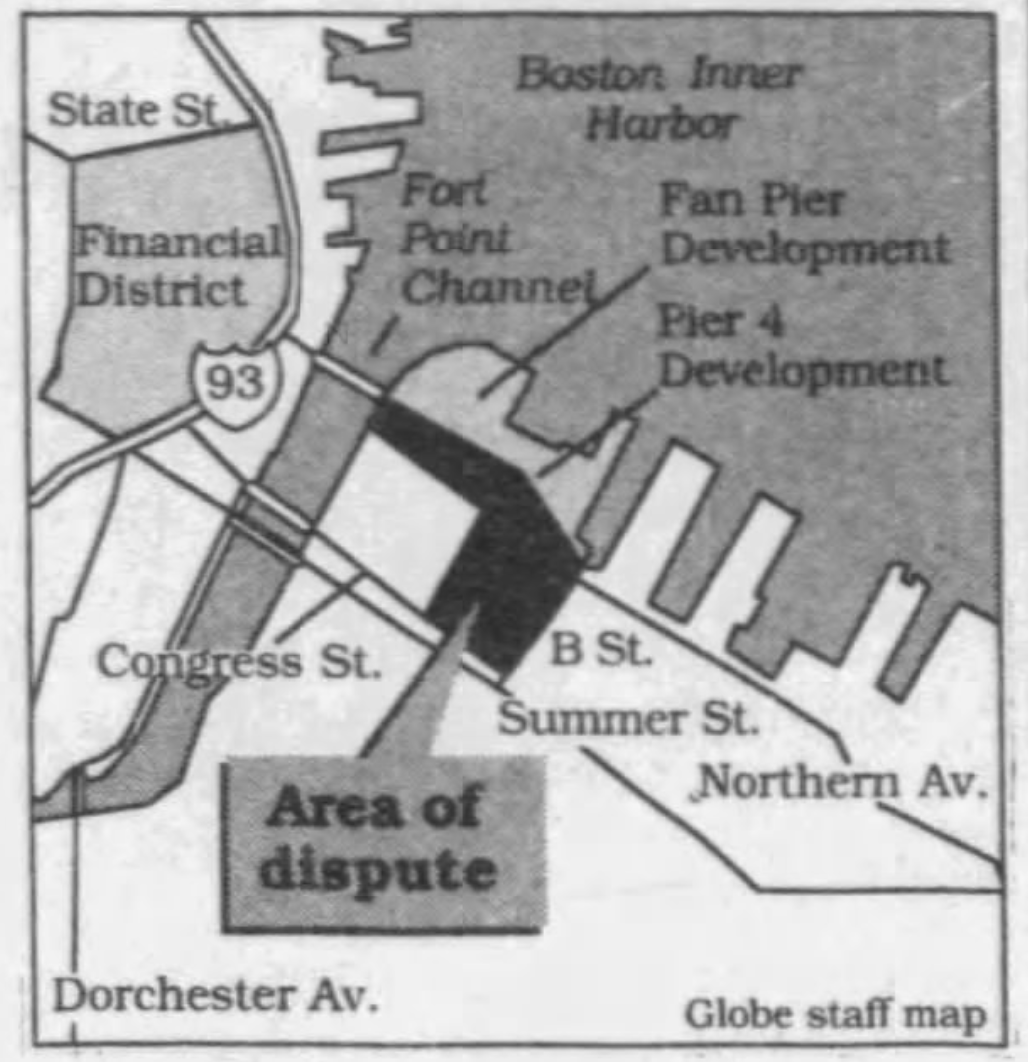
J.P. Morgan’s monopoly New York, New Haven & Hartford Railroad—’the New Haven’—for decades owned the freight yards terminating at Fan Pier and much of the surrounding land, and went bankrupt during the Great Depression in 1935. The company reorganized, failed again, and in 1968 was merged into the newly created Penn Central, which folded after barely two years, then the largest bankruptcy in U.S. history. Penn Central began selling off its vast real estate holdings in Massachusetts, and in 1978 a group of developers including the upstart Frank McCourt Jr. agreed to acquire the L-shaped parcel adjacent to Fan Pier for $3.5 million. They couldn’t come up with the money, and ended up selling the option on the property to the blueblood firm Cabot, Cabot & Forbes, which completed the purchase. The dogged McCourt, though, had retained an option to buy the land from CC&F, and attempted to exercise it at the last minute; they didn’t want to sell, and a lengthy legal battle between the two parties followed. A front-page Globe headline read, ‘Rivals vie to pluck a real estate plum.’

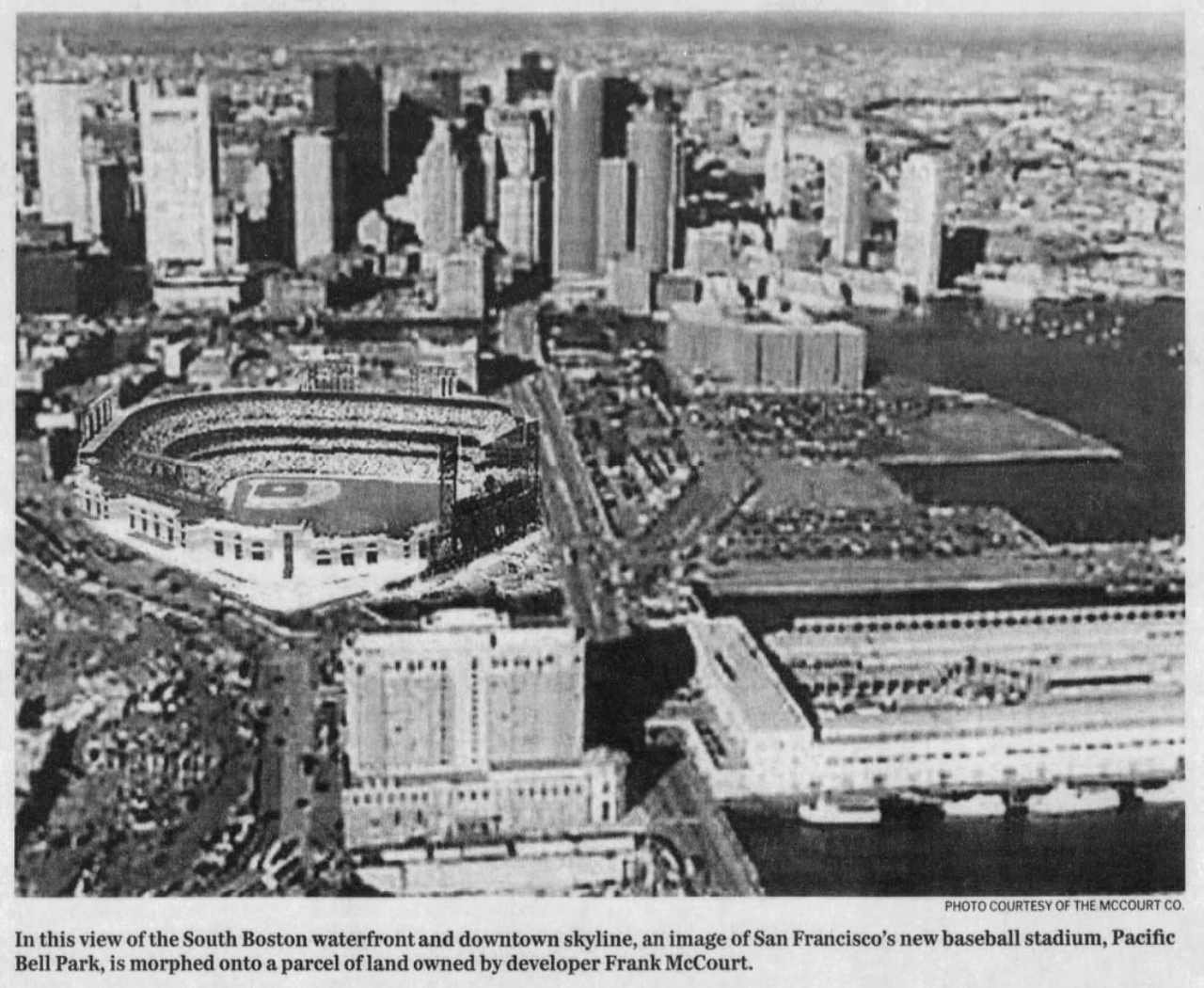
In 1987, a Massachusetts Supreme Judicial Court judge ruled in McCourt’s favor, and he successfully acquired the land for $8.5 million. Over the years McCourt would present various grand development schemes to city authorities and the public, including the construction of a new waterfront stadium as part of a bid to buy the Red Sox, but none came to fruition. Economic difficulties and a strained relationship with Mayor Thomas Menino ultimately led McCourt to look westward instead, and in 2003 he leveraged his prized parcel as collateral to finance a purchase of the Los Angeles Dodgers from Rupert Murdoch’s News Corp.

Boston Globe, December 7, 2001

When the $145 million loan came due a few years later, McCourt turned over the Seaport land to News Corp, which quickly flipped it to John Hynes and Morgan Stanley for $204 million. The deals would keep flowing as the 23-acre spread was carved up: a few plots sold to Swedish construction giant Skanska here, a couple others to Pasadena private equity firm Cottonwood Management there. WS Development acquired the remaining 12.5 acres from Hynes’s Boston Global Investors and Morgan Stanley for $359 million in 2015. A Boston Business Journal analysis found the total purchase price across all the land sales since from 2011 to 2015 had reached $665 million.

When WS Development first entered the Seaport in 2007, it was still mainly known for building suburban shopping plazas. A 1995 Globe article described it as a ‘real estate firm that often acquires sites for Wal-Mart.’ Its profile rose with the 2009 opening of Legacy Place in Dedham, which became an instant success by putting forward a new vision of outdoor-oriented, ‘lifestyle center’ retail, contra to the prevailing style of enclosed, big-box-anchored malls like those in Burlington and Natick. As ‘a new type of mixed-use retail district and an embodiment of New Urbanism,’ the design firm Prellwitz Chilinski says, ‘Legacy Place captures the appeal of a town-like pedestrian experience, offering a lively, people-friendly streetscape with landscaping and exterior cafés suggesting a neighborhood that grew over time.’

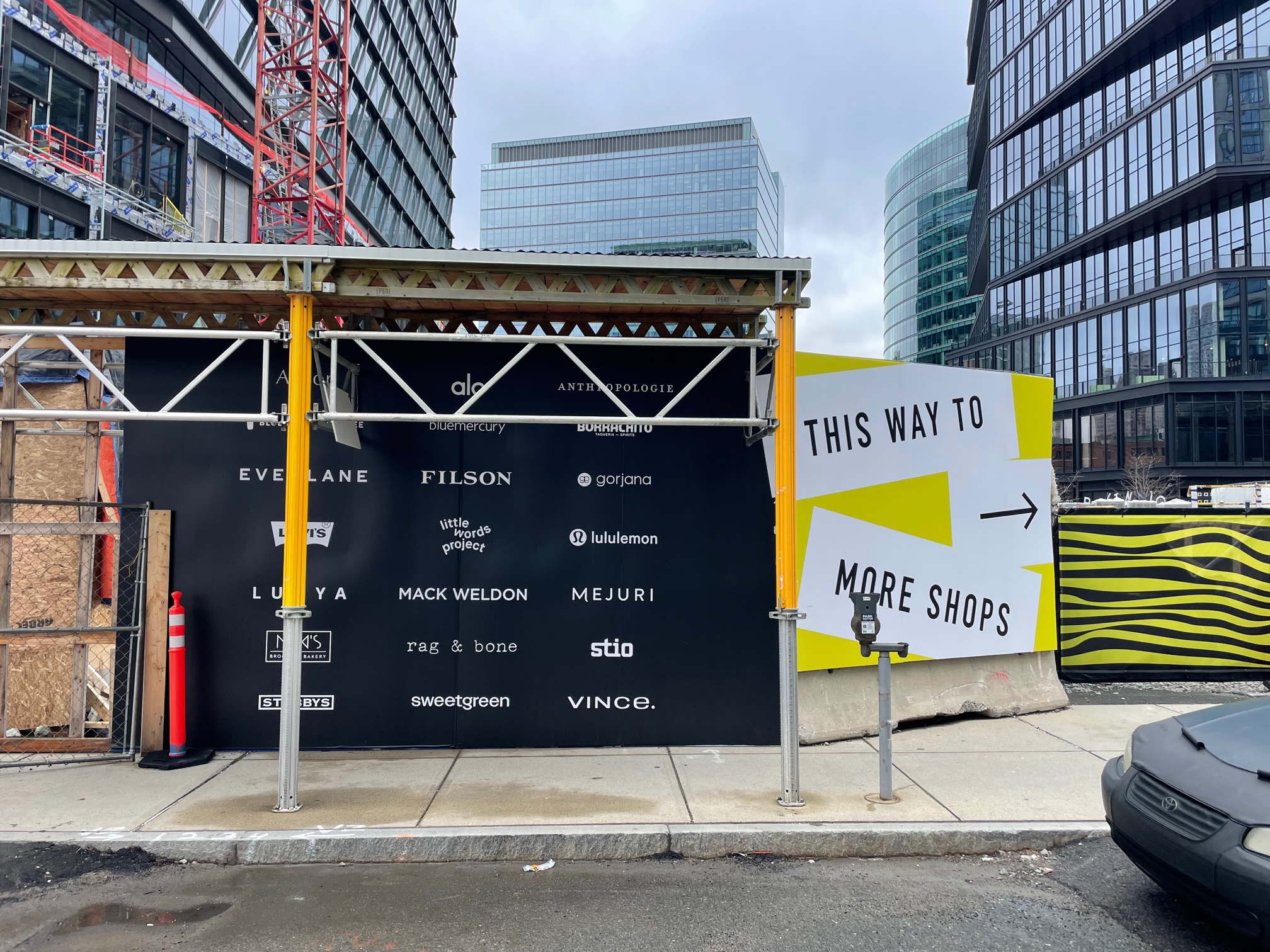
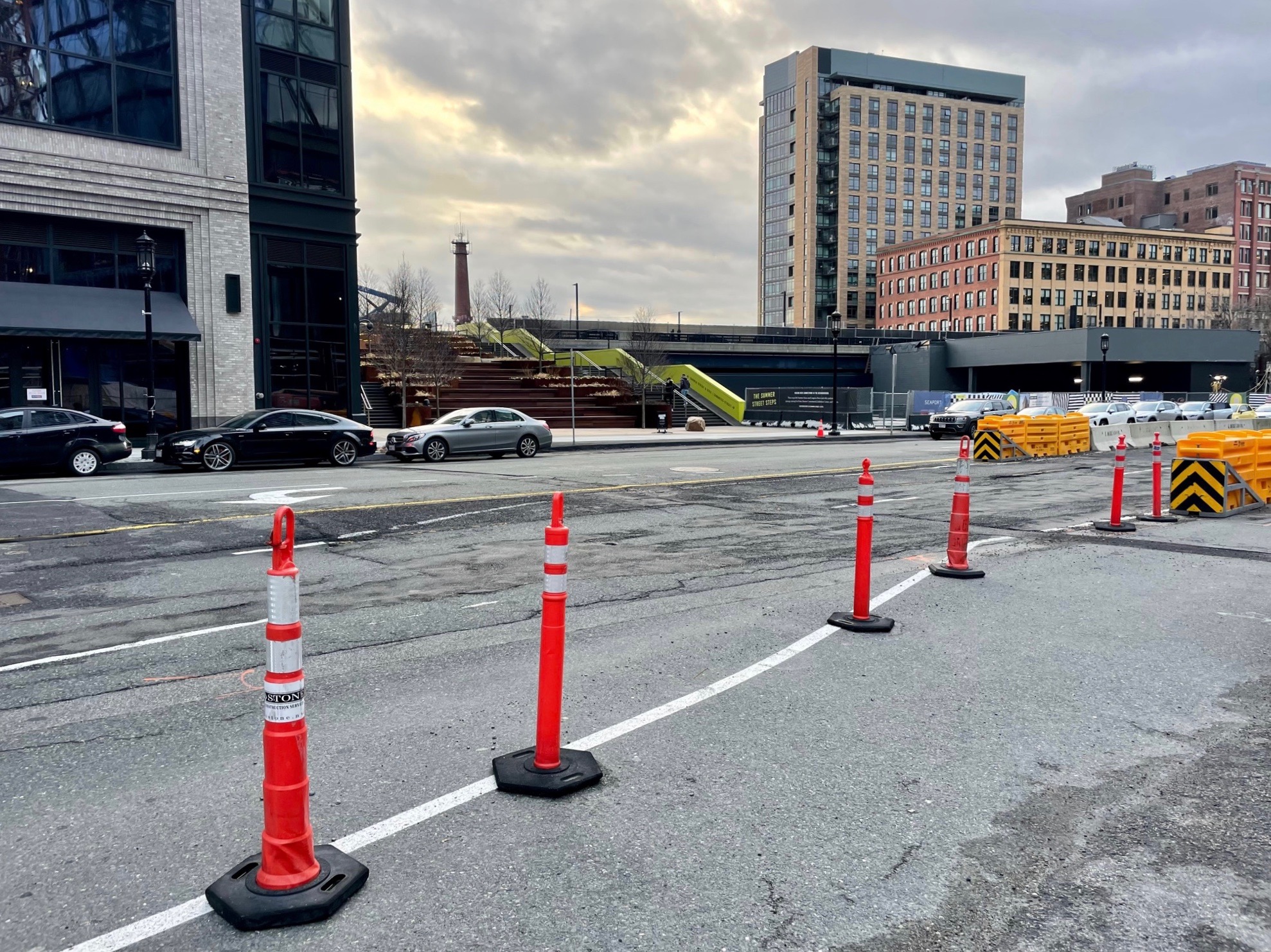
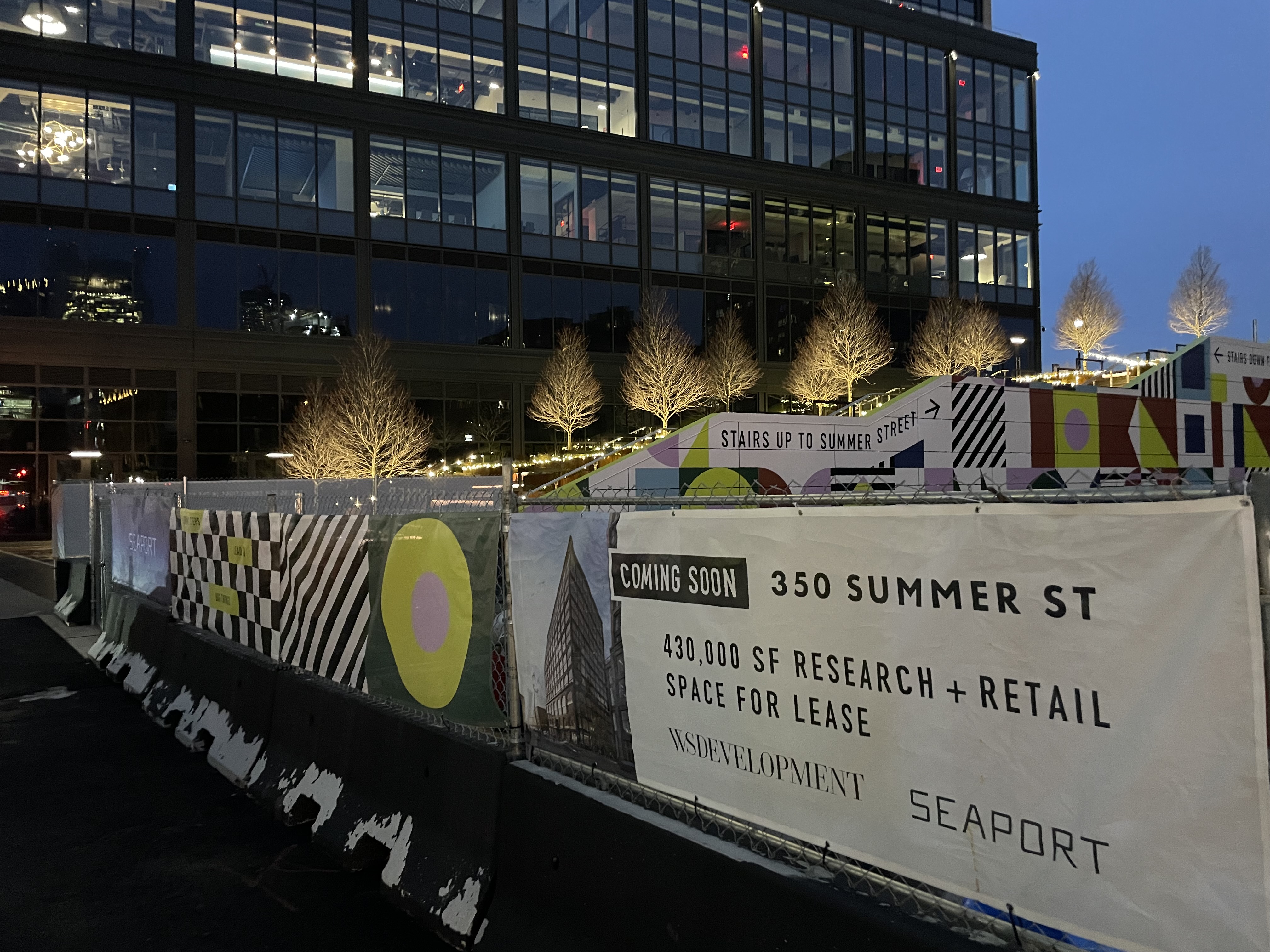
This more thoughtful ‘approach to placemaking’ can be commended, but there are only so many ways to innovate fundamentally retail-oriented spaces. If the new Seaport can often feel like a high-end, harborside mall, well, it’s in the developer’s DNA. Inducements to shopping are highly visible throughout WS’s properties. See, for example, the banner on a temporary construction wall across from the bottom of the Summer Street Steps, as work on the connecting ‘Harbor Way’ path continues: ‘This way to more shops,’ it beckons, beside a busy grid of brand logos.

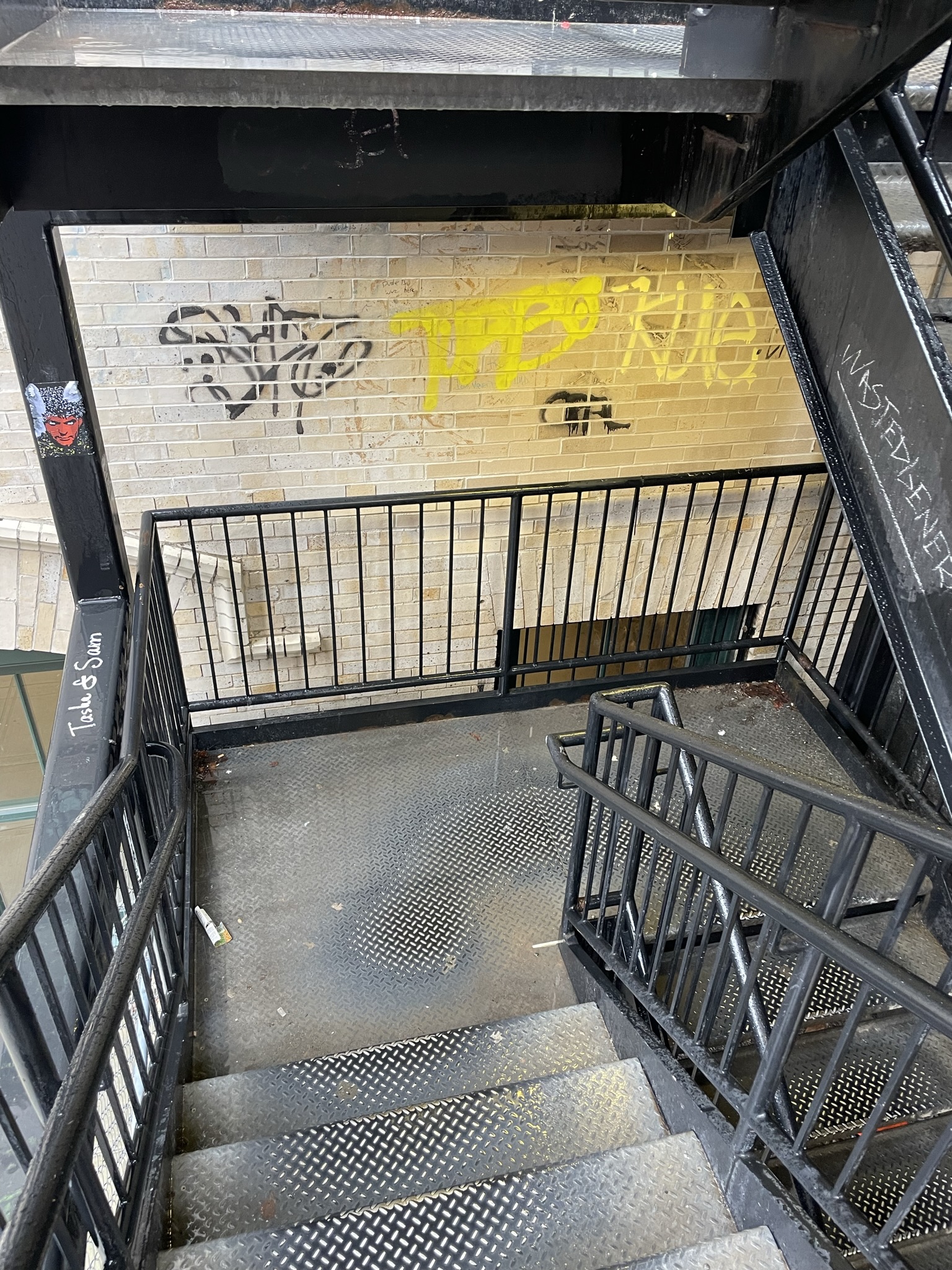
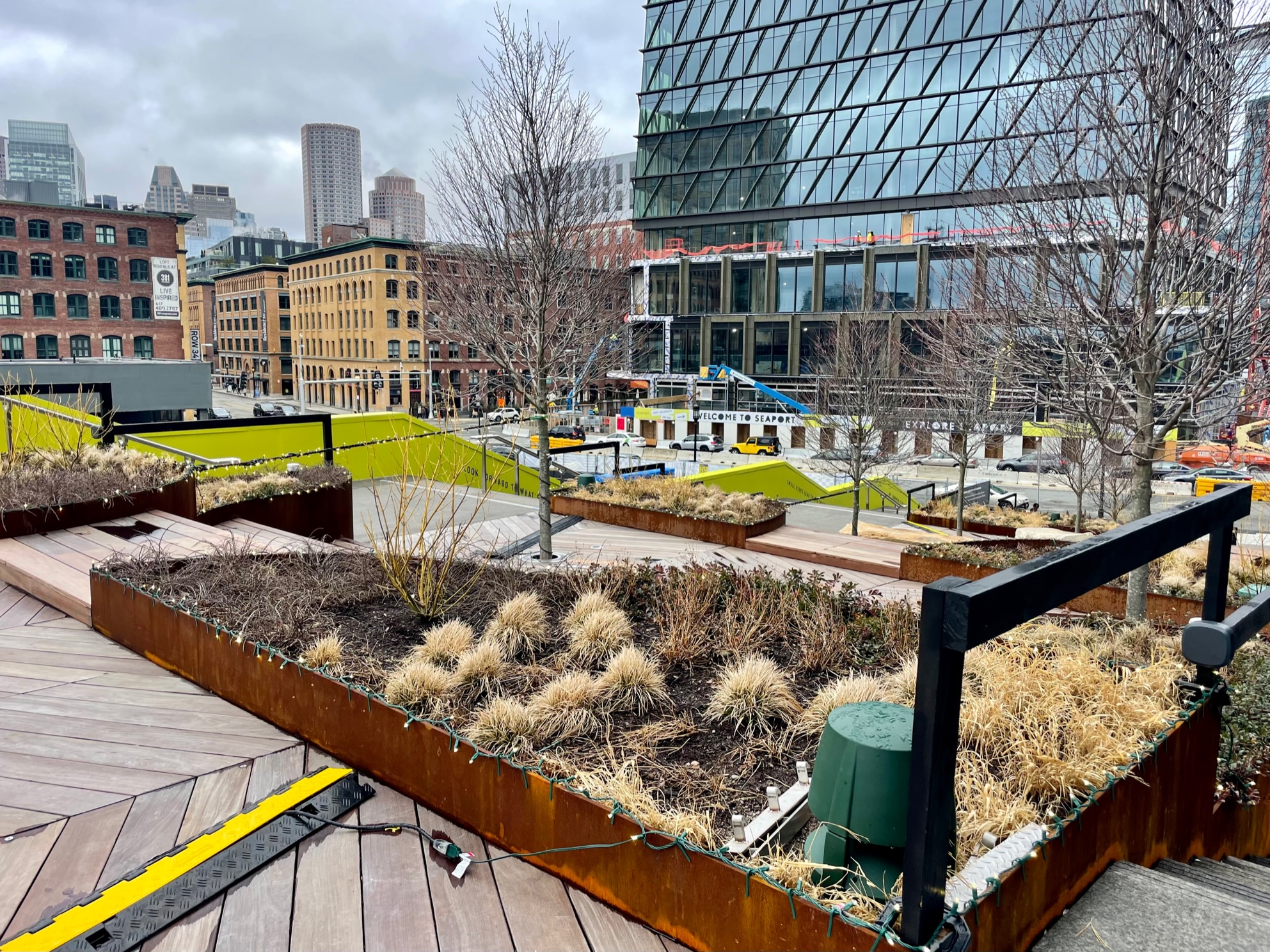
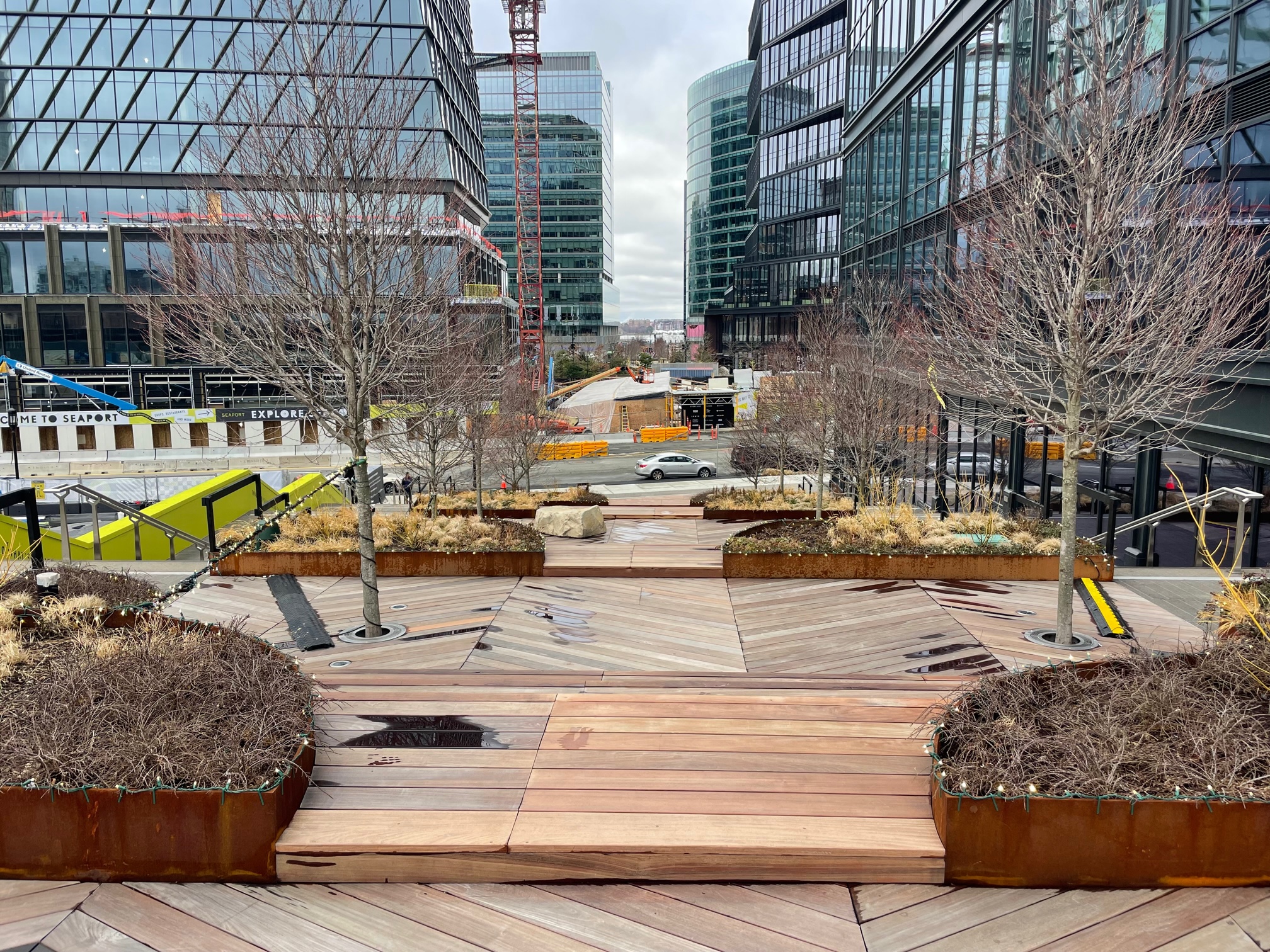
The single strangest feature of the Steps likewise seems to be borrowed from the retail playbook. There are five large, green JBL speakers deployed in a zigzag down the tiered landings, playing a Spotify Today’s Top Hits-type selection of songs at moderate volume apparently around the clock. From the entrance to ‘Harbor Way’ at Autumn Lane through where it currently lets out at Pier 4 Boulevard, there is also a constant stream of pop music. This is fine, maybe even pleasant if you happen to catch a favorite tune, but it doesn’t help dispel the sensation of walking through a shopping center.

What about the rest of the Steps? There are nice design touches: the central wooden boardwalk, and the emphasis on the raised planters and trees, which when lush and blooming will make the location an attractive oasis in a neighborhood sorely lacking green space. Lights at night add warmth to an eerie and canyon-like area bracketed by construction sites. There is a tiny, almost unnoticeable dab of a harbor view from the top of the stairs, but it may be seasonally obscured when the project is complete and the leaves of the Harbor Way trees come in.

The more interesting view is actually looking west, down Congress Street, the Wharf Co. lofts in the foreground and International Place looming behind, but this is only temporary. The Steps opened along with the adjacent 350 Summer Street office tower, home to Roche-owned ‘molecular insights company’ Foundation Medicine, and its companion building 400 Summer Street is due to rise on the other side. Construction hasn’t yet begun, and this past October WS asked for an extension on its permit from the Boston Conservation Commission, claiming that ‘global economic conditions and the office and laboratory leasing market have changed dramatically, impacting [their] ability to finance and lease’ the tower. In January the Wall Street Journal reported that office space vacancy in major U.S. cities had hit 19.7%, the highest figure since the data began being tracked in 1979, and a follow-up story warned that ‘even premier towers are starting to wobble.’

350 Summer’s prime location alone, with Amazon moving in across the street and a number of blue-chip biotech, consulting, and law firms nearby, should ensure WS will find a tenant eventually. But there is a certain irony to the plea for more time. The block was initially permitted for 350,000 square feet of residential space, until WS filed in 2019 to change the building use to ‘office and/or research and development.’

Basic features of the Summer Street Steps have also changed, or are yet to materialize. As the Fort Pointer has documented over the past several years, the initial renderings of the Steps in 2017 presented a rather grander picture. Sure, the project isn’t finished, it’s the middle of winter, and plans evolve. Still, the site simply looked far more spacious and impressive in the original images than it is in reality.

February 2017 rendering of the Summer Street Steps. (https://www.bostonplans.org/getattachment/8005ea79-e8dd-40d8-82b8-ada0d7daa442)

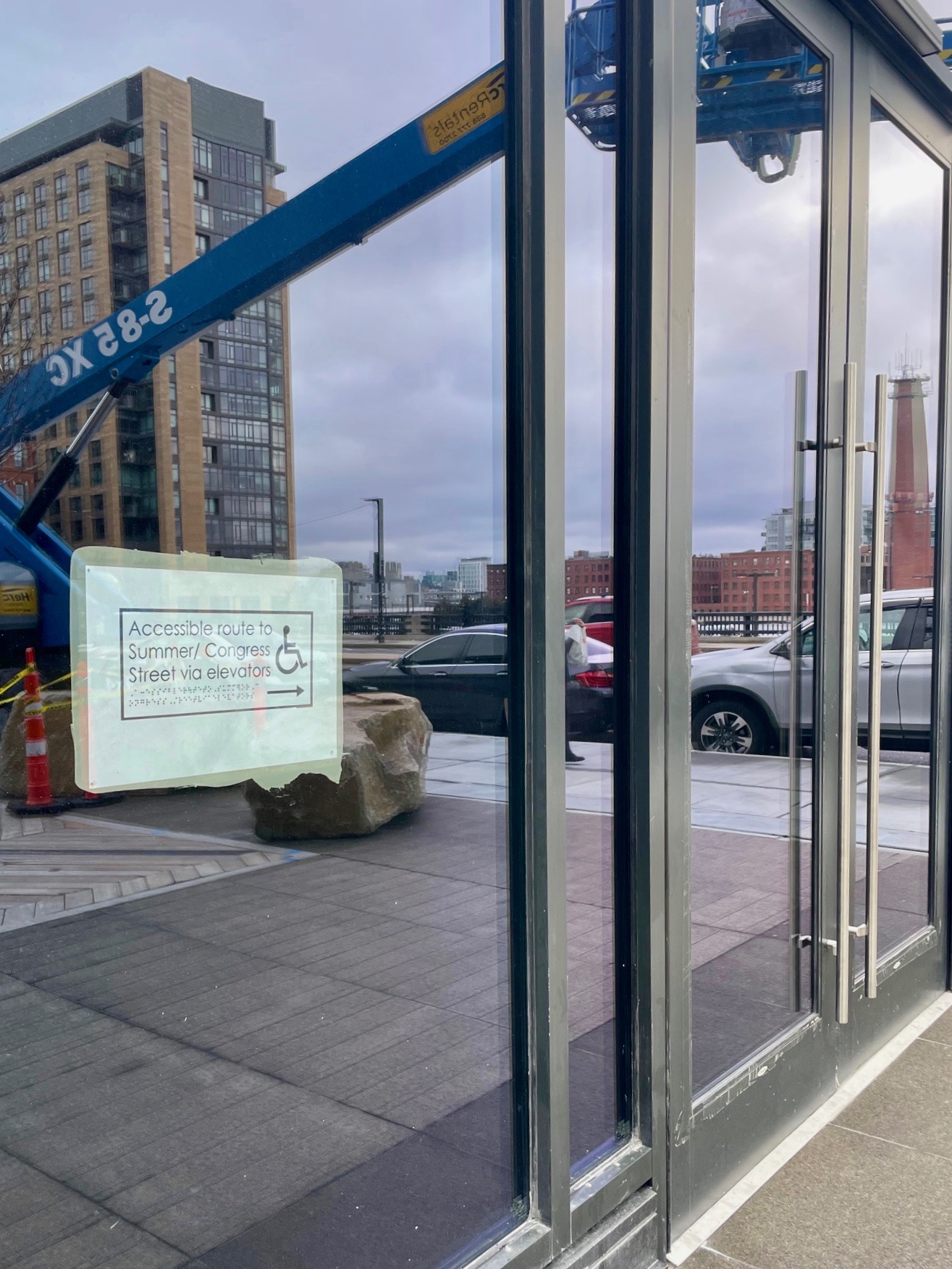
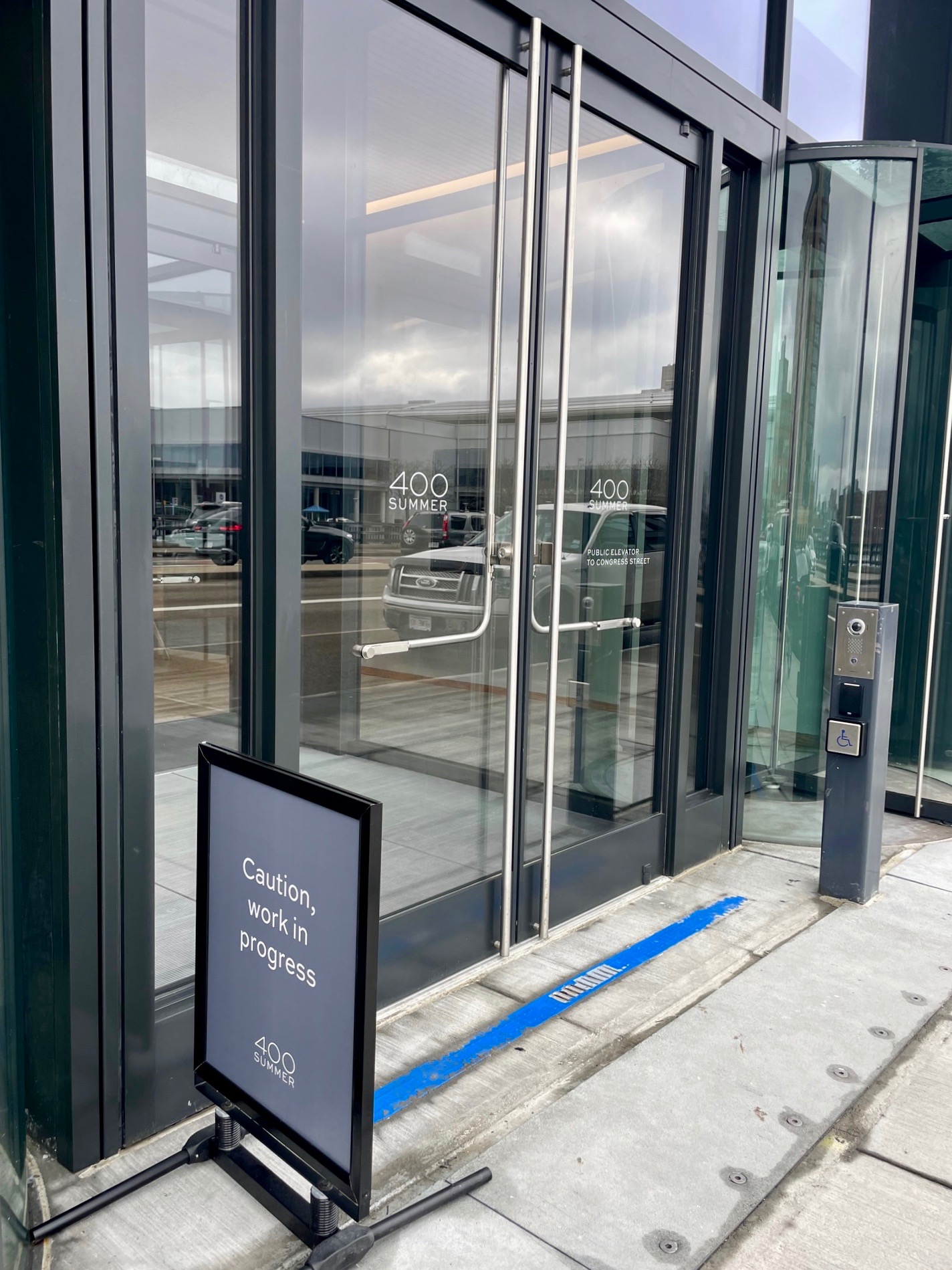
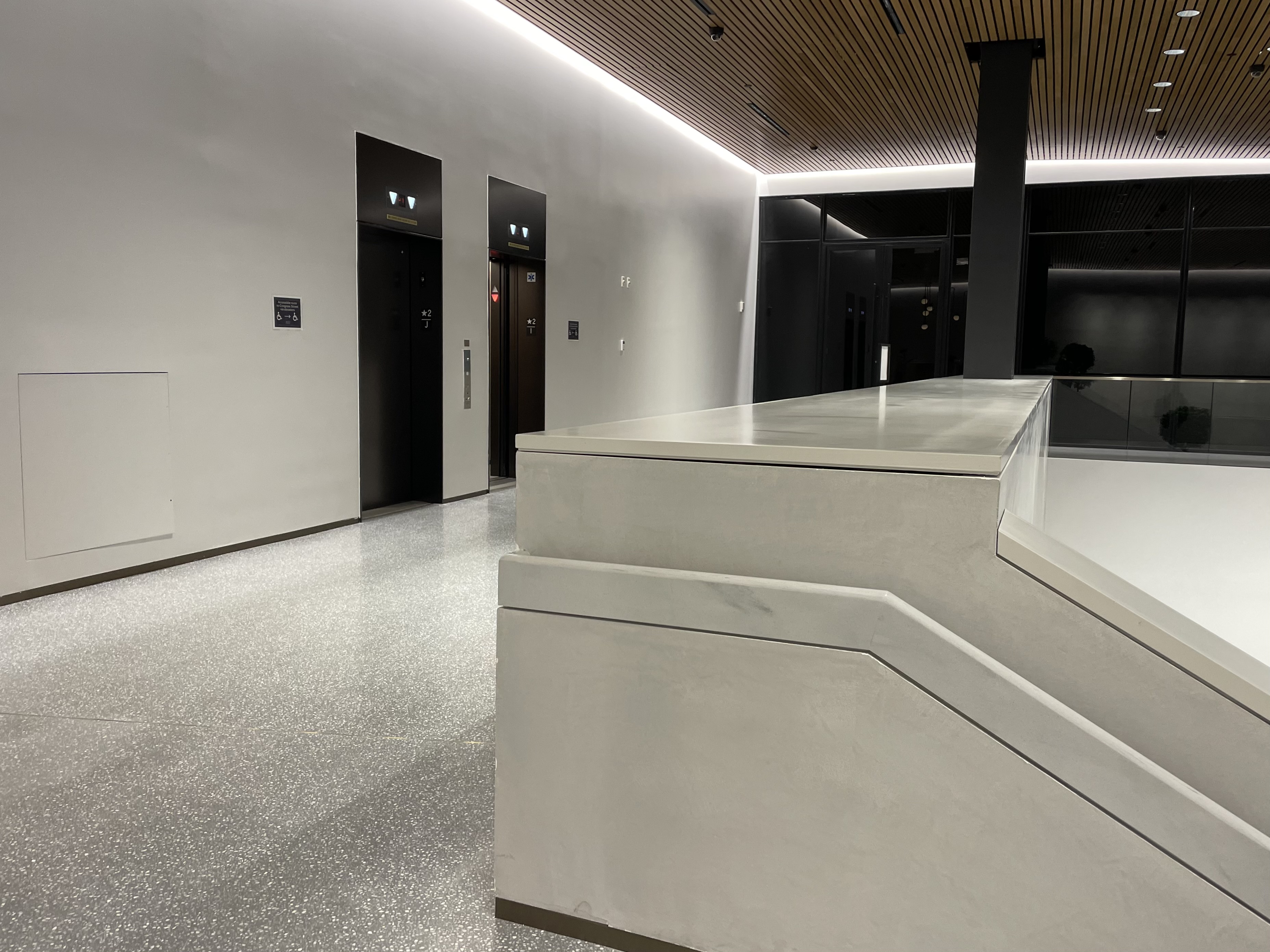
For such a large, blank canvas, accessibility hasn’t been granted the utmost consideration. In a 2017 comment letter, the waterfront advocacy group Boston Harbor Now strongly encouraged taking a holistic approach to mobility at the location, ‘incorporating a combined ramp and stairs design’ to ‘promote an equal experience for all users.’ Instead, the Boston Planning & Development Agency settled for a commitment from the developer to ‘install a public elevator in close proximity to the Summer Steps and outside of the building’s structural core.’ Currently the elevator route is not immediately adjacent, nor prominently called out, and on either level involves walking three doors down into and through the lobby of Foundation’s office. WS’s Notice of Project Change document submitted to the BPDA in February 2017 said, ‘The experience and design quality of this route will be similar to that of the Summer Street Steps and it is intended that the public would not need to enter into traditionally privatized space such as a residential or office building lobby in order to access this critical accessibility pathway.’

That is a particularly flagrant dereliction; other aesthetic criticisms may seem like trivial sideline quibbling. Building anything in Boston, let alone two thoughtfully designed and historically-informed towers bearing public benefits, is hard enough. The obstacles are numerous. Large sums must be raised, bureaucracy navigated, abutting interests placated, tenants signed. But surely we can do better than ‘take what you can get.’ Billions of dollars of public money—the harbor cleanup, Big Dig, Silver Line, courthouse, convention center—went into making the Seaport a viable arena for private development. Powerful companies and illustrious families fought for decades to build on the waterfront, because everyone knew such an unparalleled opportunity would likely never come around again. The moment demanded more than Class A+ office space and nice stores.

The Summer Street Steps at least are not solely that. They serve a valuable purpose, and years from now could even be fondly seen as the ‘iconic public gathering place’ that has been promised. Stairways are potent symbolic structures, and in the best cases can define and elevate a space to sublime heights. In the original 2017 project plan, WS described their work as being ‘modeled conceptually on the Spanish Steps in Rome and other monumental stairs around the world.’ If only the execution were as ambitious as the vision: the Summer Street Steps are fine, but a Baroque masterpiece they are not.

Making the Grade? The Summer Street Steps, So Far

The Curious Case of Thomson Place

Why the City of Boston can’t fill a deep pothole in the middle of a busy commercial strip

We seldom think of streets as private spaces. The word itself connotes openness, freedom, the opportunity and danger of the public realm, and has for many centuries: the OED notes the Old English stræte could mean ‘the public square or forum of a town or city,’ and modern usage still closely links all manner of commerce, politics, and culture to the street. Main Street, Wall Street, streetwalker, street fight, street food, streetwear, street cred. ‘To take to the streets’ is ‘to assemble in a public place in order to engage in a political revolt or protest.’

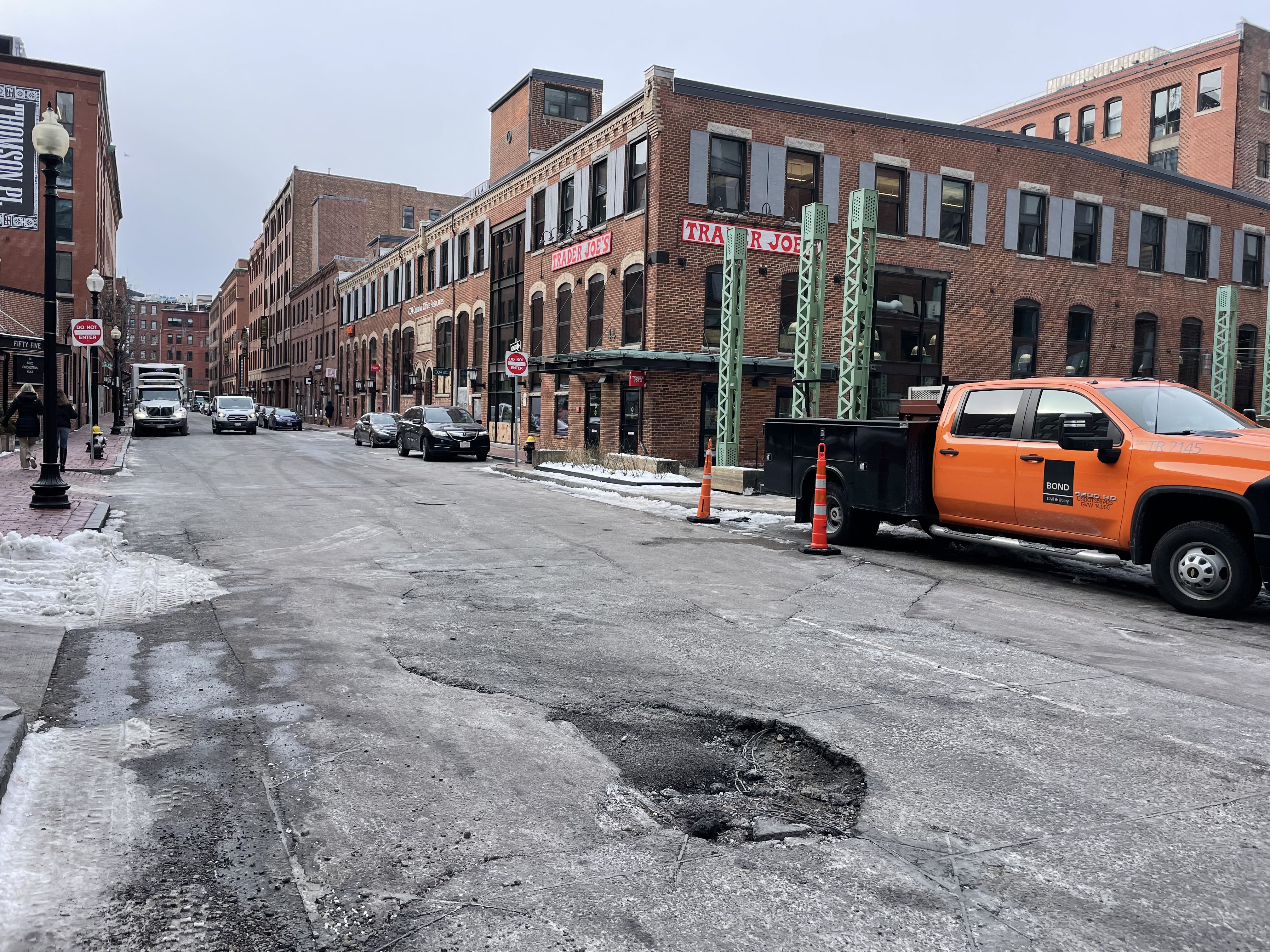
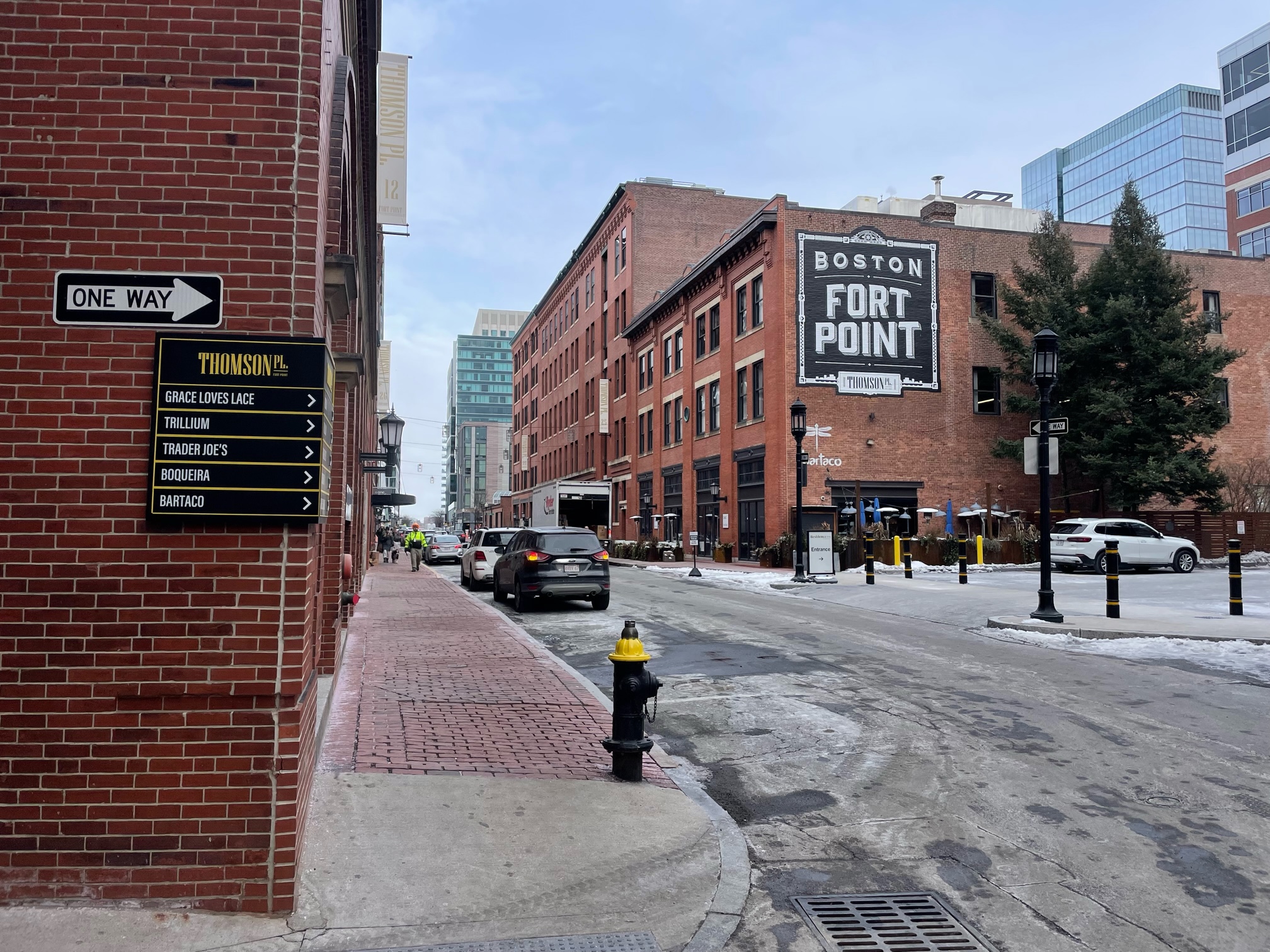
Thomson Place in the Fort Point neighborhood of Boston is a street by any definition, and indeed has become something of the main drag of the surrounding area, home to the Trillium brewery, Trader Joe’s grocery store, four restaurants and counting, a medical clinic, and several corporate offices. There is a Marriott hotel at one end, and a Shake Shack and Silver Line transit station at the other. Its calm, one-way traffic is a refreshing respite from the rushing clamor of both Seaport Boulevard and Congress Street, and its historic, human-scaled architecture stands in stark contrast to the hulking new towers of the master-planned Seaport Square project nearby. But Thomson Place is technically not a public space. It is a ‘private way,’ not owned by the city of Boston, but by Invesco Real Estate and Newton-based Crosspoint Associates.

How did a global investment management company and regional real estate firm come to own this old street and the early 20th-century warehouse buildings lining it? It’s a bit difficult for the layman flâneur to untangle, such are the convoluted workings of urban development and the decaying state of the public internet and search engines, but we can start with the invaluable Fort Point Channel Landmark District
Study Report
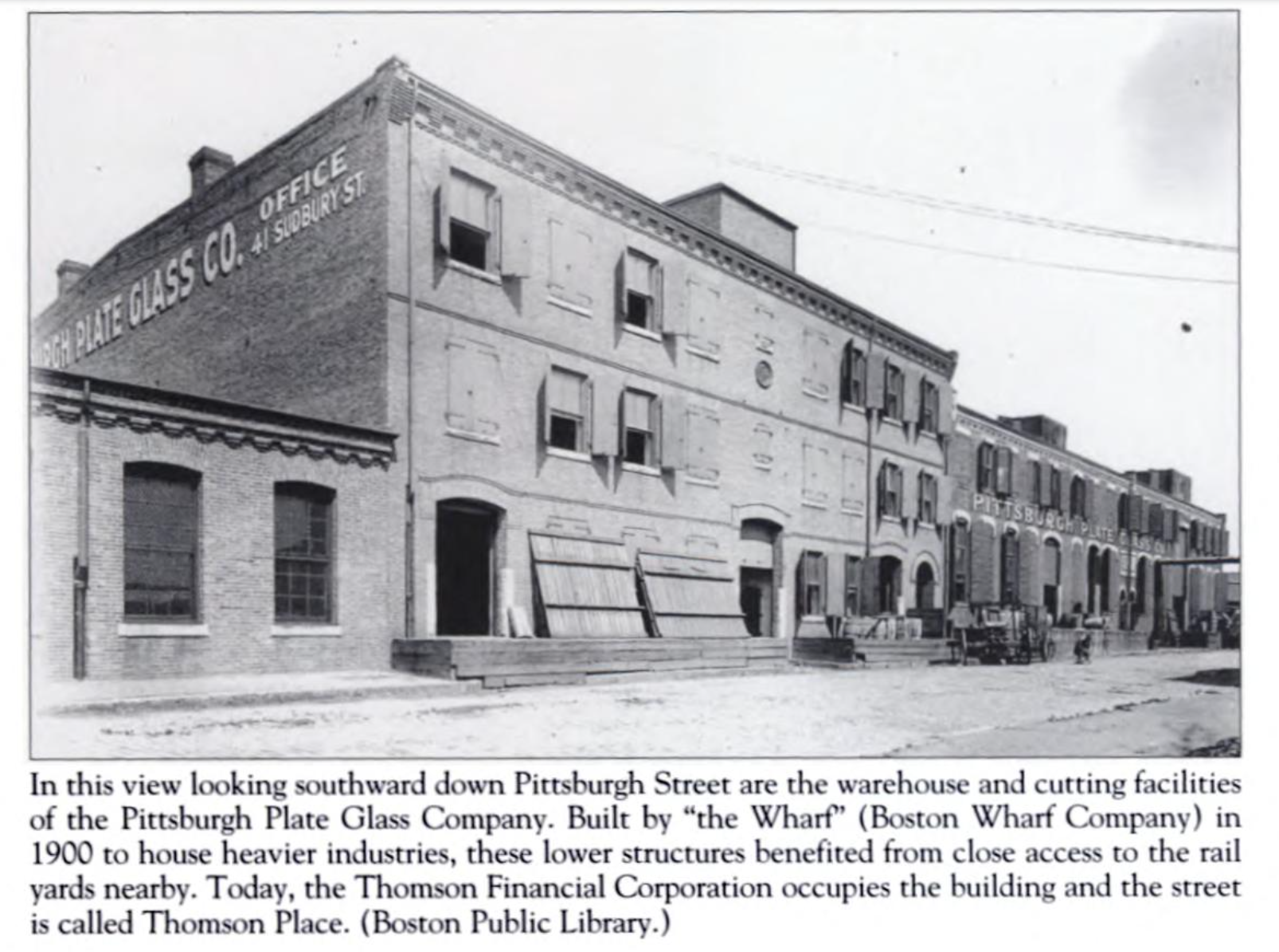
. The story goes something like this: the Boston Wharf Company, which built more or less the entire Fort Point district from scratch starting in the mid-nineteenth century, laid out the A Street Extension in 1896, which was later named Pittsburgh Street for the Pittsburgh Plate Glass Company that occupied a cluster of buildings at the northern end of the street, including the striking, low-slung warehouse that now hosts Trader Joe’s.

From Images of America: Boston’s Fort Point District, Michael J. Tyrrell (Arcadia Publishing, 2004)

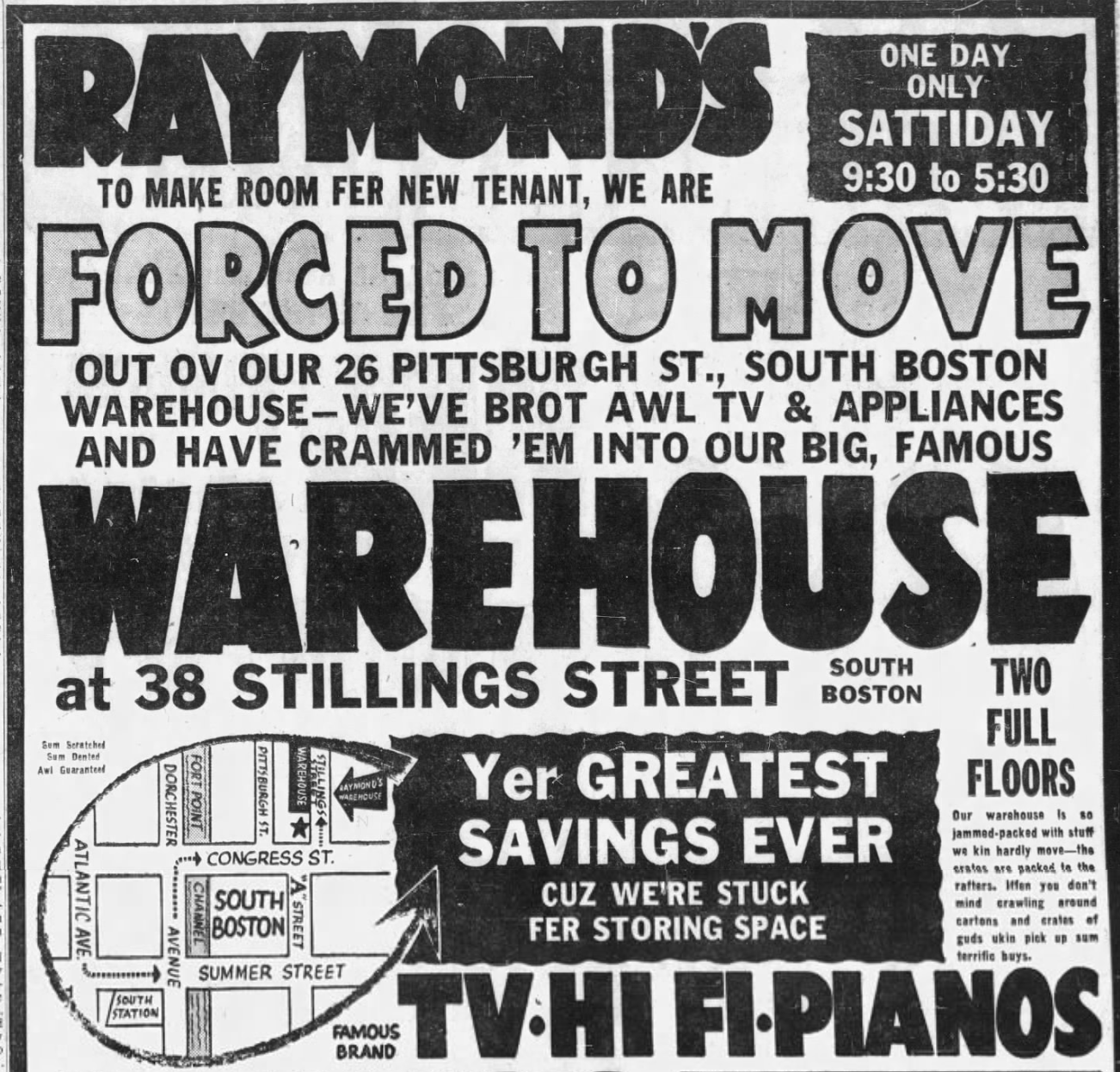
From there it gets hazier, requiring a deep dive into the Globe archives for clues as to what was going on during the ‘dark’ decades between Fort Point’s industrial heyday and its ongoing revitalization from roughly the 1980s onward. In 1954 there’s a record of the Central Wool Warehouse Corporation occupying the building at 26 Pittsburgh Street, which then served briefly as some kind of home appliance clearing house for the once-prominent department store Raymond’s, a more downmarket competitor to Filene’s and Jordan Marsh. Its advertising copy employed an eccentric, ‘swamp Yankee’ vernacular full of creative misspellings:

Boston Globe advertisement, May 31, 1957

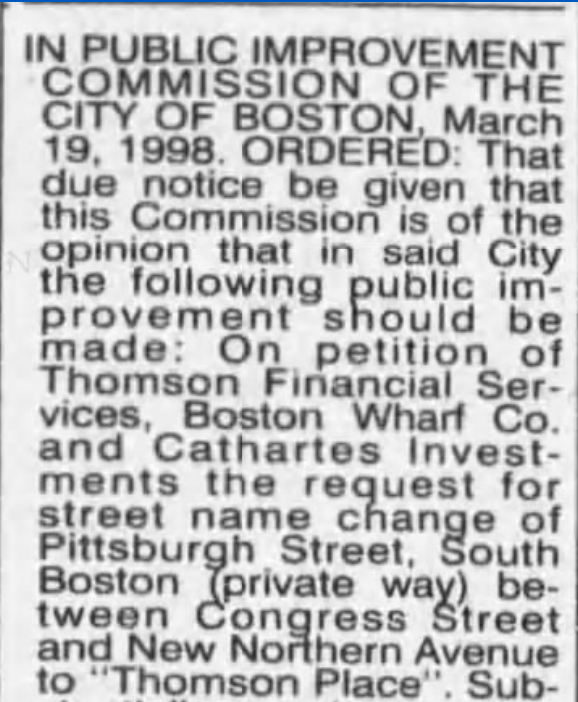
26 Thomson Place now houses the Amazon-owned One Medical primary care clinic. The renaming from Pittsburgh Street dates to 1998, at the request of the Boston Wharf Co. and its flagship tenant Thomson Financial Group, which began occupying Fort Point office space as early as 1982, launching a trend of major corporate moves to the South Boston Waterfront decades before the likes of Vertex Pharmaceuticals followed suit.

A December 2003 Globe article has the details:

When Thomson, then known as Boston Business Research, first moved its employees into 10,728 square feet of space at 12 Farnsworth St. in 1982, many adjacent buildings were empty. Daniel Pleines, vice president for real estate at Thomson, said the vacancies allowed the company to grow incrementally but steadily. In 1985, the company took its first entire Boston Wharf building.

The amount of Thomson’s Boston Wharf space peaked at almost 500,000 square feet in 2000.

The same year, the Boston Wharf Company began selling off its sprawling holdings in Fort Point, the most consequential move since its creation of the area 150 years prior, and one that left the pioneering local artist community ‘stunned.’ The writing was on the wall; the Globe quoted a local resident and activist who feared a coming wave of development would leave Fort Point with ‘tourists on one end and a duplication of the Financial District on the other, and very little left over for a real neighborhood.’

Boston Globe, May 23, 2000

A series of deals followed, and in 2005 the Wharf Co. sold its last tranche of properties to a subsidiary of Goldman Sachs, completing the liquidation of a portfolio that at its peak spanned 79 buildings, 30 acres, and over 3 million square feet of space. The Thomson Place site was sold to ‘an undisclosed client of HDG Mansur Investment Services Inc.’ for $92 million in 2004, flipped again in 2007 to Crosspoint Associates for $120.5 million, and in 2015 Invesco took over majority ownership in a $183.5 million deal. Invesco tapped local architecture firm Margulies Peruzzi for an ambitious ‘retail activation and streetscape project,’ and the milestones came in relatively short order: Trillium moved to its current site in October 2018, the street opened to one-way car traffic in October 2019, and the same week Trader Joe’s arrived after much speculation and anticipation. This last development in particular signaled a major evolution in the character of the street and the viability of the Seaport in general, for what ‘real’ neighborhood doesn’t have a grocery store? The developers pulled off a seemingly rare feat, making good on their goal of ‘respecting the historic context of the neighborhood while activating a new retail area for some big name tenants.’

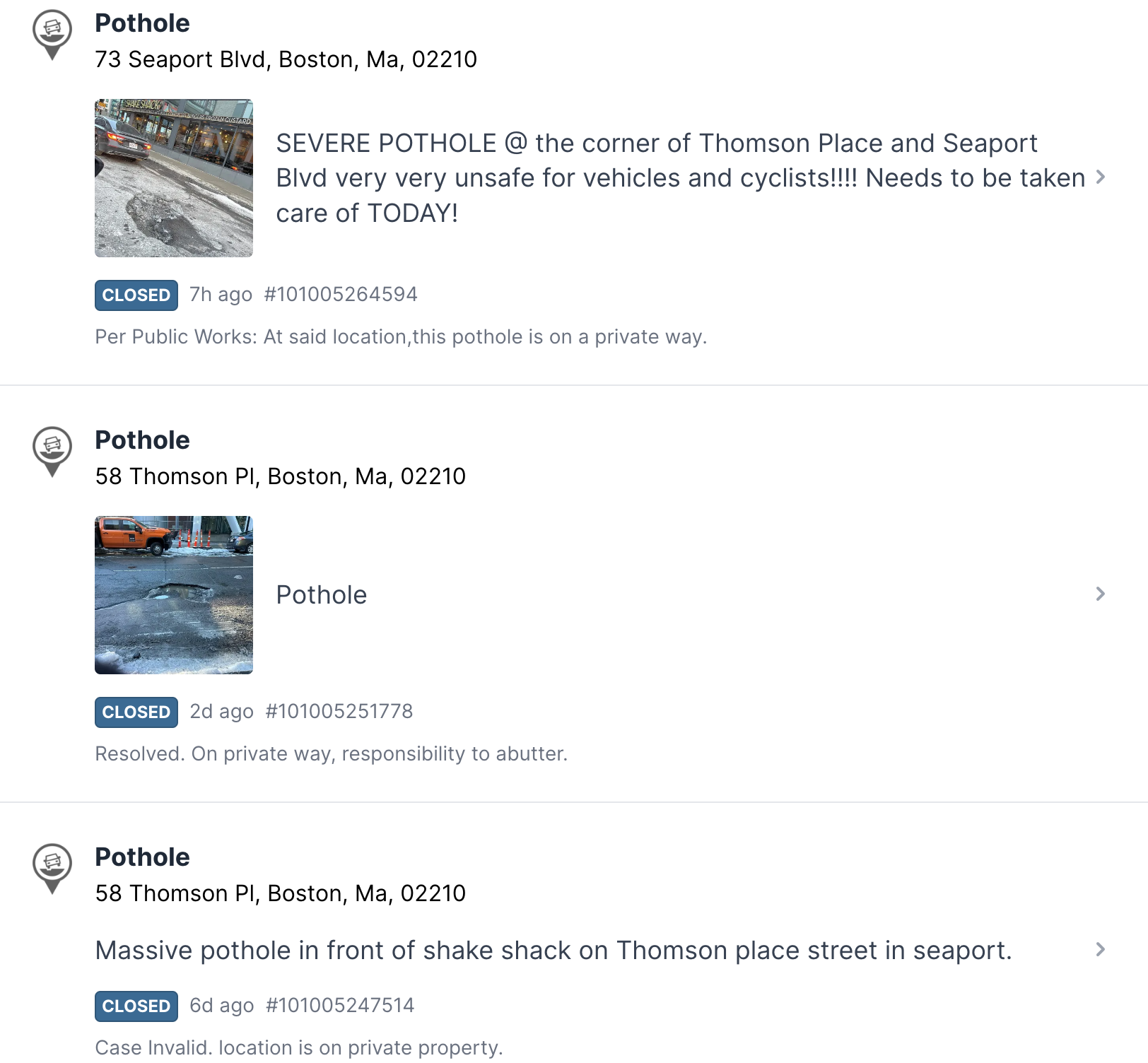
So what does any of this have to do with a pothole? Again, despite its redevelopment over the last five years as a central dining and shopping destination, Thomson Place has retained its designation as a ‘private way.’ This has important implications for street upkeep: while the ‘City of Boston is responsible for all general maintenance of public ways,’ ‘residents are responsible for all maintenance of the streets and sidewalks along the private way.’ Which is how you end up with a situation like this:

Reports on 311.boston.gov, 1/19/24

Since New Year’s Eve there have been five separate 311 reports of this specific pothole at the north end of Thomson Place between Trillium and Shake Shack, and the earliest claims that ‘It’s been there for over a year!!’ (The following sadly reports that the pothole ‘dented my rim and cost $600 to fix.’) All but the first have been closed without resolution with variations of the same response: ‘Per Public Works: On private way, responsibility to abutter.’ In other words, not the city’s problem. There’s a touch of bureaucratic absurdity to the finger-pointing that’s a little funny and a little bleak, simultaneously banal yet also symbolic of a deeper dysfunction that plagues our public places and infrastructure. That is, in the most expensive neighborhood in one of the richest cities in the richest country in the world, if we can’t fix a pothole in a well-trafficked thoroughfare, how can we possibly call ourselves serious people?

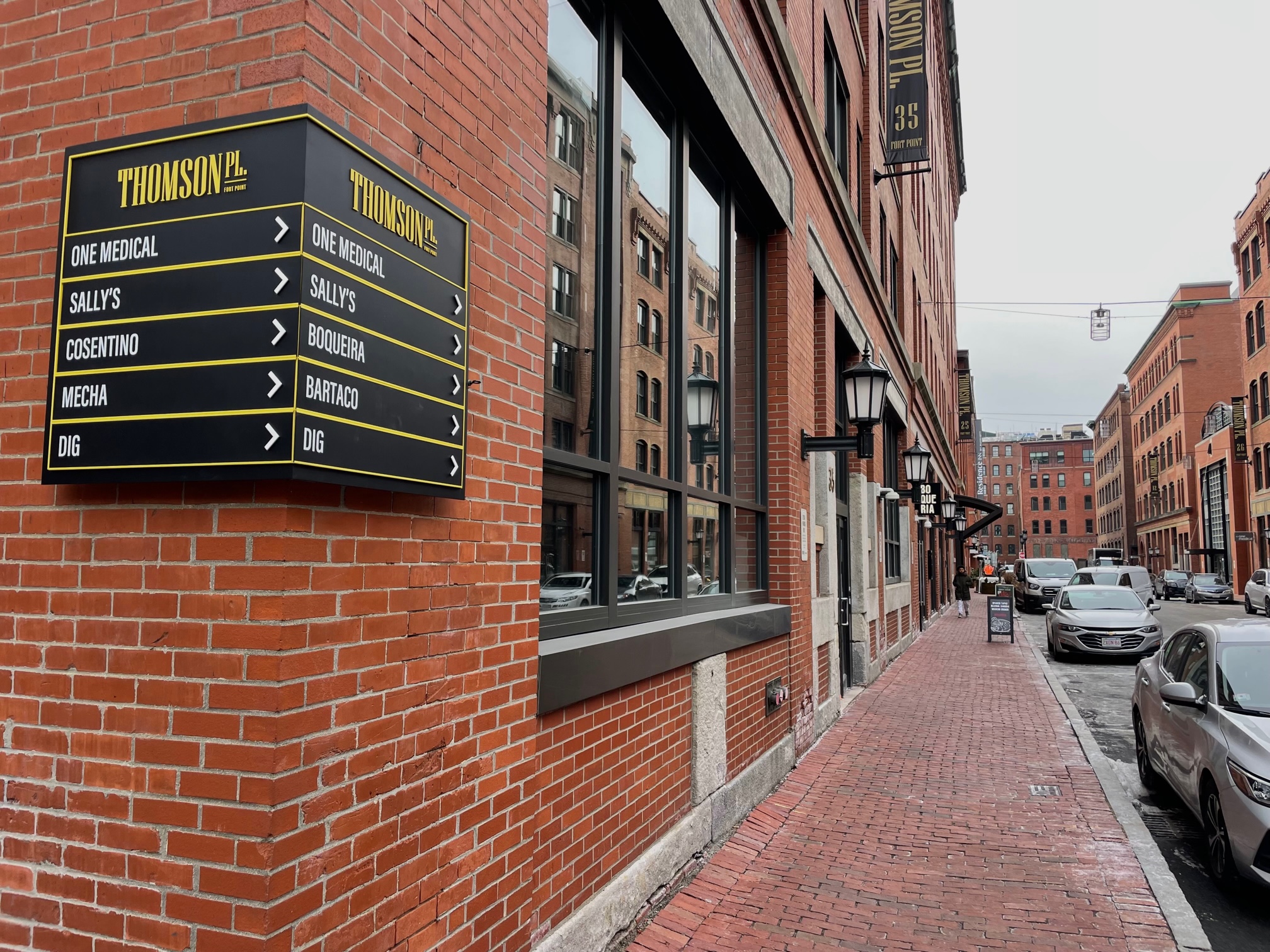
All of this is not to blame Boston Public Works nor Invesco, though we might ask for a little more conversation between both, and a higher level of attention to detail from the latter—see, for example, the misspelling of new tapas restaurant Boqueria as ‘Boqueira’ on both of the new ‘wayfinding’ signs on Thomson Place:

Rather, the point is simply to look a bit closer, and in doing so to begin to understand how the places that define our daily movements and routines came to be. Sometimes a pothole is just a pothole. This one tells a story.

The Curious Case of Thomson Place

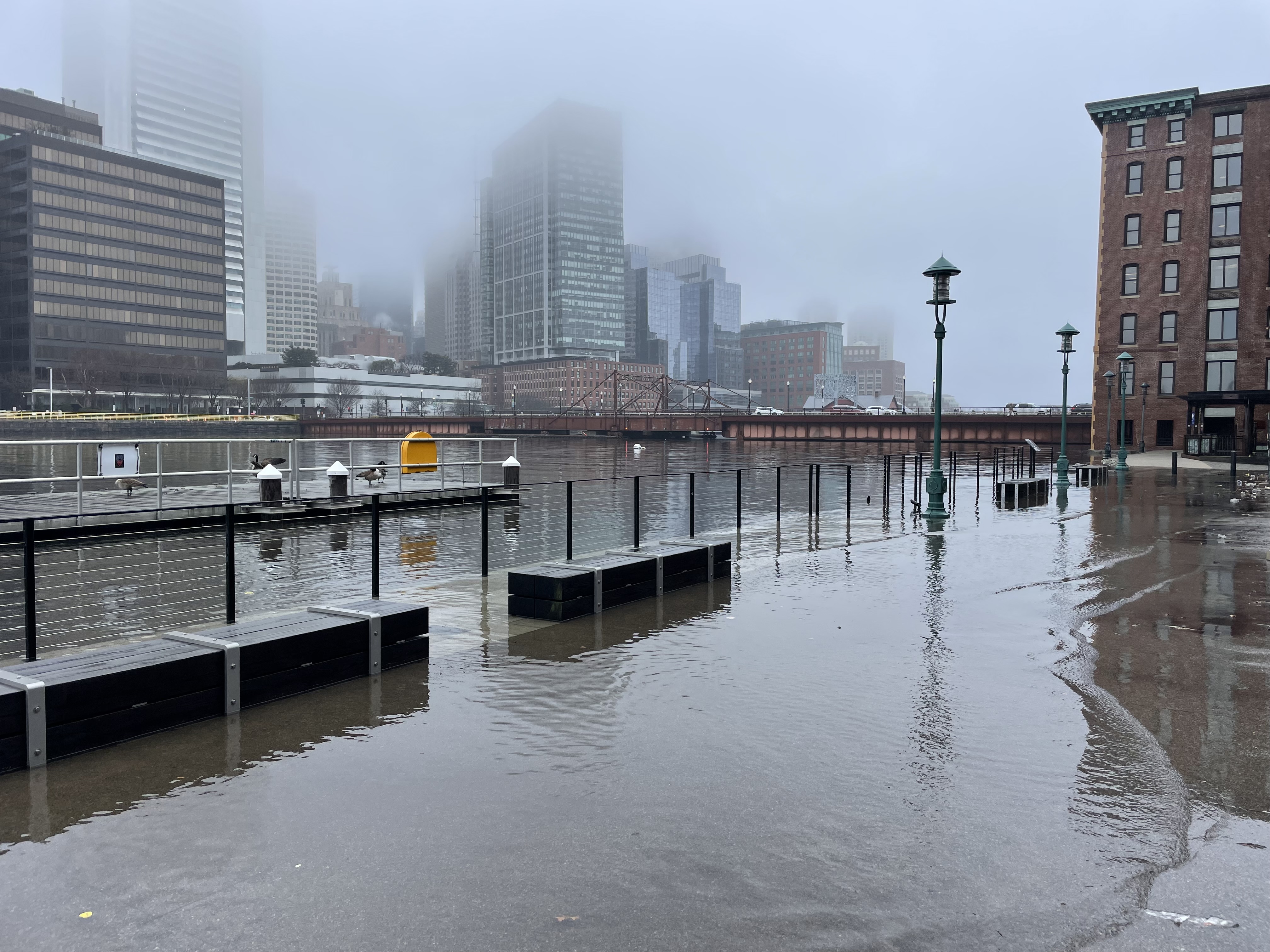
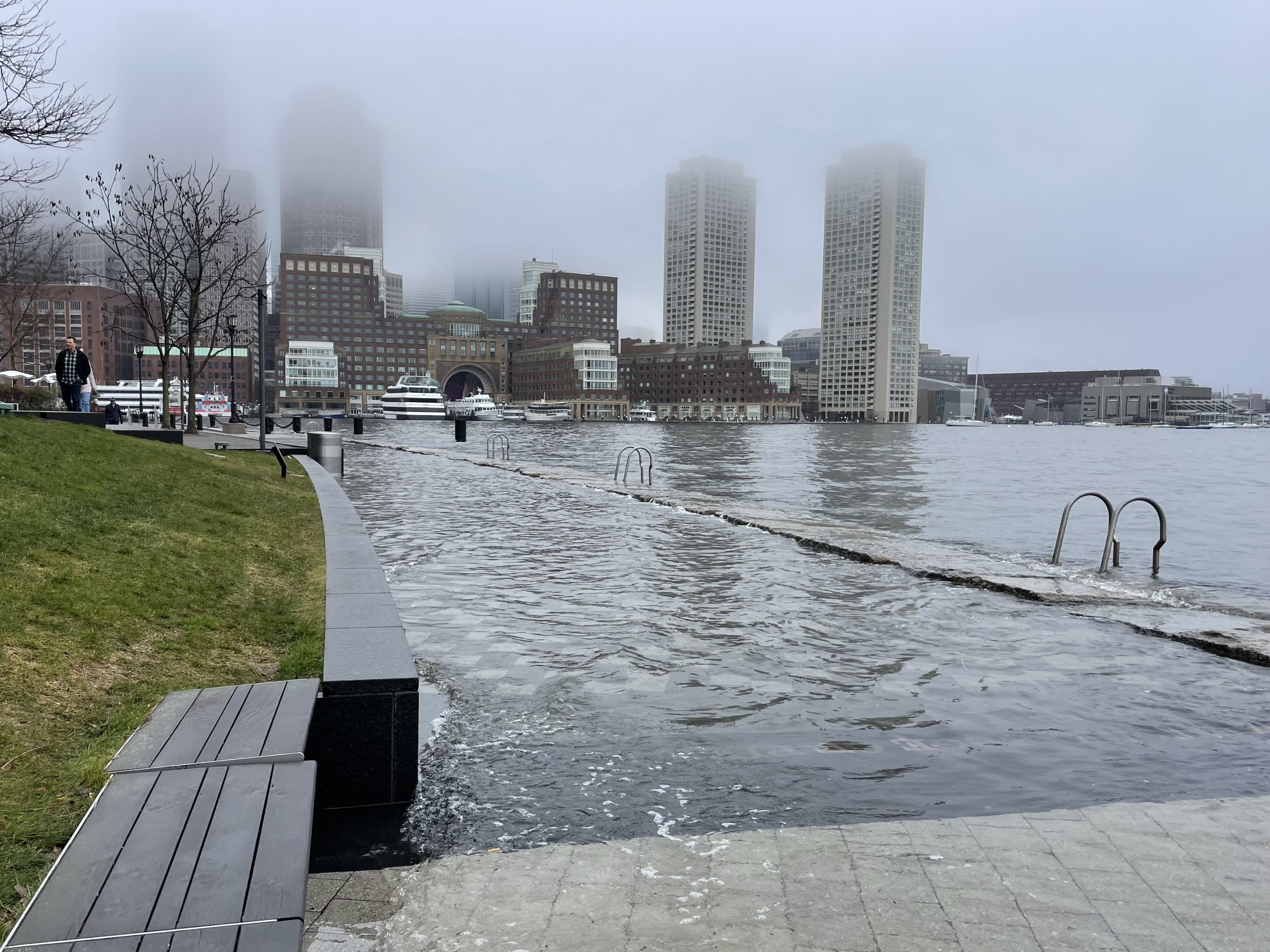
Boston Harborwalk Flooding, 1/13

It’s been a strange week of weather. On Sunday a hyped nor’easter delivered only a few inches along the coast, which melted more or less entirely by Tuesday, when another system brought torrential rain along with wind gusts and temperatures in the 50s. Today, more wind and rain overnight, the air pushing 60º, but the high tide put on the main event.

Scenes were a bit more dramatic in the North End:

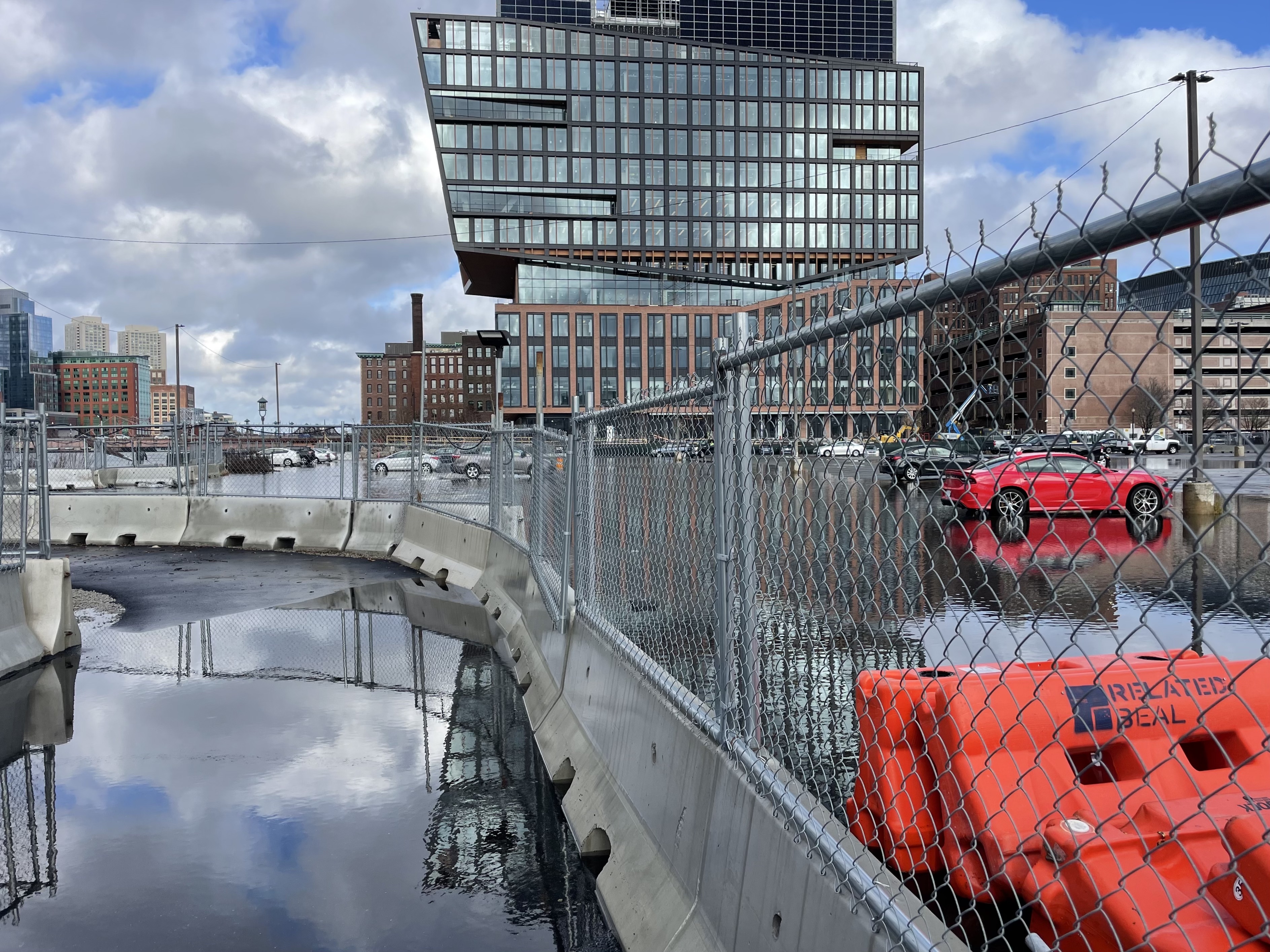
At peak high tide the area along the Fort Point Channel was impassable, flooding the back of Lolita, the edge of the new $700 million Eli Lilly Genetic Medicine Institute building, and part of the parking lot where Related Beal’s $1.2 billion Channelside development is planned to break ground soon.

It’s become something of a cliche to suggest the Seaport will be underwater in 10, 20, 50 years—the floating dumpster of 2018 remains the most famous portent of the deluged future—but this breezy, imprecise way of talking about sea-level rise and vulnerable coastal areas doesn’t offer much beyond signaling a kind of au courant, cynical savvy. That is, what are we really talking about? Occasional major flooding events like today or the one in 2018, which combined an astronomical high tide with a storm surge and wave action from a historic ‘bomb cyclone’?

Or the actual wholesale flooding of the Seaport and waterfront neighborhoods of Boston, such that they would be rendered catastrophically damaged and unnavigable? The new documentary Inundation District appears to be the most serious look at this prospect yet, but so far has had limited screenings and no wider distribution.

Either way, the building continues, and the ongoing major redevelopment of the land along the Fort Point Channel stands out as one particularly high-profile example. At the very least, it can’t be said the warnings are going entirely unheeded: Related Beal’s plans for Channelside mention ‘Fully extended and integrated flood protection resiliency without visible berm obstruction,’ and ‘Raised site (up to +21.5 BCB) to accommodate Sea Level Rise (SLR) which raises the elevation of most site catch basin grates above 2070 high tide line.’

Which gets to the heart of the matter: 2070 sounds impressively far out and distant, likely beyond the lifespan of most of the people managing, financing, and ultimately profiting from the project, but in a city with houses dating back to the 17th century, planning for 46 years from now seems almost comically shortsighted. This kind of mentality is hardly a new development. In the aftermath of the 2008 financial crisis, the banker lingo ‘IBGYBG’ became widely known, featuring in many media reports and even  Congressional testimony:

As today’s hearing illustrated, the ratings process became particularly corrupt in recent years, as companies like S&P and Moody’s slapped AAA lipstick on collateralized debt pigs, bending standards to keep the investment banks doing these deals happy and profits gushing in the door.

Eric Kolchinsky, a former team managing director at Moody’s, said he considered what had taken place—that is, what he saw go on first hand—to be securities fraud. Another witness, former Moody’s vice president Richard Michalek, explained the term IBGYBG. “I’ll be gone, you’ll be gone,” he said. “That thinking was driving what was going on.” Make your money, then get out before the whole thing blows.

As usual, the French is more elegant, and in this case more apt: Après nous, le déluge.

Boston Harborwalk Flooding, 1/13

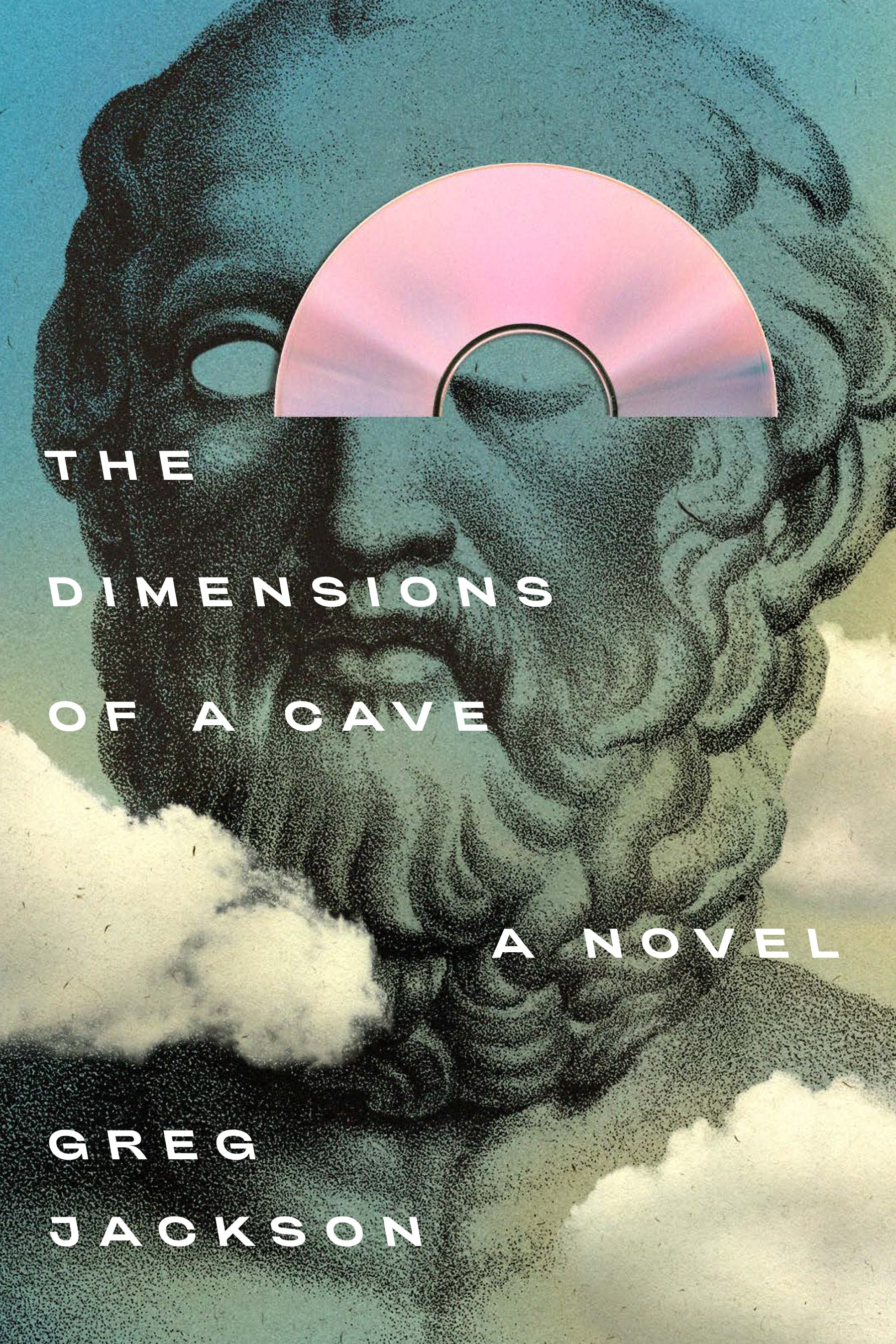
The Dimensions of a Cave – Greg Jackson

Propaganda, mass surveillance, algorithmic metadata analysis, torture and interrogation: these are responses to a world in which violence is a property of information, understood in information’s terms. The deaths occasioned by terrorism are a mere byproduct of its goal, which is informational violence. It means to attack the minds of those who survive, not the bodies of those who perish. Its aim is to insinuate a feeling in our private lives. Our psyches. And torture means to draw reluctant privacy into the light. Metadata intends to reconstruct an inner truth through the superficial palpation of its outer form. And what of that private place, the last fastness of inviolate humanity? One day it will collapse. Give up the ghost and fall inward. But first it will die by a thousand incursions, as the probes get deeper, smarter, as we learn—like brutalized interrogees—what the algorithms want, reward, and select for, and as our desire to rebel against this becomes yet another way to manipulate us, one more tactic to exploit while the policing function moves inward and installs itself, like the most potent software, in the alloy of our brains.

This is an insane book. To review it properly might require the powers of one of the contemporary lit heavies blurbed on the back; dedicated weeks of thinking, writing, and revising; and/or probably a second read altogether. At 476 pages thick with lengthy meditations on technology, power, consciousness, violence, and the nature of reality, that would be a tall order. The novel hasn’t been out two months yet, so that might be why no really serious appraisals have been published: the mention in The New Yorker‘s ‘Briefly Noted‘ kind of reads like they didn’t finish (or much attempt) it, and The Spectator‘s is better but seems choked by a 500 word count limit. The Scotsman‘s literary editor ‘fear[s] this may be a somewhat niche novel,’ but offers a thoughtful précis and some measure of praise: ‘a fascinating set of speculations, even if overlong and overwrought.’

The book is neither, if you’re bought in and along for the ride, or already a fan of Jackson’s distinctive, impossibly sophisticated prose. The metaphysical density and verbal acrobatics are leavened by crisp, bantery dialogue, and a Hollywood-ready plot keeps it all moving along, flexing a range of genre elements: D.C. political thriller, journalism noir, gritty War on Terror exposé, cyber-sci-fi conjecture. The obvious cinematic reference points are The Matrix, The Truman Show, a bit of Inception, but there are enough shades of the The Cell to wonder if Jackson ever saw that unsung Y2K-era relic, in which Jennifer Lopez enters the mind of a serial killer using experimental virtual reality technology.

It is a demanding text, though, and if it’s interesting to think about what might’ve been if Jackson hadn’t ‘cut an entire book out of it,’ ‘over 50,000 words,’ as he says on the Our Struggle podcast, most readers who reach the end will probably appreciate that he did. Sentence by sentence, it has to be some of the most ambitious and balls-out writing put out by a big corporate publisher in recent years, refreshingly unafraid to show off its erudition and command of language. The ‘virtuoso’ tag is apt. Many no doubt will find it over the top—take the opening paragraph:

The island clung to the mainland by a spit of sandbar as low and shingled as a manicured walk and could not therefore be properly called an island. Still we called it that, ‘the island,’ and at times, when the ocean cycles and planets aligned, the perigean king tide with its liquid cargo brought the water up over the lip of that persistent littoral, briefly severing all tie to the shore and bringing the fact of the land into sympathy with its name.

‘Perigean,’ ‘liquid cargo,’ ‘persistent littoral’: Jackson is a master at crafting vivid imagery and supple prosody with the aid of recherché vocabulary, and if it can at times ring as overwrought, it’s mostly just impressive. I’ve never read a novel that required as much reaching for the digital dictionary, and started keeping a list of all the words looked up throughout:

escarpments, cyanotic, pavor nocturnus, susurration, garniture, porphyry, cicatrice, pullulating, agate, donnée, raddled, sempiternal, monitory, lemniscate, ormolu, blancmange (those two used in the same sentence), nitid, collimated, gnarr, cupreous, thewy, pegamoid, benthic, nuncupative, solatium, bruiting, gelid, involute, leporello, fankle, faience, penetralium, scrims, flocculating, pentimenti, falcate, écorché, antres, caporal, hallux, jaillissant, formulary, fulgurant, rufous, embowering profluence (two-for-one), fibril, horrent, crewel, preterition, parterre, ha-ha, barmecidal, moulage, flèchelike, purdah, corolla, sillage, friable, phatic, parti pris, brume, hyaloid, gracile, gentian, bajada, lisle, crypsis, lethean, metic, Lar Familiaris, nescient, tetter, stridulating, voile, apoptosis

Like the plot, the syntax is intricate and nested, the clauses so often winding and refracting that, combined with the expansive lexicon, many sentences have to be read at least twice to grasp their meaning:

In this fading breath of dream I felt the coincident sense-form of so many departures—unrecoverable moments, lost people, the caustic of life’s first bitter lessons—and I understood in the dim way we understand such things that all our experiences, our entire lives, rhyme on the tonality of these emotions, this iterative formulary, at once dull in its repetition and nuanced, layered even, in all the pleated crosscurrents of its ambivalence.

Is it all a bit much? Not really, because Jackson manages to put the writing in service of both a page-turner story and a wide-ranging disquisition on topics timely and timeless: artificial intelligence, surveillance, imperial power, corporate power, the delusions of the self, the futility of fact, the inevitability of atrocity. The last gives the book its major set-piece show of bravado, a 30-page tour of episodes of mass slaughter, enslavement, rape, and mutilation throughout history, structurally and thematically reminiscent of the several-page sentence describing the Theresienstadt ghetto in Sebald’s Austerlitz. The novel is another ‘modern day retelling of Heart of Darkness,’ and this monologue of ‘horrors’ is delivered by its Kurtz stand-in Bruce, who nods to the source material with a sketch of the Congo Free State’s depravity and his later insistence that he’s ‘not some madman gone native.’ 

The ‘modern day’ twist is twofold: the idealistic newspaper journalist Bruce leaves D.C.to cover the war in Afghanistan, disappears, and resurfaces, in a sense, in an experimental metaverse developed by a defense contractor as a successor to the failed intelligence program SIMITAR—’soft interrogation managed in totally artificial reality.’ He then refuses to ‘leave,’ and his mentor Quentin, whose story on SIMITAR is killed by his editors at the behest of the White House, is tasked with getting him out, or so it seems. Fairly high-concept stuff, and a major changeup from Jackson’s 2016 short story collection Prodigals, such that on the same podcast episode he confesses to a ‘fear that anybody who liked Prodigals is just going to be so kind of disappointed’ by the novel. But that was the vision, to go big and to get away from the more familiar, domestic, sex and drugs and ennui stuff that got tagged as arch ‘satire of the elite’ in reviews:

There’s a little, tiny soupçon… of autofiction in Prodigals, and I got so nauseously sick of autofiction and so angry at autofiction that I decided in my latest book to do the exact opposite, and not put any of my life into it, not put any characters into it who were versions or shadows of myself, and also to try and create a purely imaginative world.

In this he succeeded. The depictions of journalistic tradecraft and the national security apparatus in particular are so convincing that it’s hard to fathom how they could emerge from imagination and research alone, and to some extent it seems they didn’t. Jackson worked for renowned investigative journalist Ron Suskind during the late, fervid Bush years, and had his own brush with the kind of bureaucratic menace and pervasive surveillance that The Dimensions of a Cave probes:

I sent Greg up to New York to do some sort of color reporting about demonstrations and security precautions, because Bush and Ahmadinejad that day were both speaking at the UN at the same time. Greg went up there and was just doing what a reporter does, sort of taking notes, looking around, and he is detained by officials up there, including a State Department intelligence official, various folks in law enforcement, taken aside and essentially grilled for an hour and a half.

They end up taking his notes and also, in a way, kind of threatening him, saying, “Look, we know who you are.” They run his name through every computer in the planet, his mother, other people he knows, certainly me, as well. And at the end of the day, they said, “If anything happens up here in the next week, we know where to find you.”

Similarly, the novel’s layered storylines turn out to be the reverberations of elaborate ploys to control the flow of information, to occlude and to muddle—heads up, plot details follow—as Bruce is goaded into committing an extrajudicial killing of a powerful warlord, partly to neutralize his investigation into shadowy networks of state-sponsored corruption and plunder, and Quentin’s VR odyssey is apparently all a feint to trick him into revealing the identity of his insider source from the original SIMITAR story. So it all gets rather slippery:

It was following this train of thought that Quentin became fixated on the question of Bruce’s reality. Was it possible to know whether his friend had been a fellow dreamer within that liminal sphere or merely a fantasy and projection of Quentin’s own dreaming? It was the difference between an experience of another person and an experience of oneself. It crossed Quentin’s mind that Bruce may have been deluded, baited, as he had been himself, into performing a role in a larger plot, by being made to believe his own contrived fantasy, one in which he was the crusading hero and scourge of the powerful. 

It’s a clever way to wrap, skirting and subverting the ‘it was all a dream’ cliche, and if you’re not really reading for the story so much as the sumptuous texture of its telling, it’s still something of a relief to see the ending stuck. As the Greek chorus of Quentin’s fellow journalist friends, for whom he has spun the otherworldly yarn over five long days, warily concludes: ‘We’d been affected by what we heard, and in some way changed. Could we simply retreat back down the bolt-holes of routine to the close, dark corridors that hedged our days?’ Nothing is real, and nothing to get hung about—or if only if it were that easy. 

We’re drawing closer to the surface. To the fantasy. For now we content ourselves with the image growing larger and clearer. But at some point our longing to penetrate the image will overwhelm us. We won’t abide separateness. We’ll pass into it—through the glass. Don’t ask me how. Maybe we’ll enter it so slowly it takes generations, and we won’t know we’re inside until it’s too late. Too late! I say it like it’s a bad thing, but won’t it be marvelous? Won’t our dreams come true? Our memories return? Our fantasies take place? Then the limits of our life—the inadequacy of moments, our insignificance—will be no more.

The Dimensions of a Cave – Greg Jackson

The Boom, the Channel, and the New Human

In January 2020, then Director of the Boston Planning & Development Agency Brian Golden was busy overseeing a ‘building boom’ so historic one had to cast all the way back to the days of John Winthrop for a precedent: ‘There hasn’t been this much built in a six-year sequence,’ he told Boston.com, ‘since the founding of the city in 1630.’ A heady claim for a city famously enlarged vastly beyond the 1.2 square miles of the original Shawmut Peninsula, but by the measure of ‘tens of millions of square footage in permitted development,’ probably true enough.

The ‘biggest building boom in the history of the city’ became something like Golden’s signature line: he was seeding the narrative to WBUR as early as 2015, again in a 2017 Wall Street Journal piece, in a joint Globe op-ed with Mayor Marty Walsh in 2019, and the BPDA dropped it in the second sentence of the press release announcing his resignation in 2022. Whether well-meaning boosterism, anxious overcompensation, or canny PR bluster to keep the deals flowing and the ground breaking, the breathless insistence on the bigness of the ‘boom’ seemed to gloss over something fundamental: building what, exactly?

Over a decade into the post-recession development mania, Boston has become known as much for its wildly expensive housing as its universities, sports, or tourist charms, and the ‘affordability crisis shows no sign of abating,’ per the Boston Foundation’s 2023 Greater Boston Housing Report Card. In 2022 Boston edged out San Francisco as the second costliest city for renters in the country (technically third if you count Jersey City separately from New York), and the median single-family home price in the metro area hit a record high of $910,000 this past July.

So what were the builders building? One answer is ‘luxury’ condos and apartments, an angle covered at length by the Globe Spotlight Team in ‘Reckoning with Boston’s towers of wealth,’ the third installment of its big new report on the housing crisis:

Since 2000, more than 50 sizable developments featuring multimillion-dollar condos — both new construction and renovations — have opened in Boston, according to a Globe analysis of city and state records. In a flurry of activity in the seven years from 2015 to 2021 alone, that included more than 1,000 new condos now worth $2 million and up.

Who can afford such pricey real estate? Less than 2 percent of the Boston population.
Yet in the seven-year span, luxury developers built about one condo worth $2 million or more for every four such super-rich households.

Compare that to affordable housing: In the same timeframe, developers created just one affordable unit through various city programs for every 21 middle- or low-income households.

As ever, Downtown and the Back Bay claimed the most dramatic, skyline-padding projects—the Millennium Tower, One Dalton, Winthrop Center—but nowhere in the city is as closely associated with the 2010s boom era as the Seaport District. Created virtually ex nihilo beginning in the 1990s, on as blank a slate in as prime a location as there could be, the Seaport now glistens with blocks of glassy new construction often criticized as generic, confected, and placeless. (A 2019 Globe Magazine listicle slotted the ‘soulless’ neighborhood in the ‘Loathe’ column, as ‘a bland cityscape, a tract of straight lines, hard surfaces, and glass boxes,’ where ‘much of the time, you’d never even know you were near the sea.’) And with still more blocks to fill, cranes will loom for yet a while longer. In one particularly jarring case, the site of the perennially packed ‘Snowport’ Holiday Market, hosted on one of a couple open plots left in the neighborhood’s center, has for several years been approved for an 18-floor tower consisting mostly of office space.

On the cusp of the boom: the Seaport’s sea of parking lots, pictured in 2006. (Boston.com: Seaport District through the years)

Notably visible in aerial shots of the old, wasteland-era Seaport is the cluster of buildings on the area’s upper edge, along the Fort Point Channel. Designated the city’s ninth protected historic district in 2009, the Fort Point neighborhood had stood for well over a century, originally developed by the Boston Wharf Company from an even blanker slate than the new Seaport: the ground itself didn’t exist yet. As the Landmarks Commission Study Report explains, the company not only made the land by filling in muddy tidal flats, in a drawn-out process lasting nearly a half-century, but also designed and built the streets and eventually the industrial buildings that still stand today.

From marshy beginnings, Fort Point boomed. Summer Street became the center of the country’s wool trade, and the curved New England Confectionery Company (Necco) complex along Melcher Street ‘was the largest establishment devoted exclusively to the production of confectionery in the United States.’ The story following the Depression and WWII is a familiar one: manufacturing decline, mounting vacancy, and decades of decay until groups of artists began working and living, not strictly legally, in the high-ceilinged brick-and-beam lofts, which would gradually become again attractive to investors as the broader vision for the waterfront materialized.

Today, with the core Seaport area built up and accounted for, the largely fallow strip of land fronting the Fort Point Channel is up next. First to rise, at 15 Necco Street, is Eli Lilly’s $700 million Genetic Medicine Institute, which points to the other great gold rush of the development boom era: lab space. As Bloomberg reported in March 2022, Boston had ‘more lab space under construction than anywhere else in the U.S.,’ and was ‘poised to surpass the San Francisco Bay Area as the country’s biggest hub for life sciences.’ While the rush has since slowed, the biotech industry has already made a distinct imprint on the greater Seaport, beginning in 2011 when Vertex Pharmaceuticals announced a game-changing move from its Cambridge headquarters with a $1 billion lease of two new Fan Pier buildings. (And has kept it coming: upon completion of a new lab and office complex in 2025, ‘Vertex will occupy 1.9 million square feet of real estate in the Seaport across five sites, making it the largest biotech in Boston in terms of square footage.’)

The new Eli Lilly building, with its recently installed signage.

The case of Eli Lilly in particular is rich with detail illustrating this evolution of a new economy, and perhaps even a new human. Its 15 Necco site was originally slated to be the world headquarters of General Electric, the centerpiece of a much-hyped relocation to Boston that involved a tag-team wooing effort by Mayor Walsh and Governor Charlie Baker to the tune of $145 million in tax breaks and government incentives. At the time seen as a historic coup, the deal unraveled spectacularly as the ailing industrial dinosaur imploded, shedding upwards of $200 billion in market cap over two years and eventually being removed from the Dow Jones after 111 consecutive years in the index. In 2023 the company unceremoniously packed up and left Fort Point altogether for a single floor in a tower across the channel.

Over the same period, Eli Lilly’s stock went vertical: now the most valuable drug company in the world, the WSJ reports, ‘it became the first big pharmaceutical to surpass a market capitalization of $500 billion thanks to the popularity of its obesity and diabetes medications.’ Named for a world-leading candy factory that once churned out sugar wafers and Sweethearts by the ton, Necco Street will soon host a company projected to make as much as $50 billion annually from the blockbuster drug Mounjaro (now approved to be sold as Zepbound for weight loss), a ‘GLP-1 agonist’ like its more famous cousin Ozempic. Beyond obesity and diabetes, studies are showing the potential for GLP-1s to treat heart disease, Alzheimer’s, and even substance abuse:

‘This opens up really some dramatic new opportunities in terms of control of the satiety region of the brain, but also other regions where addiction might be controlled,’ said Lawrence Tabak, principal deputy director at the U.S. National Institutes of Health (NIH). ‘I think these drugs are going to change the way people experience healthcare… If you are able to get a better control of obesity in this country, the savings on the back end due to reductions in cardiovascular disease, and then, you know, related conditions will be quite vast.’

And those are just the ‘traditional’ drugs. Lilly’s new Genetic Medicine Institute will significantly expand the company’s research into futuristic ‘RNA and DNA-based technologies’ that hold the potential to treat and even cure the rarest and most intractable diseases; as the company puts it, ‘The possibilities to come from genetic medicine are potentially limitless.’ In that field it’ll have some catching up to do with its Seaport neighbors. CRISPR Therapeutics opened its R&D headquarters in late 2022 in a new building a half mile away down A Street, and last week the FDA approved its sickle cell treatment developed in partnership with Vertex, the first such approval for a medicine using the groundbreaking CRISPR gene editing technique. From wool and candy to technology that promises to transform our bodies at the most elemental level—Fort Point is set for a powerful second act.

As the Lilly building approaches completion, the race to fill the adjacent land is accelerating. Next door, construction on Related Beal’s massive $1.2 billion, mixed-use Channelside project will begin soon, targeted for completion in 2026. Further down, in August the Globe reported on plans by the developer of the CRISPR headquarters to build on parking lots once used for the Gillette razor factory, and in October Proctor & Gamble announced they would fully move Gillette manufacturing operations out of the century-old site overlooking the channel. Across the water, maybe the most momentous deal of all is taking shape, as the United States Postal Service might soon enter negotiations to sell off its sprawling sorting facility property, enabling the expansion of South Station and air rights development to complement the 51-story tower currently rising above the tracks.

Altogether, if all goes to plan, the area surrounding the Fort Point Channel will be soon be unrecognizable, a transformation to rival the Wharf Company’s original conjuring act from the tidal flats a century and a half ago. There will be world-changing laboratories, high-powered Class A office space, and multimillion dollar residences—plus concessions for affordable housing units and ‘civic spaces’ mandated by law or leveraged via the development process—but will the result be a ‘real’ neighborhood? Not long ago, two banners hung from the 249 A Street Artists Cooperative building proclaiming, ‘WE ARE FORT POINT’ and ‘NOT ANOTHER SEAPORT’. Let us hope.

The Boom, the Channel, and the New Human